Clear Sky Science · en
Optimization and experimental analysis of a cleaning device for super rice with high impurity rates based on airflow field enhancement
Why cleaner rice harvests matter
When a modern combine harvester cuts a field of high-yield "super rice," it gathers not only grains but also wet stalks, husks, and bits of leaves. If the machine’s cleaning system cannot cope, farmers end up with rice that contains too many impurities or lose valuable grain out the back. This study tackles that problem by redesigning how air flows through the cleaning section of a rice combine, aiming to deliver cleaner rice with less waste while reducing the need for costly trial-and-error testing in the field.
How rice is cleaned inside a harvester
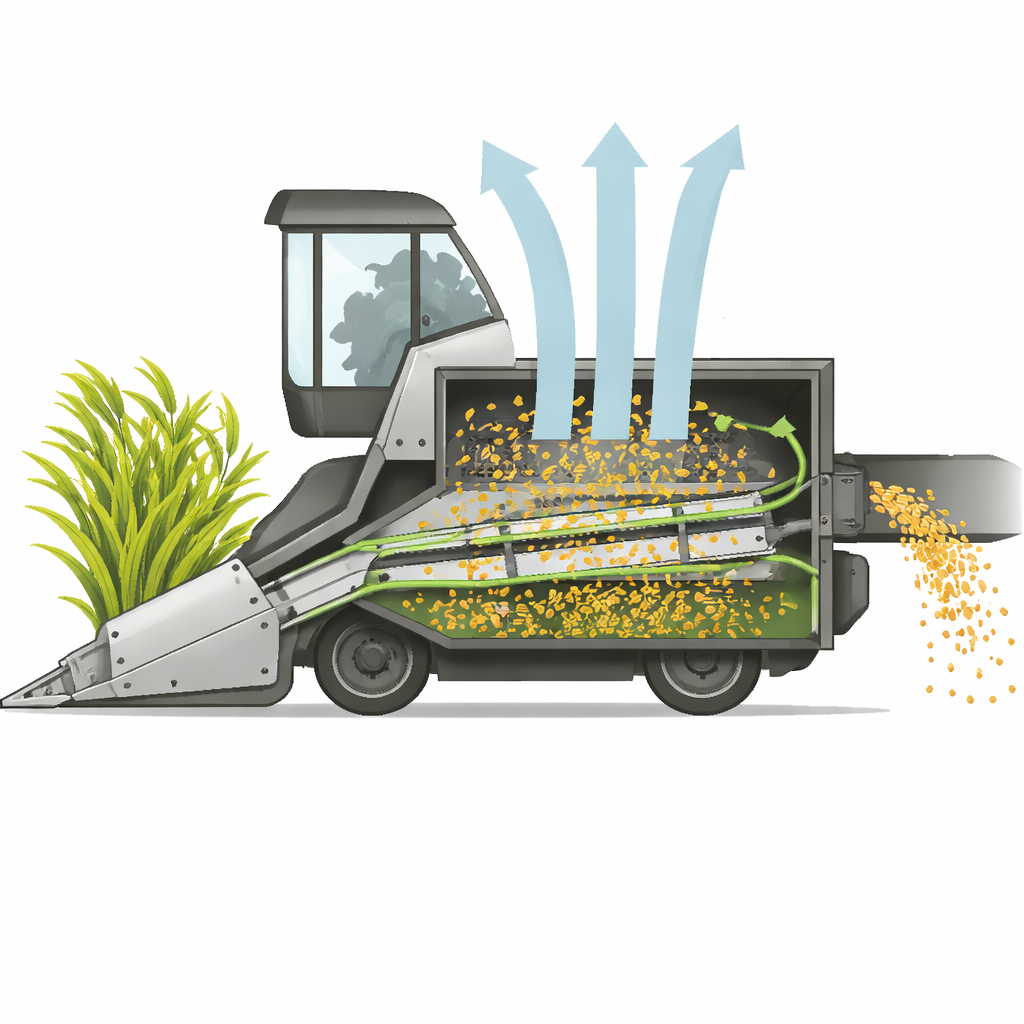
Inside a combine harvester, rice panicles are first beaten and rubbed in rotating drums so that grains separate from stalks. This mixed stream of grains and plant debris then enters a cleaning chamber. There, a vibrating sieve shakes the material while a fan blows air upward. Ideally, heavy grains fall through the sieve into a collection auger, while lighter stems and chaff are carried away by the airflow. In practice, especially with high-yield, high-moisture super rice, a large volume of mixed material piles up at the front of the sieve and traditional wind-sieve designs struggle to separate grains cleanly without blowing them out of the machine.
Measuring the invisible air currents
To improve this process, the researchers first treated the airflow itself as something that could be measured and optimized. Using a full-scale test rig that mimics a working harvester, they fed freshly cut rice through the threshing drums and into the cleaning chamber. A grid of collection boxes under the sieve revealed where grains and impurities actually landed, while sensitive air-speed instruments mapped the three-dimensional airflow just above the sieve. From these data, the team defined three simple indicators of “good” airflow: strong average airspeed in the busy front section of the sieve, a noticeable increase in airspeed near the rear where long stalks accumulate, and even airflow from side to side so that all parts of the sieve work similarly.
Tuning the fan and guides like a wind instrument
Next, the team systematically adjusted key mechanical settings that shape the internal wind: the speed of the fan, the angles of two metal guide plates that steer the air leaving the fan, and the size of openings in the upper sieve. Using a structured set of test combinations, they identified which settings mattered most for each airflow indicator and for real-world performance in rice fields. The best balance was achieved with a relatively fast fan (1250 revolutions per minute), a steeper first guide plate, a moderate second guide plate angle, and a specific opening size for the fish-scale style sieve. In field trials, this combination already lowered both grain loss and impurity compared with less optimized settings, confirming that these airflow indicators reliably predict cleaning quality.
Shaping the wind with curved plates
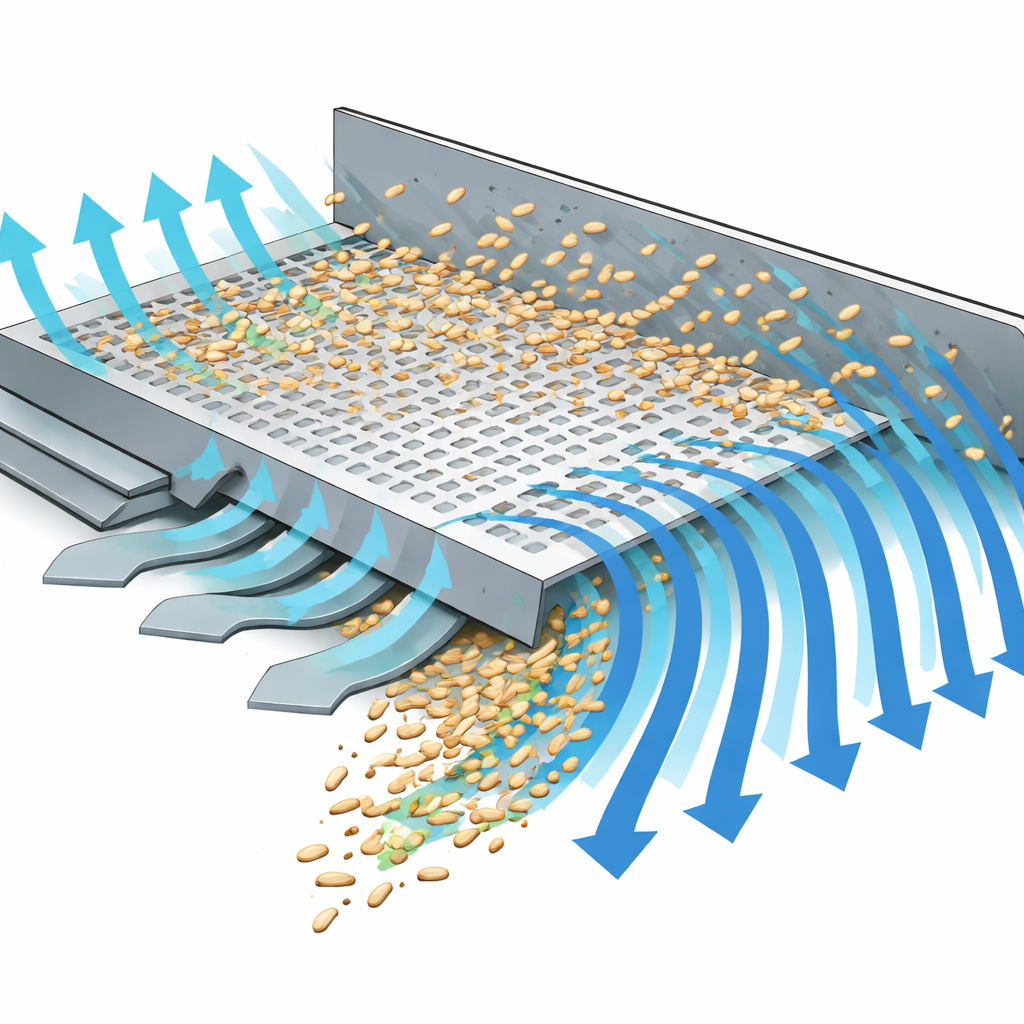
Building on these insights, the researchers went beyond tuning and actually reshaped the path of the air. They redesigned the lower shaking plate beneath the sieve, adding streamlined curved arc plates that act like small wings. These curves reduce blockage at the fan outlet and guide more of the airflow upward near the front of the sieve, where clean grains are most densely deposited, while also strengthening airflow again toward the rear where large pieces of straw need to be blown out. After installing this new structure, measurements showed that front-section airspeed nearly doubled, airflow at the back of the sieve rose noticeably, and sideways variations in speed were cut roughly in half, indicating a smoother, more controlled wind field.
Cleaner grain and less waste in the field
When the improved design was tested in real rice fields, the practical benefits were clear. Under demanding conditions with high impurity rates and substantial feed rates into the machine, the share of unwanted material in the collected rice dropped from about 4.8% to 1.8%, and the proportion of grains lost out of the rear of the cleaner fell from roughly 2.5% to 0.8%. In everyday terms, more of what the farmer has grown ends up as usable grain, and less time is needed for post-harvest cleaning. By linking careful airflow measurements, smart test design, and a simple structural modification, this work shows how “shaping the wind” inside a harvester can make rice harvesting more efficient and reliable, and the same approach could be adapted to other grain crops as well.
Citation: Wang, G., Wang, F., Liang, Y. et al. Optimization and experimental analysis of a cleaning device for super rice with high impurity rates based on airflow field enhancement. Sci Rep 16, 10709 (2026). https://doi.org/10.1038/s41598-026-40829-4
Keywords: rice harvesting, combine harvester, airflow optimization, grain cleaning, agricultural machinery