Clear Sky Science · en
Prediction and reduction of dynamic factor based on dynamic behavior of gear systems
Why fast-spinning gears can be a hidden weak link
From electric vehicles to wind turbines, many modern machines rely on gears that spin at thousands of revolutions per minute. At these high speeds, even tiny imperfections can make gears vibrate, amplify loads, and wear out much faster than expected. This study looks at how to predict and tame those hidden forces in spur gears, so engineers can design gear sets that are both reliable and lighter, without overbuilding them "just in case." 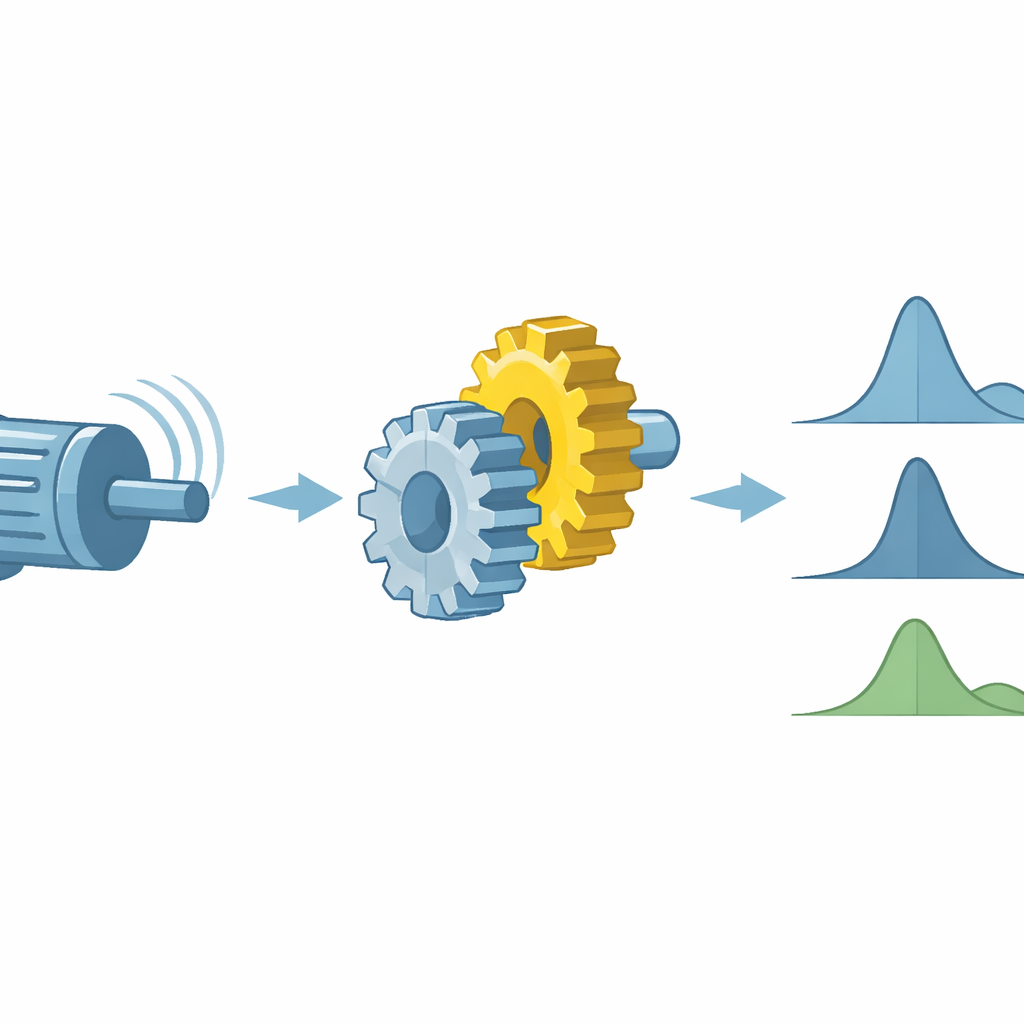
When gear teeth hit their breaking point
As a gear set turns, each tooth pair repeatedly comes into contact and separates. Ideally this happens smoothly, but in reality there are small errors in shape, stiffness changes as teeth engage and disengage, and tiny gaps where teeth do not quite touch. At certain speeds, these effects line up with the system’s natural vibration frequency, creating resonance—much like pushing a playground swing at just the right moment. The resulting “dynamic factor” is the ratio between the worst-case dynamic tooth load and the simple static load: when it climbs well above 1, tooth fatigue, surface damage, and noise all get worse, and the safe operating window narrows.
Going beyond rule-of-thumb standards
Gear designers commonly rely on an international standard, ISO 6336, to estimate this dynamic factor. One widely used option within the standard, called Method B, uses simplified formulas that treat the gear pair like a single mass on a spring. While quick and convenient, it does not fully capture the influence of real-world features such as damping, changing tooth stiffness during meshing, or the supporting shafts and bearings. The authors built a more detailed multibody dynamics model of a spur gear pair, including time-varying stiffness and carefully chosen damping, and then validated it against existing experimental measurements of tooth forces across speeds from 500 to 4,000 rpm.
What the detailed simulations revealed
The refined model reproduced the main resonance of the gear pair at 3,450 rpm—the same speed seen in experiments—and matched the measured dynamic factor at that peak within about 2.5 percent. It also captured smaller “subharmonic” peaks at fractions of the main resonance, which are linked to higher-order variations in stiffness and are sensitive to manufacturing and lubricant effects. When the researchers compared their results with ISO 6336 Method B, the standard overestimated both the speed at which resonance would occur and the size of the dynamic factor, especially at higher speeds. For example, at a notional operating speed of 7,500 rpm, the standard predicted a dynamic factor around 1.8, whereas the simulation gave a much milder value close to 1.1—evidence that the standard can be overly conservative and lead to unnecessarily heavy gears. 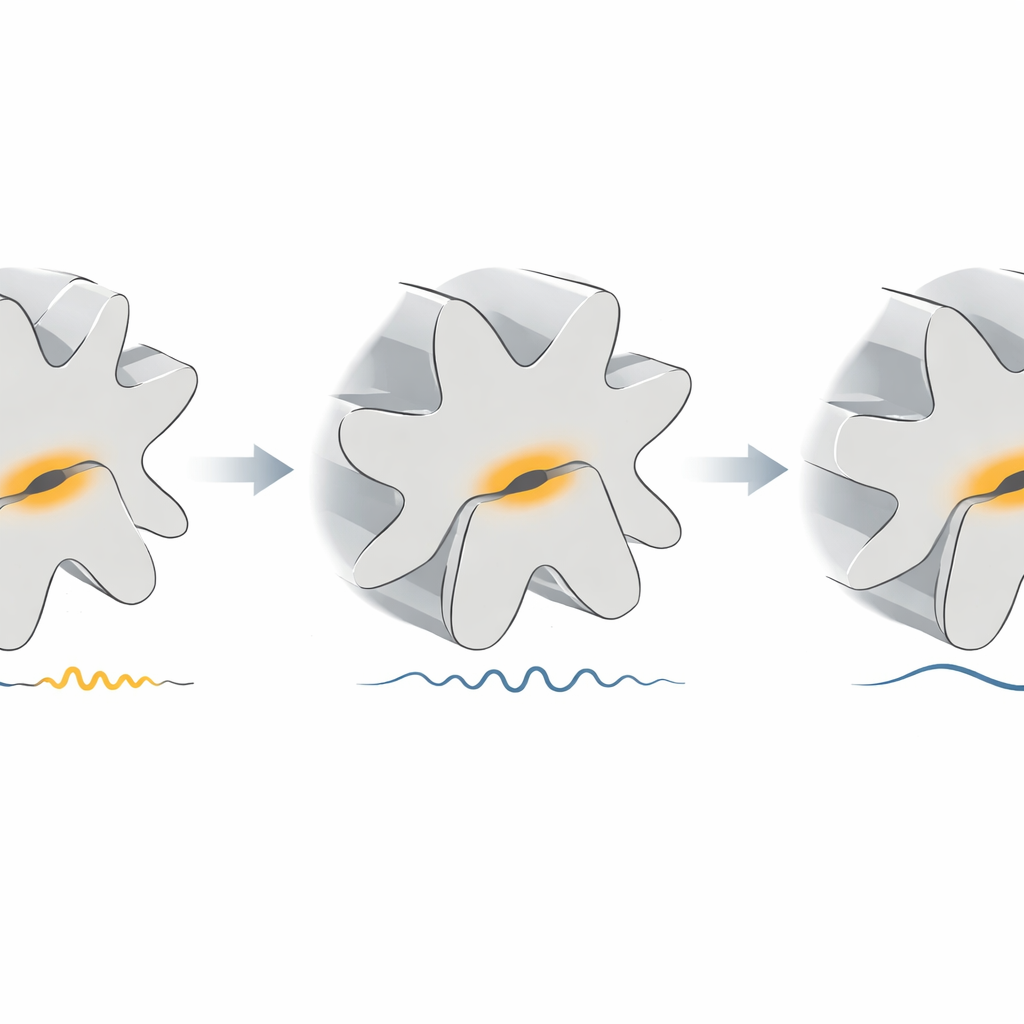
How load and tooth shape can calm the system
The team then explored how two design levers—applied torque and tooth profile shaping—change the dynamic behavior. Counterintuitively, increasing the transmitted torque from 100 to 500 N·m actually lowered the dynamic factor by up to 14 percent and shifted the main resonance to slightly higher speed. Under higher load, the tooth contact area spreads and the local stiffness increases, which helps to damp out vibrations relative to the growing static load. Next, they introduced “crowning,” a gentle rounding of the tooth shape both along its height and across its width. This reshaping reduced the peak-to-peak transmission error, a measure of how much the driven gear lags or jumps ahead during rotation, from 4.5 micrometers to 2.0 micrometers. As transmission error fell, the dynamic factor dropped by about 22 percent and the tendency for contact stress spikes near resonance was greatly reduced.
Designing lighter, quieter, longer-lasting gears
For a non-specialist, the key message is that gears do not have to be massively overbuilt to survive at high speed. By using validated simulations that mirror real gear behavior, engineers can pinpoint the narrow speed ranges where resonance causes trouble, and then either avoid those speeds or adjust stiffness and tooth shape to smooth them out. The study shows that carefully chosen torque levels and subtle crowning of teeth can lower vibration and surface stress without pushing the gear beyond safe limits. In practical terms, that means quieter operation, longer life, and lighter gear sets in applications ranging from industrial drives to future electric powertrains.
Citation: Lee, D., Shim, SB. & Kim, S. Prediction and reduction of dynamic factor based on dynamic behavior of gear systems. Sci Rep 16, 11835 (2026). https://doi.org/10.1038/s41598-026-40793-z
Keywords: gear resonance, dynamic factor, multibody dynamics, tooth profile modification, high-speed transmissions