Clear Sky Science · en
Integrative transcriptome and genome resequencing reveals conserved flowering regulators and allelic variants in early- and late-flowering linseed (Linum usitatissimum L.) accessions
Why the timing of blooms matters
For farmers and consumers alike, when a crop decides to flower can make the difference between a bumper harvest and a poor one. Linseed (also known as flaxseed) is grown for its healthy oil and industrial uses, and breeders want varieties that flower at just the right moment for local weather and water conditions. This study digs into the inner workings of linseed plants to uncover which genes control early versus late flowering, and how subtle DNA changes might help tailor crops to future climates. 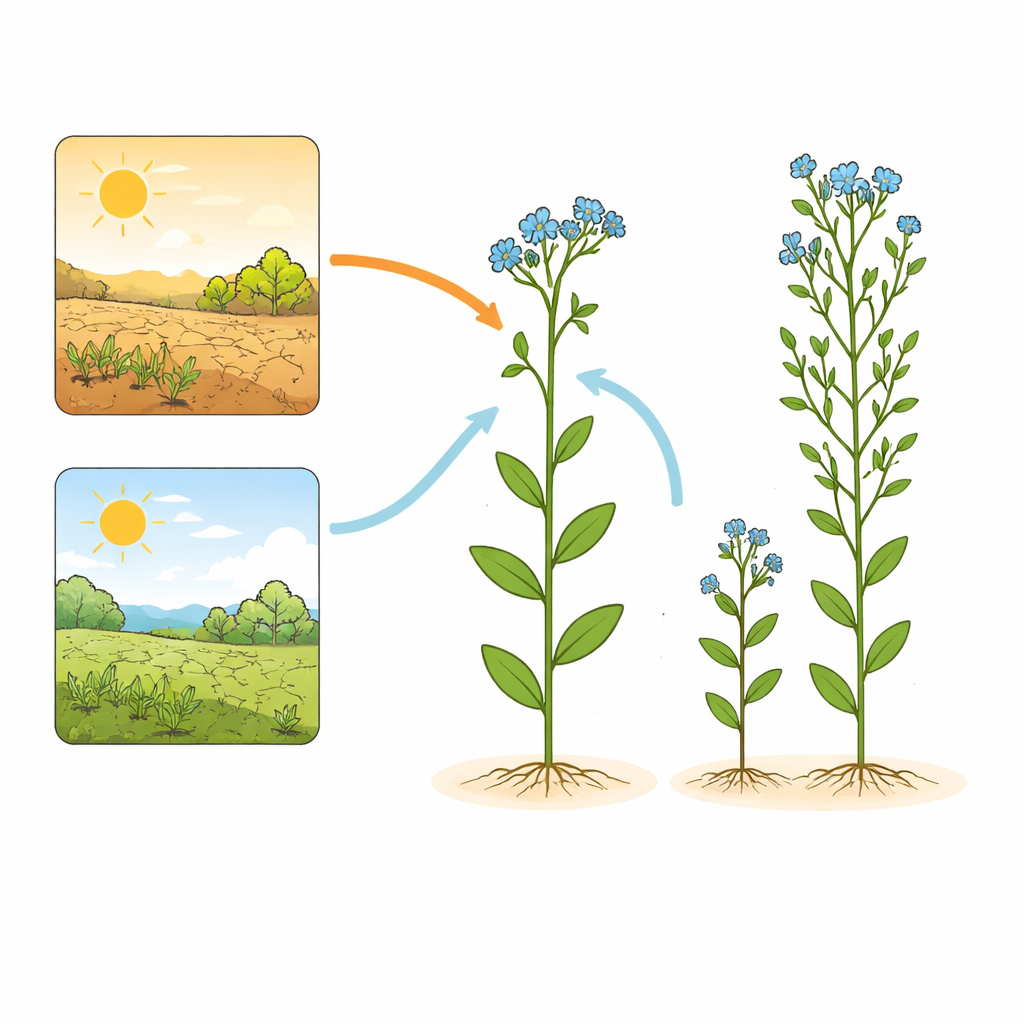
Looking inside plants that bloom early
The researchers focused on two linseed varieties that naturally flower early in the season. They collected samples from five key tissues: two stages of developing floral buds, fully open flowers, leaves, and stems. Using high-throughput RNA sequencing, they measured which genes were turned on or off in each tissue, generating expression data for nearly 35,000 genes. By comparing vegetative parts (leaves and stems) with reproductive parts (buds and flowers), they identified more than 14,000 genes whose activity shifted, revealing a broad genetic reprogramming as the plant transitions from growth to reproduction.
Signals that set the plant’s internal clock
Flowering time is strongly tied to the plant’s internal clock and its ability to sense daylength and light quality. The team found that many genes belonging to the circadian and photoperiod pathways showed contrasting activity between leaves and floral tissues. Light-sensing components and clock genes, including those responding to red, far-red, and blue light, were generally more active in leaves and stems, where environmental cues are perceived. In contrast, some clock-related regulators became more active in buds and flowers. This pattern supports the idea that leaves serve as timing sensors, generating mobile signals that travel through the stem to the growing tip, where they trigger the switch to flowering.
Hormones, sugars, and redox balance as hidden messengers
Beyond light and time-of-day signals, the study uncovered strong involvement of plant hormones and metabolic status in flowering control. Genes linked to hormones such as gibberellins and abscisic acid, as well as brassinosteroids and auxin, were differentially expressed between vegetative and reproductive tissues. Many of these genes participate in growth regulation, stress responses, and the fine-tuning of flowering signals. The researchers also saw large shifts in genes involved in sugar metabolism and cellular redox balance—processes that reflect how much energy and reducing power the plant has available. Together, these findings paint flowering not as a single switch, but as the outcome of intertwined timing, hormone, and energy networks. 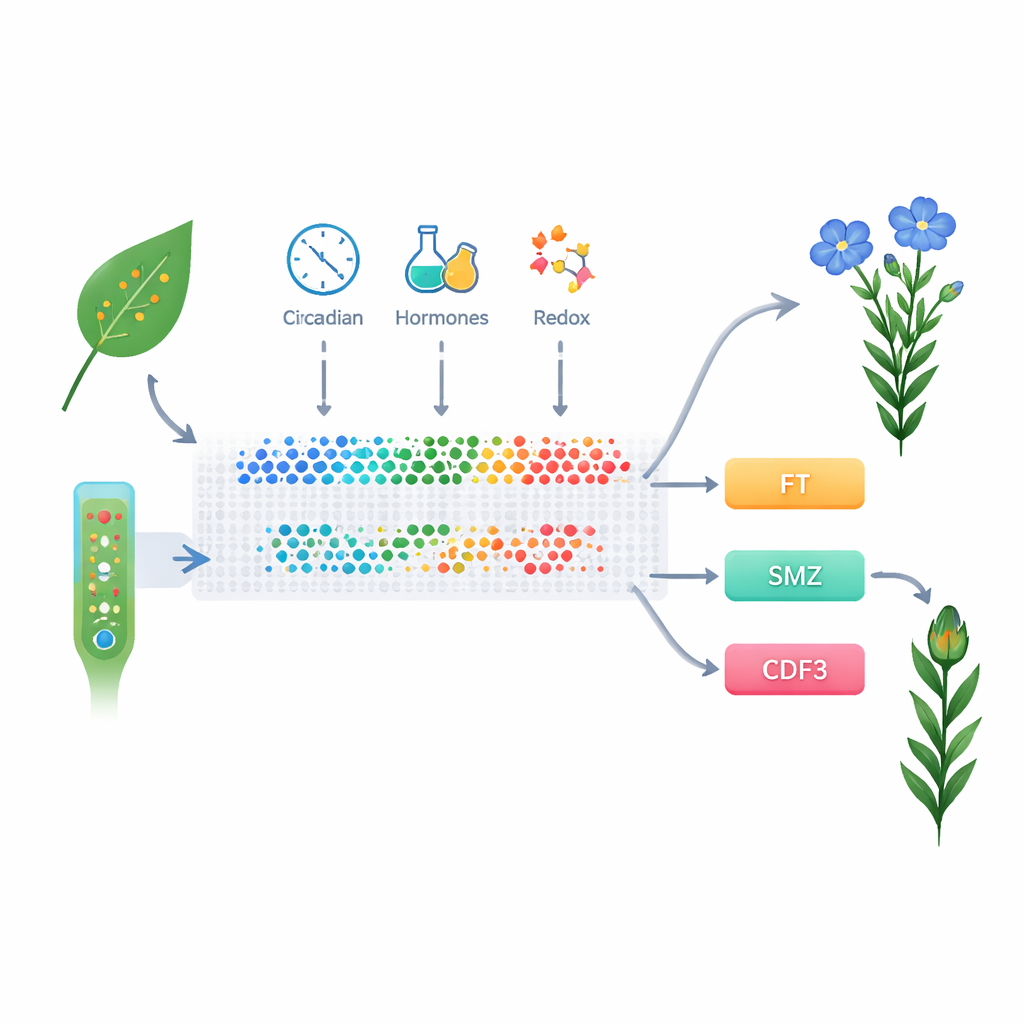
Pinpointing master switches of bloom time
To narrow down likely master regulators, the team combined three lines of evidence: genes that changed expression between tissues, known flowering genes first discovered in the model plant Arabidopsis, and candidate genes previously linked to flowering time in linseed through genome-wide association studies. This three-way comparison highlighted three especially promising genes. One is an FT-like gene, often described as producing a mobile "florigen" signal that moves from leaves to the shoot tip to initiate flowering. The second, SMZ, acts as a repressor of flowering, and the third, CDF3, belongs to a family of genes that can delay flowering by damping down other flowering signals. Their expression patterns in leaves and floral tissues matched these roles, marking them as key control points in linseed.
Small DNA changes with big impacts
To see how DNA variation might tune flowering time, the scientists sequenced the whole genomes of two early-flowering and two late-flowering linseed accessions. They examined 134 flowering-related genes and found distinctive DNA changes between early and late types in several important regulators. These included AGL19, a gene that promotes flowering, a DELLA protein that restrains growth in response to hormones, FLK, a gene affecting flowering pathways, and the clock gene LHY. In several cases, a single amino acid in the encoded protein differed between early and late lines. Computer models suggested that some of these substitutions could alter protein stability or interaction surfaces, potentially shifting how strongly they promote or delay flowering.
What this means for future linseed crops
In simple terms, this work shows that when linseed flowers is governed by a layered network: environmental sensing in the leaves, an internal clock, hormone and sugar status, and a set of master genes that integrate all these inputs. By mapping both the expression patterns and the DNA variants of these key genes, the study provides a toolkit for breeders. In the future, combining favorable versions of FT, clock regulators, hormone-related genes, and their partners could yield linseed varieties that flower earlier or later as needed—helping crops escape drought, heat, or frost and maintain yield in an increasingly unpredictable climate.
Citation: Pal, D., Shahid, D., Saroha, A. et al. Integrative transcriptome and genome resequencing reveals conserved flowering regulators and allelic variants in early- and late-flowering linseed (Linum usitatissimum L.) accessions. Sci Rep 16, 11526 (2026). https://doi.org/10.1038/s41598-026-40729-7
Keywords: linseed flowering time, flax genomics, flowering locus T, circadian clock in plants, crop adaptation