Clear Sky Science · en
Integrative analysis of single-cell RNA sequencing, bulk RNA sequencing, and proteomic data identified NOTCH3 as a hub gene contributing to human intervertebral disc fibrosis
Why back pain starts deep in the spine
Chronic low back pain is a leading cause of disability, yet the tiny structures that keep our spines flexible are easy to overlook. At the center of each spinal disc is a gel-like core that acts as a cushion. As we age or experience injury, this core can dry out and become scar-like, a process called fibrosis. This study digs into that transformation at the level of individual cells and molecules, revealing a single signaling molecule, NOTCH3, as a key driver of the scarring process in human discs. Understanding this "master switch" could open the door to treatments that restore rather than replace damaged discs.
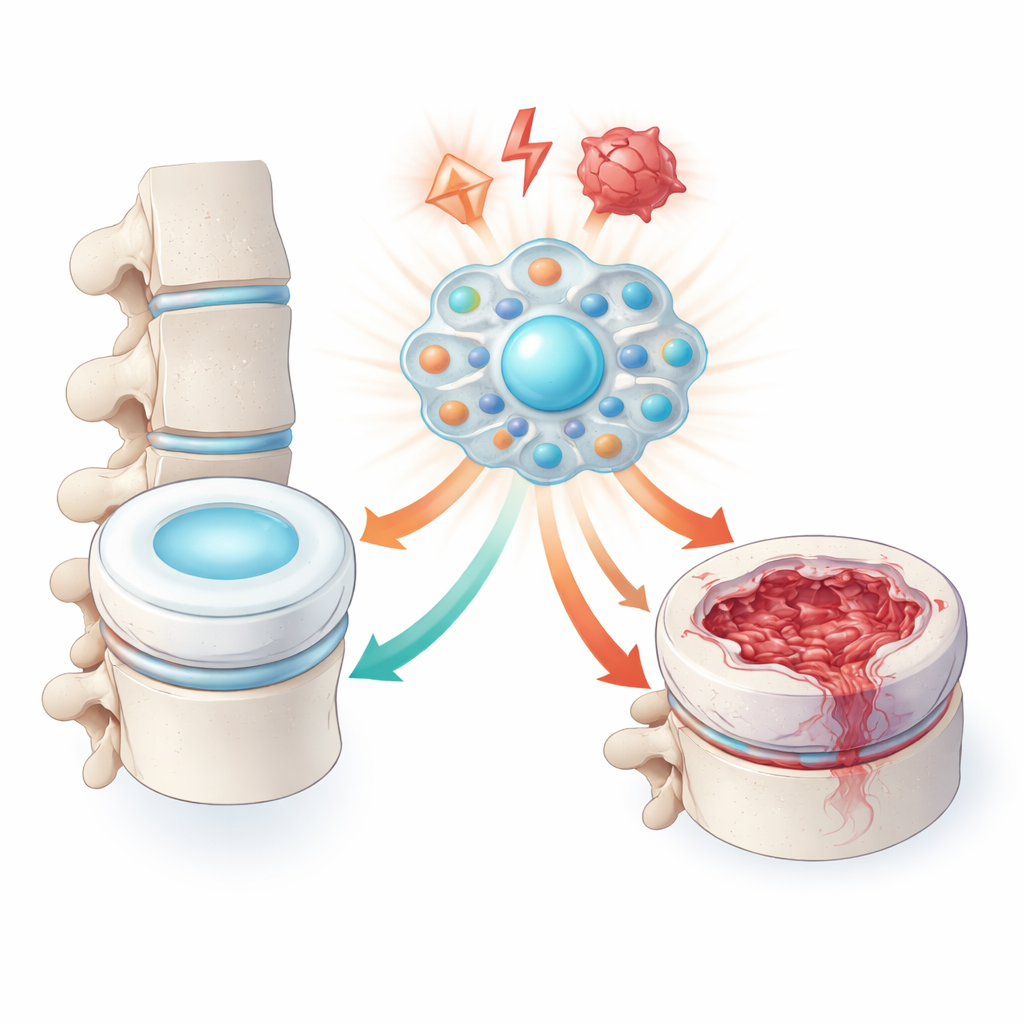
From soft cushion to stiff scar
Healthy intervertebral discs contain a jelly-like center, the nucleus pulposus, rich in water-holding molecules and flexible collagen. In degeneration, this core loses its springiness and becomes packed with dense, disorganized fibrous tissue. The authors confirmed this shift in patients by staining disc samples and examining them under the microscope. Degenerated discs showed much heavier collagen deposition and higher "fibrosis scores" than discs from relatively healthy spines. At the protein level, the normal cartilage-like component type II collagen was reduced, while fibronectin, a hallmark of scar tissue, was elevated. Together, these changes explain why degenerated discs lose height, become brittle, and are more likely to cause pain.
Peering at each cell in the disc
To understand which cells are responsible for this scarring, the team turned to single-cell RNA sequencing, a technique that measures gene activity in thousands of individual cells. They identified eight distinct groups of cells within the disc core and organized them into four broader types, including a fibroblast-like population they call fibroNPCs. Degenerated discs contained many more of these fibroNPCs, along with increased numbers of regulatory and effector cells that respond to stress and inflammation. By reconstructing how these cells change over "pseudotime," the researchers could trace trajectories from healthier cell states toward more fibrotic, disease-associated ones, revealing a stepwise shift toward a scar-making program.
Cell conversations point to a key signal
The disc is not just a passive cushion; it is a community of cells constantly talking to each other. Using computational tools, the authors mapped these cell-to-cell conversations and found that degenerating discs had far more intense communication networks. Signals traveling through pathways known for controlling growth and tissue remodeling—notably the NOTCH, IGF, and TGF-beta pathways—were especially amplified. When they overlaid these single-cell results with bulk RNA sequencing and protein measurements from patient discs, one molecule stood out across all datasets: NOTCH3. This receptor, sitting on the cell surface, emerged as a shared "hub gene" in fibrosis-related changes, particularly in fibroNPCs and regulatory cells that dominate degenerated tissue.
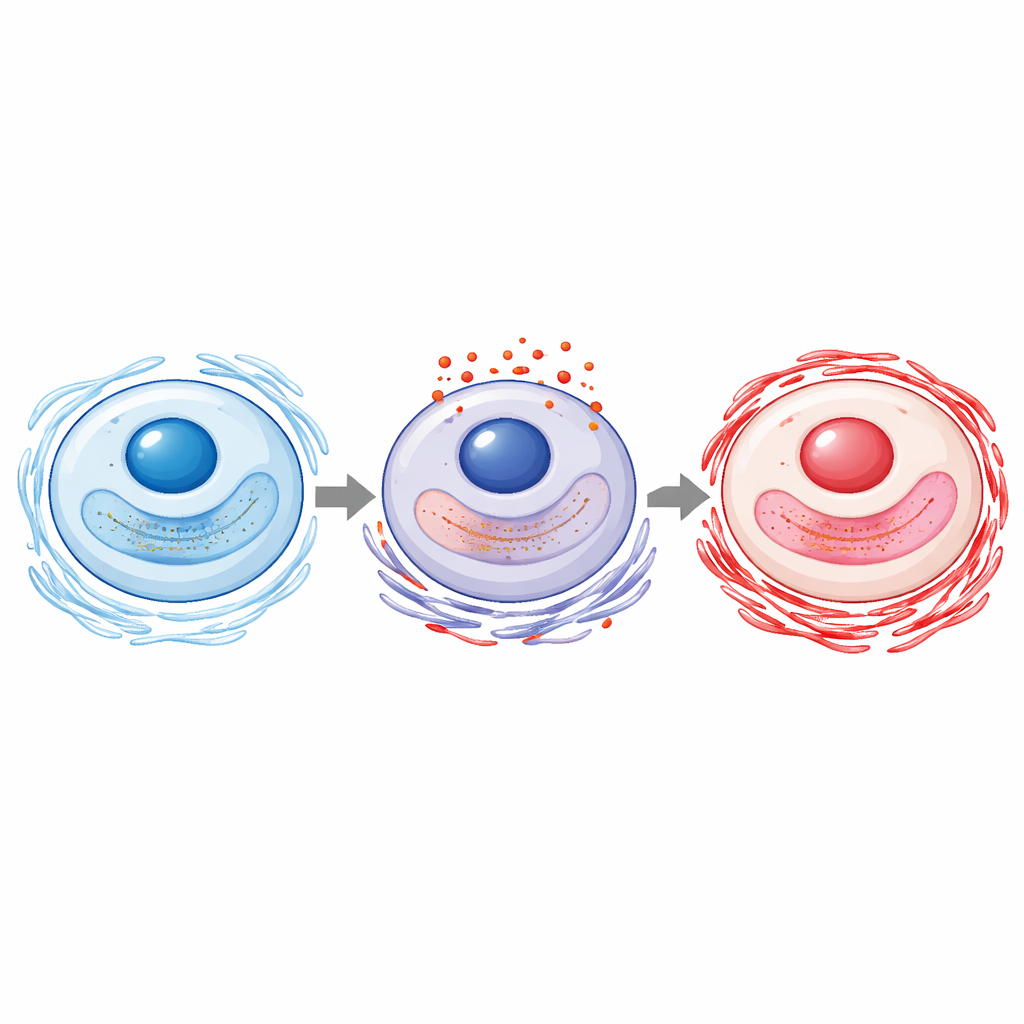
How NOTCH3 drives stress and scarring
Having flagged NOTCH3 as a suspect, the researchers examined where and how it acts. Degenerated discs contained more NOTCH3-positive cells, and the fraction of such cells rose in step with the radiologic severity of degeneration. Inside individual cells, NOTCH3 was found to cluster with the endoplasmic reticulum, the cell’s protein-processing factory, hinting at a link to cellular stress. When the team experimentally reduced NOTCH3 levels in cultured disc cells, several harmful processes eased: fewer cells underwent programmed cell death, fewer entered a senescent, worn-out state, and fewer adopted a fibroblast-like identity. Markers of endoplasmic reticulum stress dropped, while the balance of matrix proteins shifted away from fibrotic fibronectin and back toward healthier type II collagen. Overactivating NOTCH3 had the opposite effect, reinforcing stress and scar formation.
What this means for future treatments
Taken together, the findings paint NOTCH3 as a central switch that links the harsh environment of a degenerating disc—mechanical overload, poor oxygen, and chronic inflammation—to cell stress, premature aging, and the buildup of stiff scar tissue. Rather than being a passive consequence of wear and tear, fibrosis appears to be an active, regulated process that might be reversible if its key signals are tamed. While this work was done on relatively small patient groups and in cell cultures, it suggests that carefully targeting NOTCH3 and its connected pathways could help restore the disc’s internal balance, potentially slowing or even reversing degeneration and offering a new way to address chronic back pain beyond surgery or painkillers.
Citation: Ding, Q., Chen, X., Zheng, Q. et al. Integrative analysis of single-cell RNA sequencing, bulk RNA sequencing, and proteomic data identified NOTCH3 as a hub gene contributing to human intervertebral disc fibrosis. Sci Rep 16, 11179 (2026). https://doi.org/10.1038/s41598-026-40696-z
Keywords: intervertebral disc degeneration, fibrosis, NOTCH3, single-cell sequencing, endoplasmic reticulum stress