Clear Sky Science · en
Shaking table model test and numerical analysis of the steeply dipping bedded rock slopes under seismic actions
Why Steep Mountain Slopes Can Suddenly Let Go
In many earthquake-prone mountain regions, towns, roads, and reservoirs sit below rocky slopes that look solid and unmoving. Yet during strong shaking, some of these slopes can suddenly break loose and rush downhill as fast, devastating landslides. This study looks at a particular kind of hillside, made of rock layers that tilt steeply into the mountain, and asks a practical question: under earthquake shaking, how do these seemingly stable slopes first crack, then fail, and what controls whether the damage is mild or catastrophic?
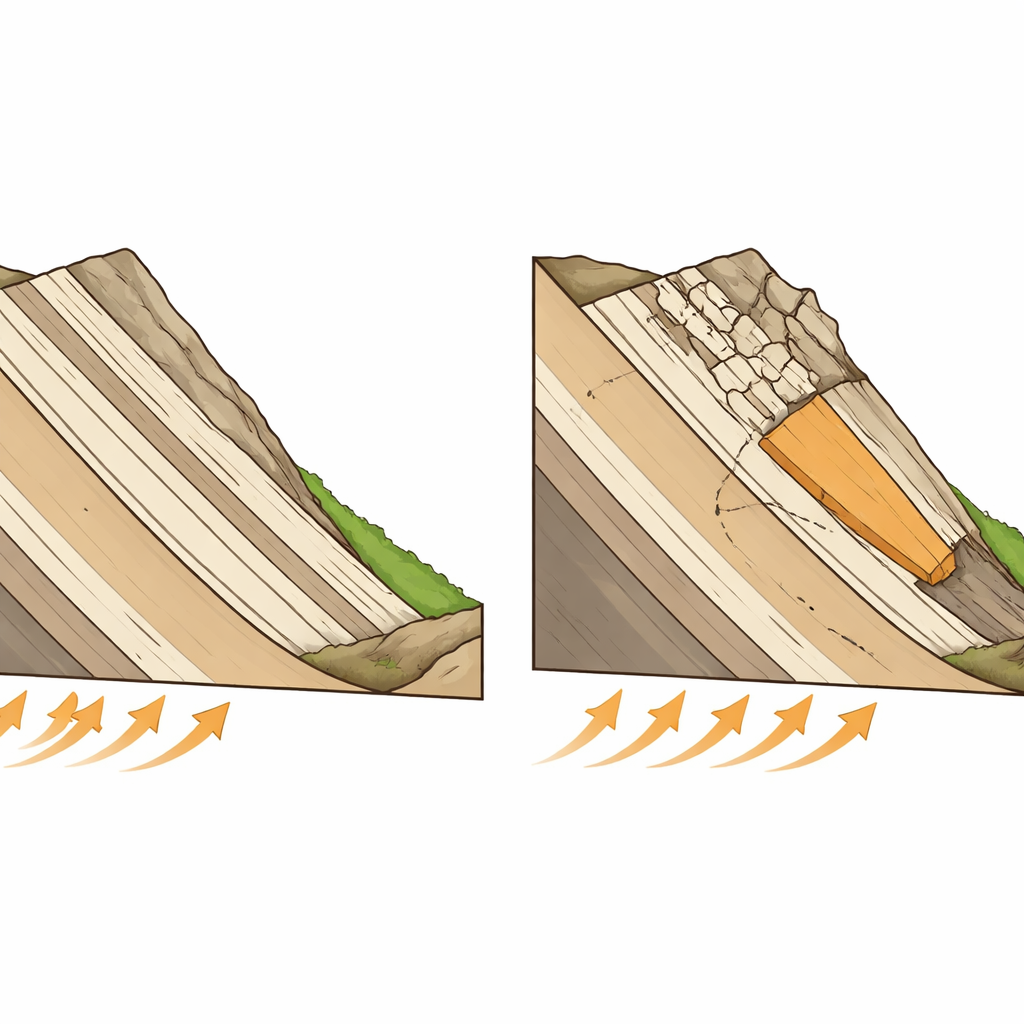
Hidden Weak Spots Inside the Rock
The slopes examined here are built from stacked rock layers, like a tilted pack of cards. In these “steeply dipping” slopes, the rock layers tilt even more steeply than the outer face of the hill, which usually makes them look quite stable in everyday conditions. However, the surfaces between layers are natural weak planes. The researchers focused on a short, stronger block near the base of the slope, known as a locking section, that helps hold the upper rock mass in place. When this section fails, the whole slope can suddenly lose its footing.
Shaking a Miniature Mountain
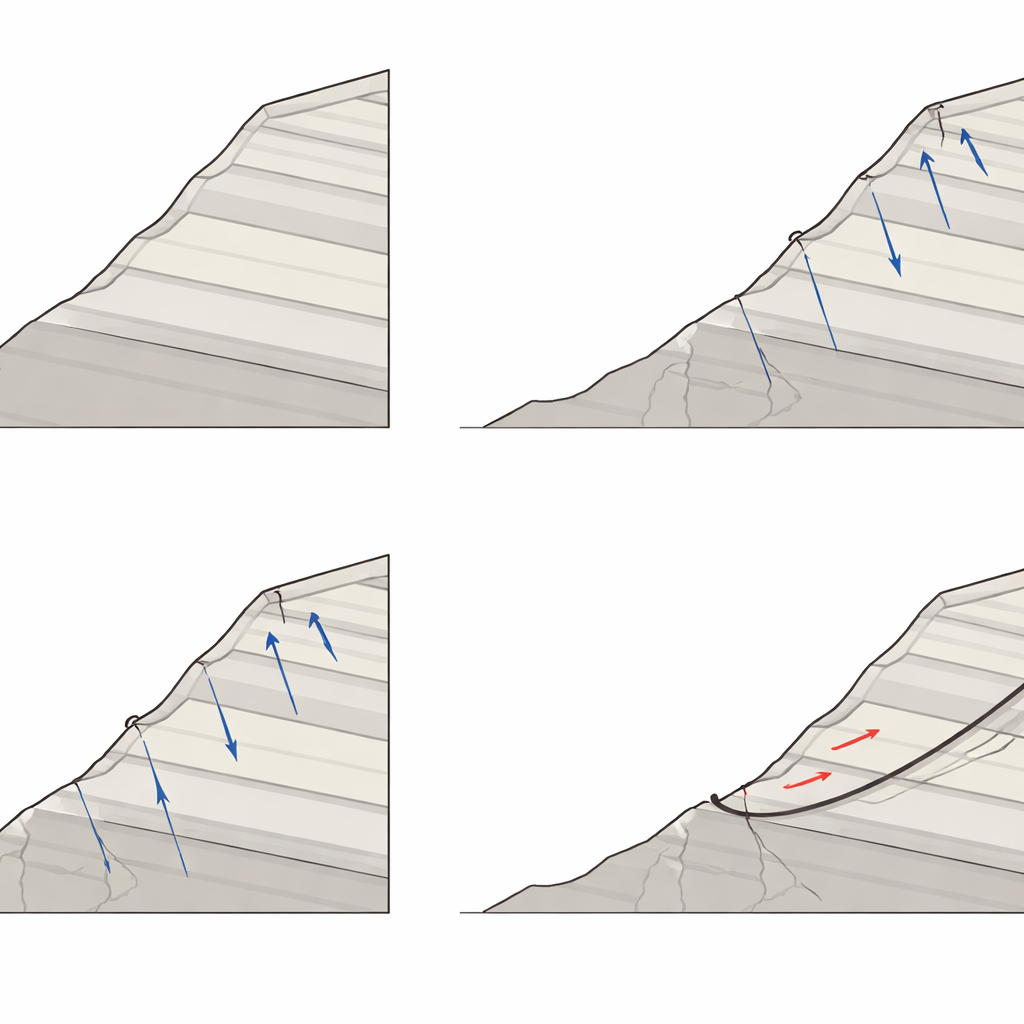
To watch failure unfold step by step, the team built a large physical model of a steep layered slope using carefully mixed materials whose strength and stiffness mimic real rock. They placed this model on a powerful shaking table that can replay earthquake motions. Using both a real seismic record from the 2008 Wenchuan earthquake and controlled sine waves, they gradually increased shaking strength. At first, only small tension cracks appeared near the top edge of the slope. With stronger shaking, these cracks spread downward along the rock layers, forming a locked block at the toe that temporarily kept the slope from sliding. When the shaking grew stronger still, that locked block suddenly sheared off, linking the layer-bound cracks into a continuous slide surface and allowing the overlying rock to lurch downslope.
Peering Inside with Digital Rocks
Physical models alone cannot easily reveal stresses inside every part of a slope, so the researchers also used a computer tool called particle flow simulation. In this method, the rock mass is represented as thousands of small, bonded particles whose motion follows simple physical rules. By carefully adjusting the particle bonds until the virtual rock behaves like the real material, they recreated the tested slope and “shook” it numerically with the same earthquake wave. The computer model reproduced the same four-stage story: initial cracking near the crest, downward crack growth and locked-block formation, sudden shearing of that block, and then translation of the sliding mass. This gave the team confidence that the key processes had been correctly captured.
How Slope Geometry Changes the Outcome
With the digital slope, the team could easily vary the angle and thickness of the rock layers. They found that when the layers dipped only slightly more steeply than the slope surface, the main hazard was classic sliding: the locked section at the base sheared, and the whole mass slipped along a combined path made of layer surfaces and the broken toe. But when the layers were much steeper, the locking section stayed largely intact. Instead, the outer layers near the surface bent and tore in tension from the outside inward, producing a stepwise, toppling-like failure rather than a single big slide. Changing layer thickness had less effect on the basic failure pattern, but thinner layers tended to suffer more severe sliding because they were more slender and easier to bend and break.
What This Means for Safer Mountain Living
For engineers and planners, the study’s message is that even rock slopes that look stable in calm weather can hide a fragile sequence during an earthquake. Failure often begins as small cracks along layer surfaces near the slope shoulder, then works its way downward until the crucial block at the base either shears off, releasing a rapid slide, or the outer layers peel away in stages. Because the first damage tends to appear at the crest, reinforcing this region and the key locking sections can greatly improve safety. These insights offer a clearer picture of when and how steep layered slopes might fail in future earthquakes, helping guide design, monitoring, and emergency planning in mountainous regions.
Citation: Wang, C., Zhang, P., Dong, J. et al. Shaking table model test and numerical analysis of the steeply dipping bedded rock slopes under seismic actions. Sci Rep 16, 10788 (2026). https://doi.org/10.1038/s41598-026-40667-4
Keywords: earthquake landslides, rock slope stability, bedded rock slopes, seismic slope failure, numerical geotechnical modeling