Clear Sky Science · en
Impact of defects and asymmetry on the acoustic transmission of serial resonators
Shaping Sound with Tiny Side Chambers
From noise-cancelling walls in buildings to ultra-sensitive medical and gas sensors, controlling how sound travels through narrow tubes is a powerful engineering tool. This paper explores how deliberately adding small “imperfections” to a chain of tiny side chambers attached to a main tube can be used to trap or let through very specific sound tones, much like choosing which notes of a song can pass through a filter.
Sound Highways and Quiet Zones
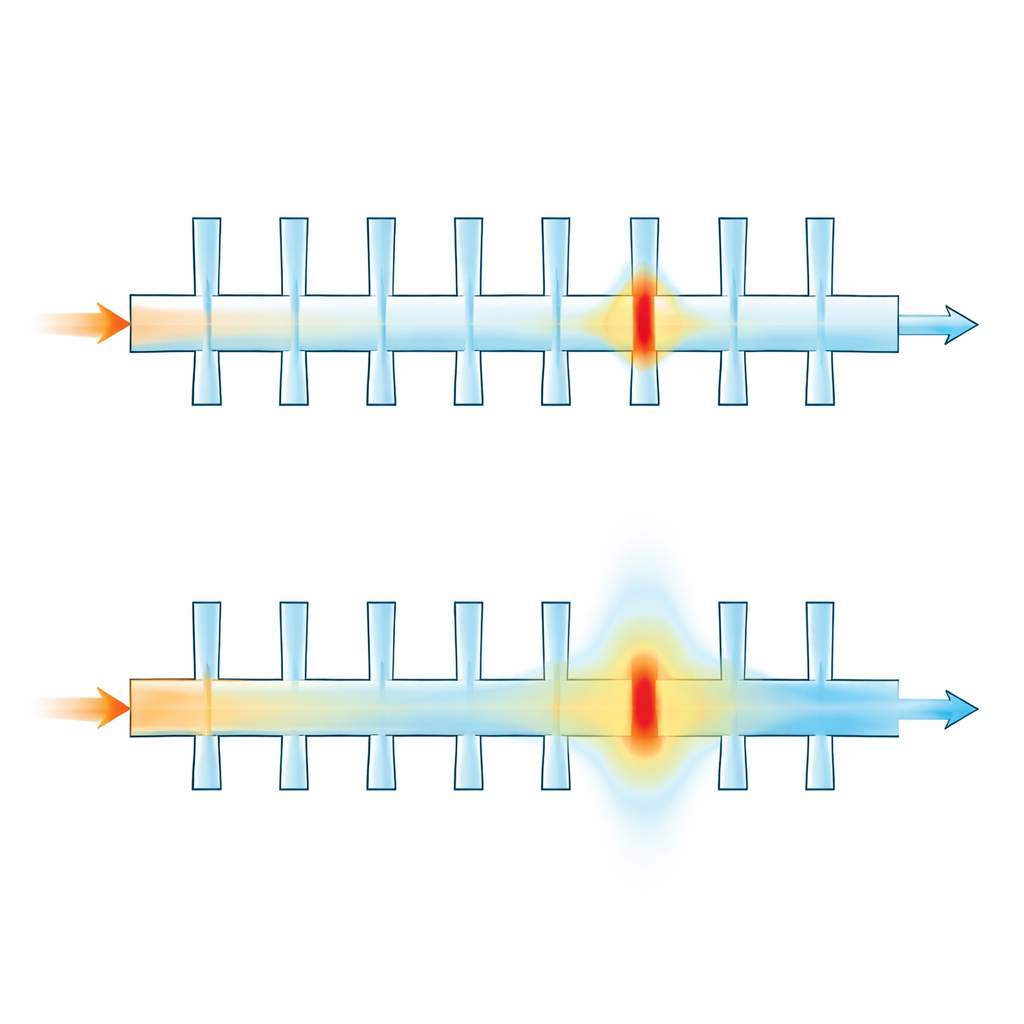
The authors study a one-dimensional “sound highway”: a straight tube along which sound travels, with many small side branches, or resonators, attached along its length. When these branches are repeated in a regular pattern, they create acoustic band gaps—ranges of pitches that are strongly blocked, while others are allowed to pass. Such structures are already known for applications like ventilation noise reduction and compact acoustic filters. Here, the focus is on what happens when this perfect order is disturbed by introducing a single modified branch—a defect—and on how the symmetry of the overall layout changes the way sound is allowed or forbidden to pass.
Two Ways to Arrange the Building Blocks
The resonators come in two flavors: closed-ended branches and open-ended branches. On their own, each type behaves like a simple filter. The closed branch mainly blocks sounds near its favorite resonant pitch and tends to pass higher tones, whereas the open branch prefers to pass lower tones and block higher ones. When arranged in sequence along the tube, these two types of branches can be combined to create broadband filters that cover a wide range of unwanted noise. The study compares two main layouts: an asymmetric arrangement, where the order of closed and open branches breaks mirror balance, and a symmetric arrangement, where the pattern is balanced on both sides of a central point.
Defects that Tune and Trap Sound
The core of the work is to see how a single altered branch in the middle of the chain behaves in both the asymmetric and symmetric layouts. Using two numerical tools—the transfer matrix method and finite-element simulations—the authors calculate how much sound gets through at each frequency and where the acoustic energy builds up. Changing the length of just this one branch shifts the special defect tone, a localized mode, up or down in pitch inside the otherwise blocked band-gap region. In the asymmetric case, increasing the defect length steadily drags this tone toward lower frequencies, creating a highly tunable transmission peak. In the symmetric case, the defect interacts with an additional special tone called a topological edge state, which is already present even without any geometric defect. Their coupling leads to a distinct, still tunable resonance that reflects the extra role of symmetry in shaping where sound prefers to live and how it leaks through.
Fine Control Through Shape and Size
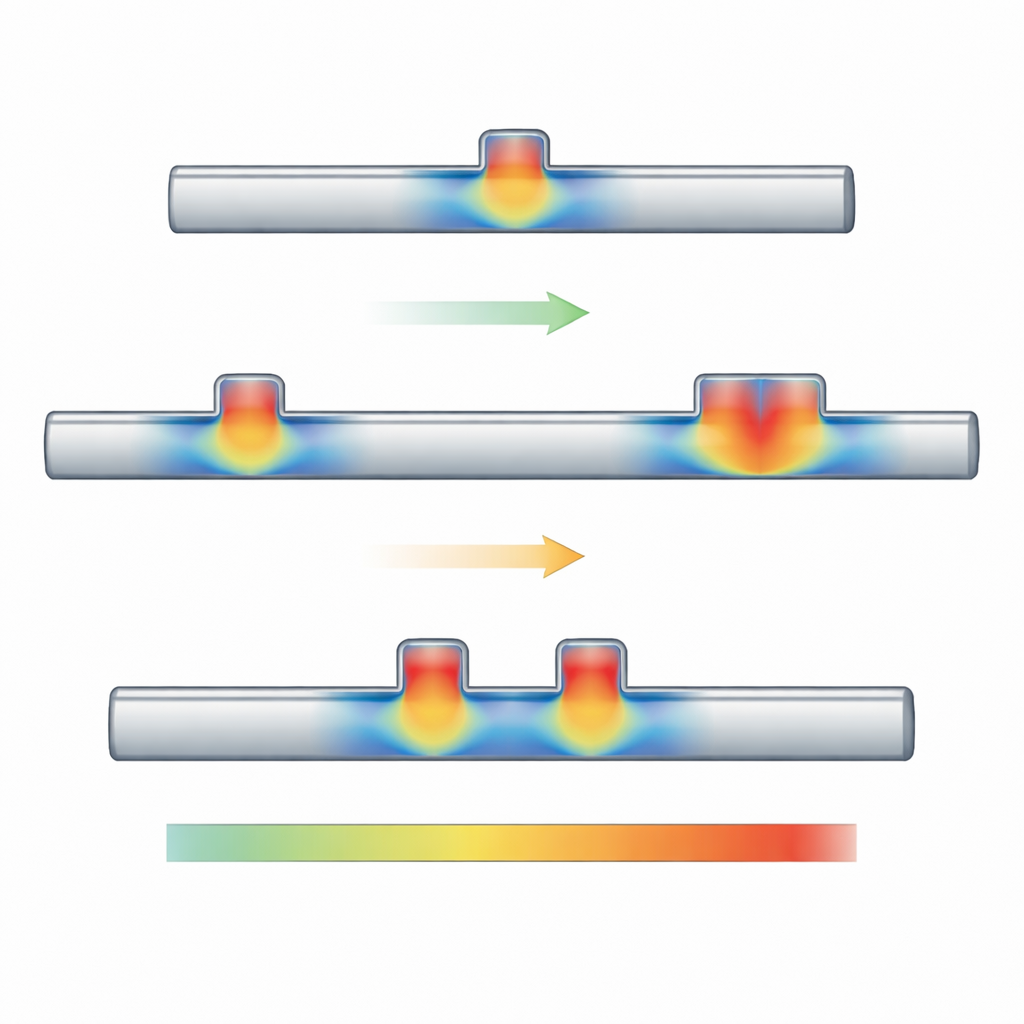
Beyond length, the authors vary the cross-sectional area of the defect branch and of all side branches relative to the main tube. Shrinking or enlarging the defect cross-section allows for fine adjustment of the defect tone’s position and how sharply it stands out, by changing how strongly sound energy is funneled into that branch. Adjusting the overall side-branch size ratio modifies how wide and deep the blocked frequency bands become, and how tall and narrow the defect peaks are. The study finds that symmetric defective structures can maintain almost perfect transmission at these special tones, even when the geometry is strongly altered, while still producing very narrow and selective peaks. Asymmetric structures, in contrast, tend to show lower peak transmission and more pronounced sensitivity to geometric changes.
From Smart Noise Barriers to Sensitive Sensors
In everyday terms, this research shows how a carefully placed and precisely shaped “wrong” piece in a repeating acoustic pattern can be turned into a powerful dial that selects which tones are blocked and which are allowed through. Symmetric layouts with central defects, in particular, offer both stability and precise tunability, making them promising candidates for compact, adjustable acoustic filters and highly sensitive sensors. Whether the goal is to carve out unwanted noise in a ventilation duct or to detect tiny changes in a fluid or gas inside the tube, controlling defect size, shape, and symmetry provides a practical recipe for engineering sound at will.
Citation: El Malki, M., Antraoui, I., Khettabi, A. et al. Impact of defects and asymmetry on the acoustic transmission of serial resonators. Sci Rep 16, 12203 (2026). https://doi.org/10.1038/s41598-026-40579-3
Keywords: acoustic filters, resonator arrays, defect modes, noise control, acoustic sensors