Clear Sky Science · en
Optimizing sleep scheduling in wireless sensor networks via node utility and critical target prioritization
Why keeping tiny digital sentries awake matters
From smart farms to wildfire alarms, wireless sensor networks are quietly watching over our world. These scattered, battery-powered devices measure heat, motion, pollution, and more, then send the data back to a central hub. But there is a catch: once their batteries die, the network goes blind. This paper tackles a deceptively simple question with big practical stakes—how can we decide which sensors should stay awake and which can safely sleep, so that we see everything we care about for as long as possible?
The challenge of watching everything all the time
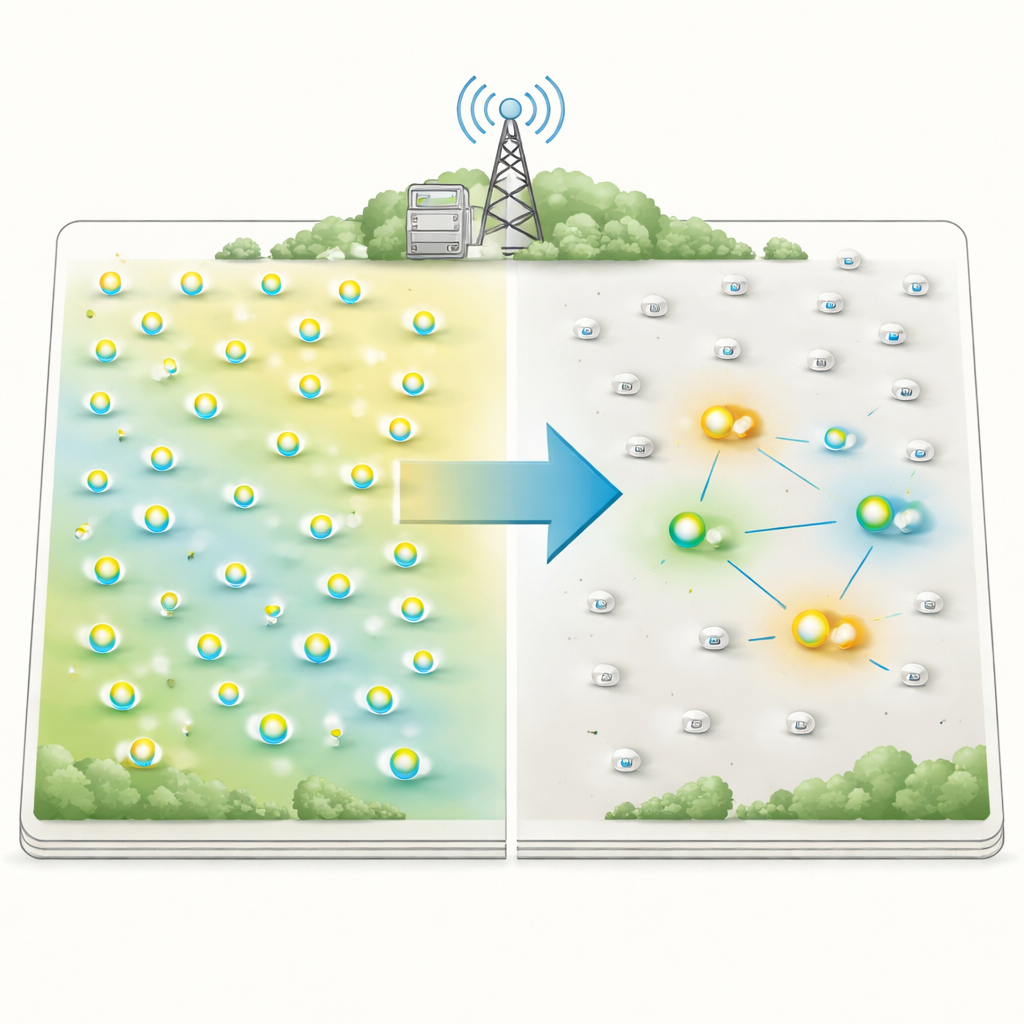
In many real deployments, dozens or hundreds of sensors observe the same area or group of important points, such as bridges, valves, or chemical tanks. Turning all sensors on at once guarantees good coverage, but wastes energy and shortens the life of the entire network. Worse, real sensors do not behave like perfect light bulbs that either fully see or do not see a target. Their ability to sense fades with distance and with battery drain, which means coverage is a matter of probability, not certainty. Existing scheduling methods struggle with this messy reality. They often keep too many overlapping sensors active, fail to protect the few sensors guarding hard-to-see spots, and ignore how much battery each node has left, leading to blind spots forming earlier than necessary.
A smarter way to share the workload
The authors propose a new sleep scheduling strategy that treats the network a bit like a city power grid: it identifies bottlenecks, spreads the load, and only turns on what is truly needed. First, they upgrade the sensing model so that a sensor’s chance of detecting a target depends not only on distance but also on its remaining energy. This creates a “probability–energy” picture of coverage, more faithful to how hardware behaves over time. They then break the sprawling network into smaller, independent regions of sensors and targets that actually interact with one another. This step, called a hierarchical disjoint cover set, turns a huge, hard-to-solve global problem into many smaller subproblems that can be handled much more efficiently.
Finding weak spots and choosing the right helpers
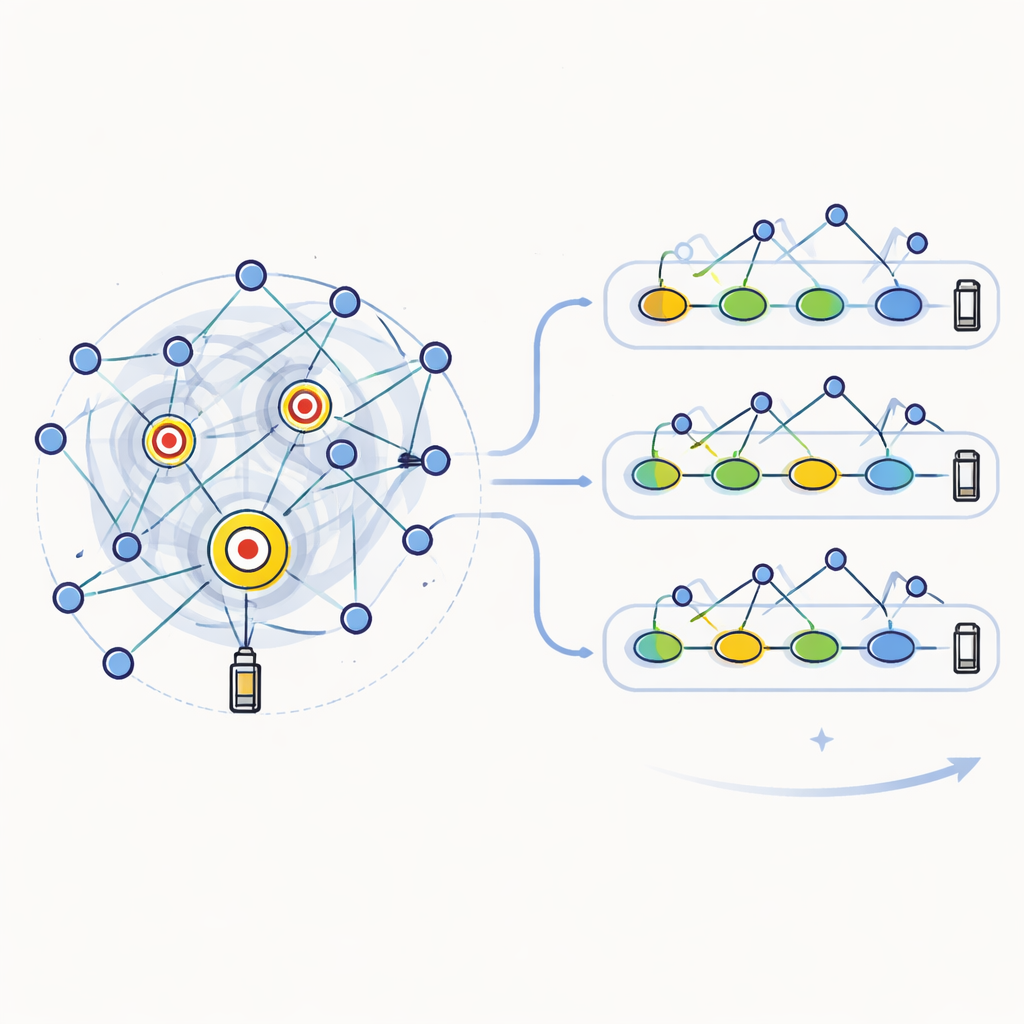
Within each region, the method scans for the weakest link: the target that is most at risk of losing coverage because it depends on only a few tired sensors. That target becomes the “critical” one to protect first. For the sensors that can see this critical target, the algorithm computes a simple utility score that blends how much battery each node still has with how many currently uncovered targets it can help watch. In every round, the sensor with the highest utility around the weakest target is activated, and the coverage picture is updated. Over time, different sensors take turns carrying the load, ensuring that hard-to-cover points are never forgotten while battery use stays balanced.
Putting the plan to the test
To see whether this strategy pays off, the authors run computer experiments on networks of different sizes and layouts, and compare their approach—called UCTF-SS—against several well-known scheduling methods, including random choice, greedy energy-based selection, clustering schemes, a wireless power transfer method, and a genetic algorithm. They measure how long the network maintains full or near-full coverage, how many nodes must be awake in each round, and how evenly energy is consumed. Across the board, UCTF-SS keeps the network alive longer, sustains higher coverage, and spreads battery drain more evenly, all while only a small fraction of sensors are awake at any time.
What this means for real-world sensor deployments
In plain terms, the study shows that it is possible to keep digital watch over critical points for much longer by being strategic about which sensors are awake, and by paying special attention to the most fragile parts of the network. By focusing on weakly protected targets, rotating sensors based on both usefulness and remaining energy, and simplifying the network into smaller regions, the proposed method stretches limited batteries without sacrificing vigilance. For designers of smart cities, industrial plants, and environmental monitoring systems, this translates to fewer battery changes, more reliable data, and sensor networks that age gracefully instead of failing in sudden patches of darkness.
Citation: Wu, J., Tian, S., Qi, X. et al. Optimizing sleep scheduling in wireless sensor networks via node utility and critical target prioritization. Sci Rep 16, 10389 (2026). https://doi.org/10.1038/s41598-026-40548-w
Keywords: wireless sensor networks, energy-efficient monitoring, sleep scheduling, target coverage, network lifetime