Clear Sky Science · en
Identification and validation of prognostic genes associated with integrative stress response in lung adenocarcinoma and construction of the risk models
Why stress signals in lung cancer matter
Lung adenocarcinoma is one of the most common and deadly forms of lung cancer, yet people with seemingly similar tumors can have very different outcomes. This study asks a simple but powerful question: can we read the internal “stress signals” of cancer cells to tell which patients are more likely to do poorly, and to guide treatment choices? By looking deep into the genes that help cells cope with stress, the researchers set out to build a practical tool that doctors could one day use to personalize care.

Reading the cell’s distress calls
All cells, including cancer cells, are constantly challenged by lack of oxygen, toxic molecules, misfolded proteins, and DNA damage. To survive, they switch on a shared internal alarm system called the integrated stress response. The authors gathered large genetic datasets from hundreds of lung adenocarcinoma tumors and matched noncancerous lung tissues. From more than 500 known stress-related genes, they first identified those that were unusually active or quiet in tumors compared with healthy tissue. This produced a shortlist of 34 candidates that seemed to link the stress-response machinery to lung cancer biology.
Narrowing down to five key warning genes
Next, the team asked which of these candidates actually tracked with how long patients lived. Using statistical models that relate gene activity to survival, they honed in on five genes—AGER, GPX3, CCNA2, KCNK3, and CHEK1. Three of them (AGER, GPX3, and KCNK3) tended to be lower in tumors and appeared protective when present, while two (CCNA2 and CHEK1) were higher in tumors and associated with worse outcomes. The researchers confirmed these patterns using tumor samples from their own hospital, showing that this five-gene combination is not just a quirk of public databases but also holds up in real-world patients.
Turning gene activity into a risk score
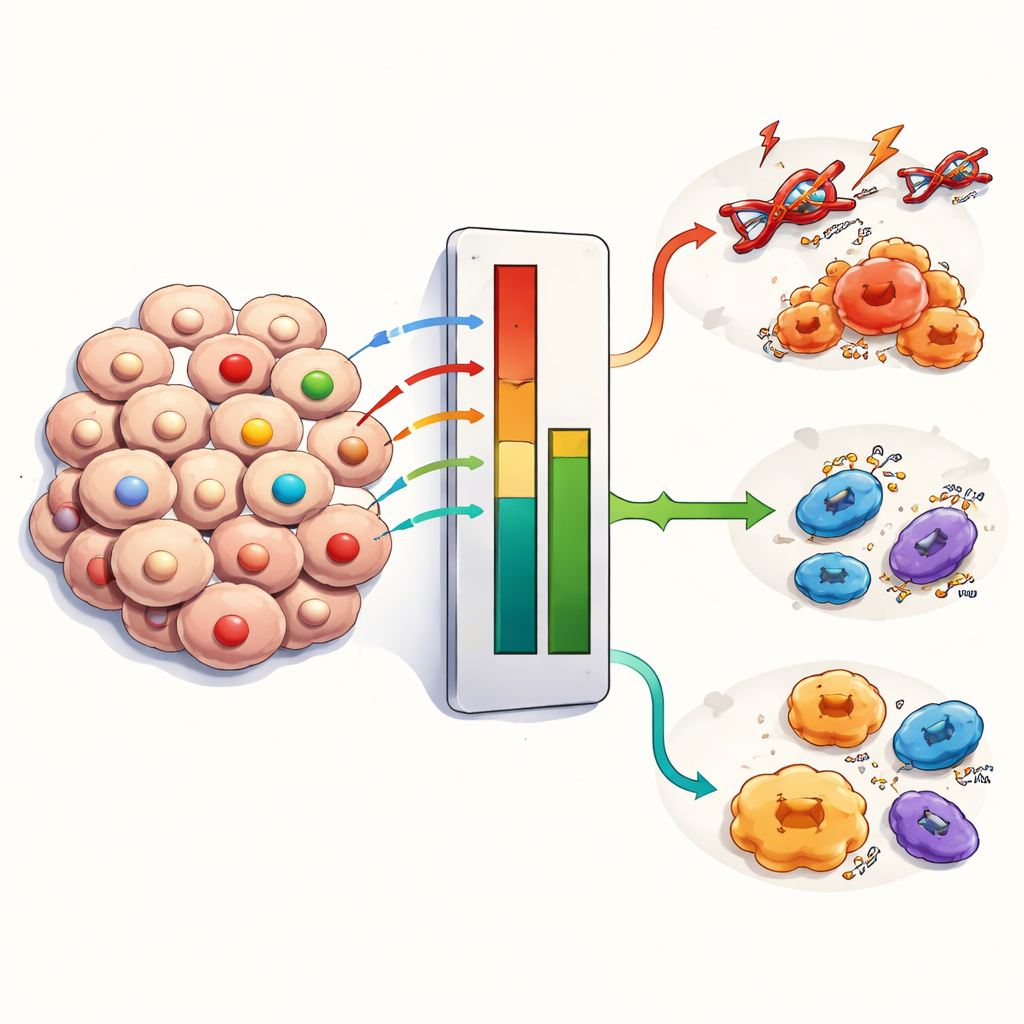
With these five genes in hand, the authors built a simple numerical “risk score” that weighs each gene according to how strongly it relates to survival. Every patient’s tumor gets a score based on its gene activity profile. When patients were split into high-risk and low-risk groups using this score, those in the high-risk group died sooner and more often. The prediction held up not only in the main dataset but also in two independent patient cohorts. To make the tool more clinic-friendly, the team combined the gene-based risk score with standard tumor staging features into a nomogram—a kind of graphical calculator that estimates a person’s chances of surviving one, two, or three years.
What the risk score reveals inside the tumor
Digging deeper, the researchers found that tumors with high risk scores were more heavily mutated and showed different patterns of immune cell presence than low-risk tumors. High-risk cancers had more mutations overall and more signs of “immune escape,” meaning they were better at dodging the body’s defenses and were less likely to benefit from certain immunotherapies. Specific immune cell types, such as activated helper T cells, macrophages, and memory B cells, showed strong links with the five genes, suggesting that these stress-related markers are tied not just to the cancer cells themselves but also to the surrounding immune environment. The team also used drug-response data to suggest which chemotherapies might work better in low- versus high-risk patients, hinting at future ways to match medicines to a tumor’s stress profile.
From molecular stress to practical guidance
In plain terms, this work translates the noisy molecular chatter inside lung tumors into a focused five-gene signal that helps predict who is likely to do worse and why. The study shows that a cancer’s ability to handle stress is closely linked to how fast it grows, how often its DNA is damaged, and how it interacts with the immune system. While more testing is needed before this tool can guide everyday decisions, the approach points toward a future in which a small gene test could help doctors identify high-risk lung adenocarcinoma patients, tailor their treatments, and potentially improve survival by attacking the tumor’s stress-adaptation machinery.
Citation: Fu, J., Tao, Y. & Liu, W. Identification and validation of prognostic genes associated with integrative stress response in lung adenocarcinoma and construction of the risk models. Sci Rep 16, 11300 (2026). https://doi.org/10.1038/s41598-026-40547-x
Keywords: lung adenocarcinoma, integrated stress response, prognostic biomarkers, tumor immune microenvironment, personalized cancer therapy