Clear Sky Science · en
Protein trafficking and synaptic demand configure complex and dynamic synaptome architectures of individual neurons
How Brain Cells Keep Their Connections in Shape
Every thought, memory, and movement depends on tiny junctions between nerve cells called synapses. Far from being identical, these contact points differ in the mix of proteins they contain, how quickly those proteins are replaced, and how they change with age. This study asks a deceptively simple question: could the mind-boggling variety and layout of synapses along a single neuron arise from just a few basic supply-and-demand rules for how proteins are moved, used, and discarded inside the cell?
A Busy Delivery Network Inside Neurons
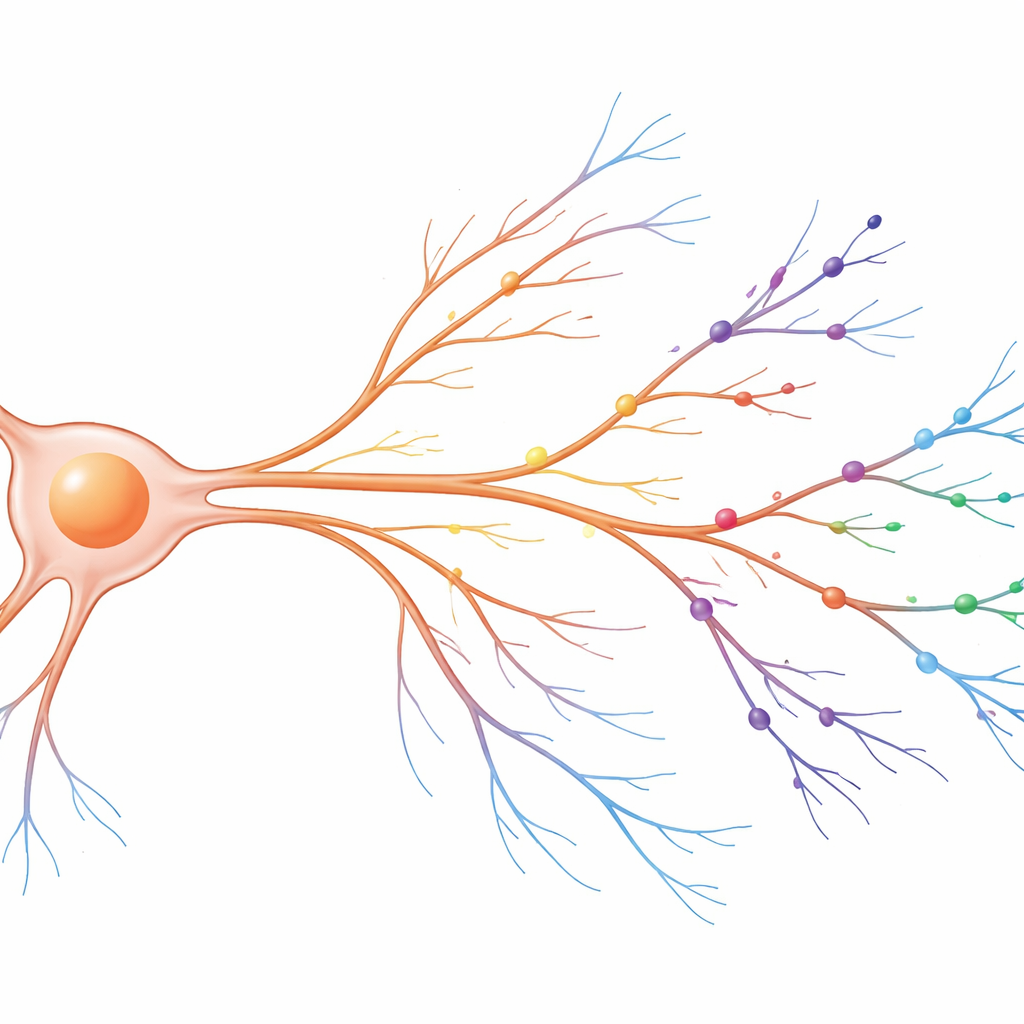
Neurons are famous for their tree-like branches that receive thousands of inputs. At each input, large assemblies of proteins help transmit and process signals. One key protein, PSD95, helps organize the receiving side of excitatory synapses and is linked to many brain disorders. Using earlier imaging work that tracked PSD95 at individual synapses across the mouse brain, researchers knew that PSD95 is not spread evenly along a neuron’s branches, and that its “lifetime” at synapses changes with age and cell type. The open problem was whether these complex patterns demand elaborate genetic instructions for every synapse, or whether they could emerge from simpler physical rules.
The Sushi-Belt Idea: Supply Meets Local Need
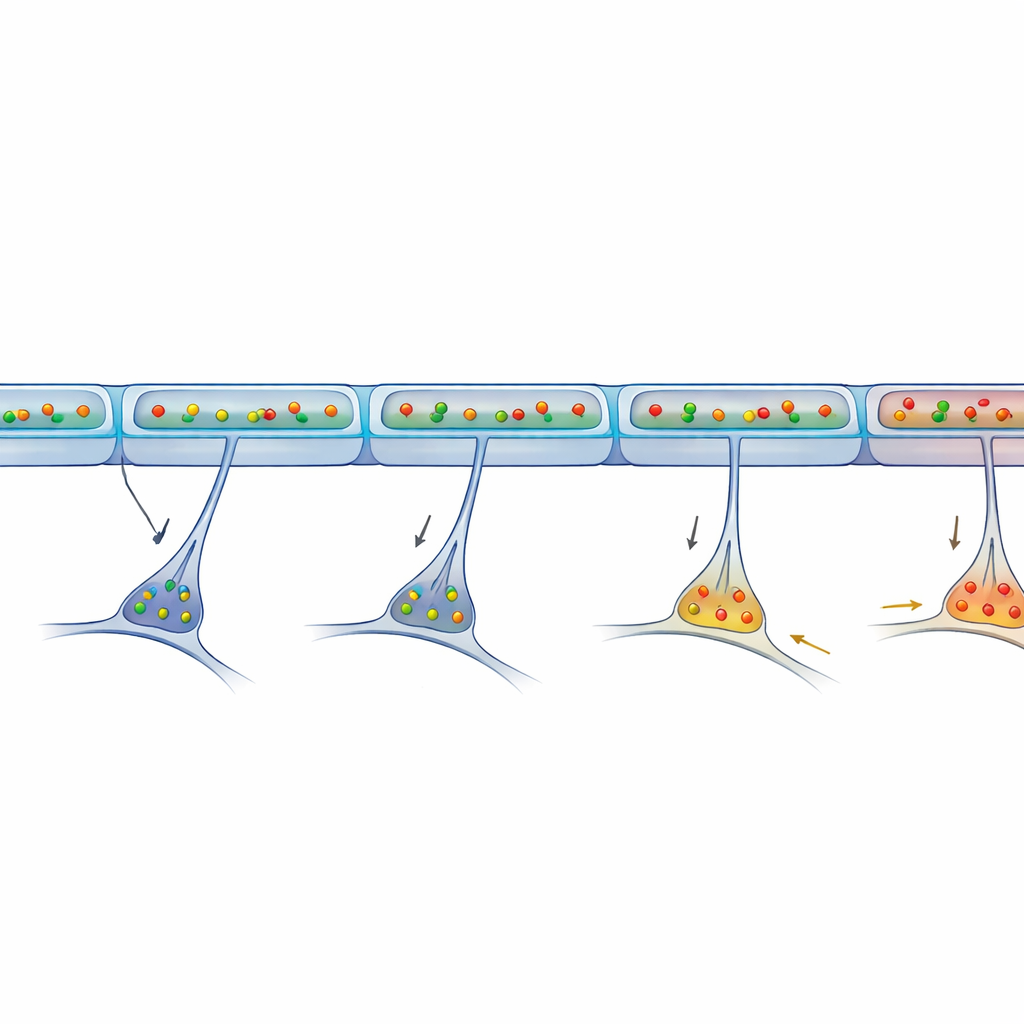
The authors build on a “sushi-belt” concept of transport inside neurons: newly made proteins in the cell body are carried along internal tracks through the branching tree, like plates on a conveyor passing diners at a restaurant. Synapses act as hungry customers; if their local demand is high, they “grab” more passing proteins, which are then held and eventually broken down. In their updated computer model, each dendritic branch is split into many small segments. Within each segment, PSD95 can move forward or backward along microtubule tracks, detach to join synapses, and be degraded over time. A single tuning knob sets how much of the overall behavior is driven by where traffic slows down versus where detachment from the conveyor is favored.
Matching Complex Synapse Patterns With Simple Rules
The team first asked whether this model could reproduce real PSD95 patterns measured in a major type of hippocampal neuron (CA1 pyramidal cells) at single-synapse resolution. They used the initial distribution of PSD95 as a starting point, then simulated seven days of transport and degradation and compared the results to experimental measurements over the same period. By gradually increasing the detail of their model—allowing each of 20 dendritic regions to have its own level of “demand,” while keeping degradation almost uniform—they reached a near-perfect match to the observed data. The best-fitting solution relied mainly on transport that responds to local demand, with only subtle differences in how fast proteins are destroyed from place to place. The simulations suggest that apparent differences in protein lifetime along the dendritic tree can be explained by shifting protein toward distant branches and letting synapses there capture and use it, rather than by large local changes in decay rate.
How Age and Cell Type Change the Balance
Next, the researchers tested whether the same core rules could account for how PSD95 behaves in young, adult, and old mice, and in another neuron type, dentate gyrus granule cells. Remarkably, for both CA1 and granule cells, the same demand and transport settings that worked for adults also reproduced the patterns in young and old animals once a single factor was changed: the global degradation rate of PSD95. In young mice, PSD95 is turned over much more quickly, while in older animals it lasts longer, even though the underlying transport logic stays largely the same. In CA1 neurons, demand-dependent transport dominated, whereas in granule cells, variation in how easily proteins detach from the conveyor played a larger role. This suggests that different neuron types may lean on different sides of the same basic delivery system to shape their synaptic landscapes.
Why This Matters for Brain Health and Disease
The work supports a striking conclusion: the rich and dynamic “synaptome” of a neuron—the detailed pattern of synapse types along its branches—can arise from a small set of generic processes working together: soma-based protein production, active transport along microtubules, local synaptic demand, and protein degradation. Rather than needing a separate genetic program for each synapse, neurons may use a global conveyor system that continuously circulates proteins, while individual synapses request what they need. Because many brain disorders affect transport, protein quality control, or synaptic proteins themselves, this framework offers a unifying way to think about how such disruptions could ripple through the synaptome and, ultimately, behavior. It also lays the groundwork for future simulations that link molecular diversity at synapses to large-scale brain circuits and their electrical activity.
Citation: Sorokina, O., Bulovaite, E., Sorokin, A. et al. Protein trafficking and synaptic demand configure complex and dynamic synaptome architectures of individual neurons. Sci Rep 16, 11541 (2026). https://doi.org/10.1038/s41598-026-40513-7
Keywords: synaptic protein transport, PSD95, neuron modeling, synaptome architecture, brain aging