Clear Sky Science · en
Boosting the responsivity of β-Ga2O3 metal–semiconductor–metal solar-blind photodetectors through oxygen-related defect states
Why invisible sunlight matters
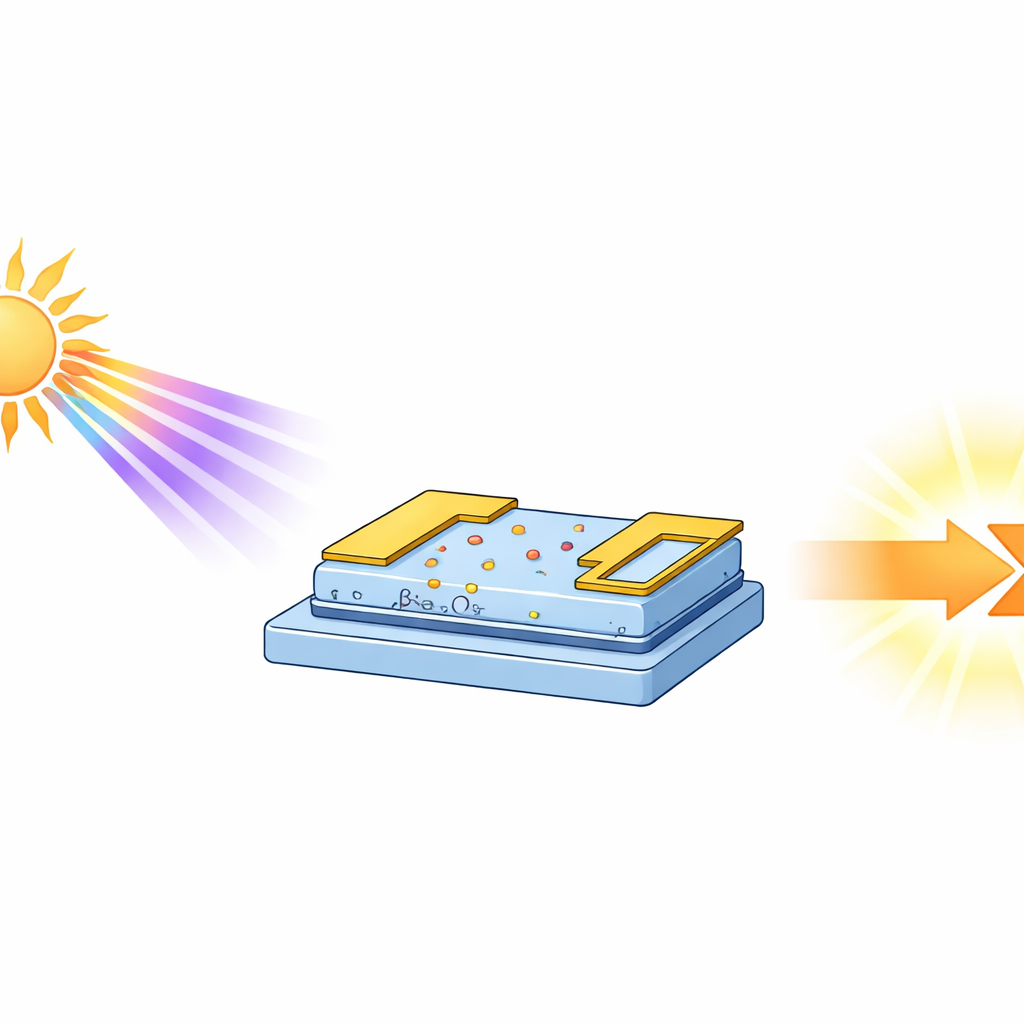
Most of the light streaming from our Sun is harmless or even helpful, but a narrow slice of its spectrum in the deep ultraviolet can be both dangerous and surprisingly useful. Devices that can see only this “solar‑blind” band—light that the atmosphere largely blocks before it reaches the ground—are prized for early flame detection, secure wireless links, and missile warning systems because background noise from ordinary sunlight is almost zero. This article explores how a particular crystal, beta‑gallium oxide, can be engineered so that tiny imperfections involving oxygen atoms dramatically boost how sensitively such detectors respond to faint ultraviolet signals.
Seeing only the dangerous glow
Solar‑blind photodetectors are designed to respond strongly to deep‑ultraviolet light between about 190 and 280 nanometers while ignoring visible light. Conventional silicon sensors struggle here and usually need complex filters. Beta‑gallium oxide, by contrast, has an unusually wide energy gap between its filled and empty electron states, which naturally aligns with this solar‑blind region. It also tolerates high temperatures and harsh environments and can be grown on large, relatively inexpensive wafers, making it attractive for future large‑area detector arrays and rugged sensing systems.
Tuning tiny flaws with heat
The authors grew thin beta‑gallium oxide films on sapphire at three different temperatures—700, 800, and 900 °C—using a vapor‑based deposition method similar to those used in the semiconductor industry. They then built simple metal–semiconductor–metal devices, in which interlocking metal fingers sit atop the film and collect the electric current generated when light hits. X‑ray diffraction measurements showed that, as growth temperature rose, the crystal structure became slightly more strained, while X‑ray photoelectron spectroscopy revealed an increase in oxygen‑related defect states: places in the crystal where oxygen atoms are missing or displaced. These subtle shifts also nudged the electronic energy levels, making the material more strongly n‑type, meaning it more readily conducts electrons.
How defects turn light into a stronger signal
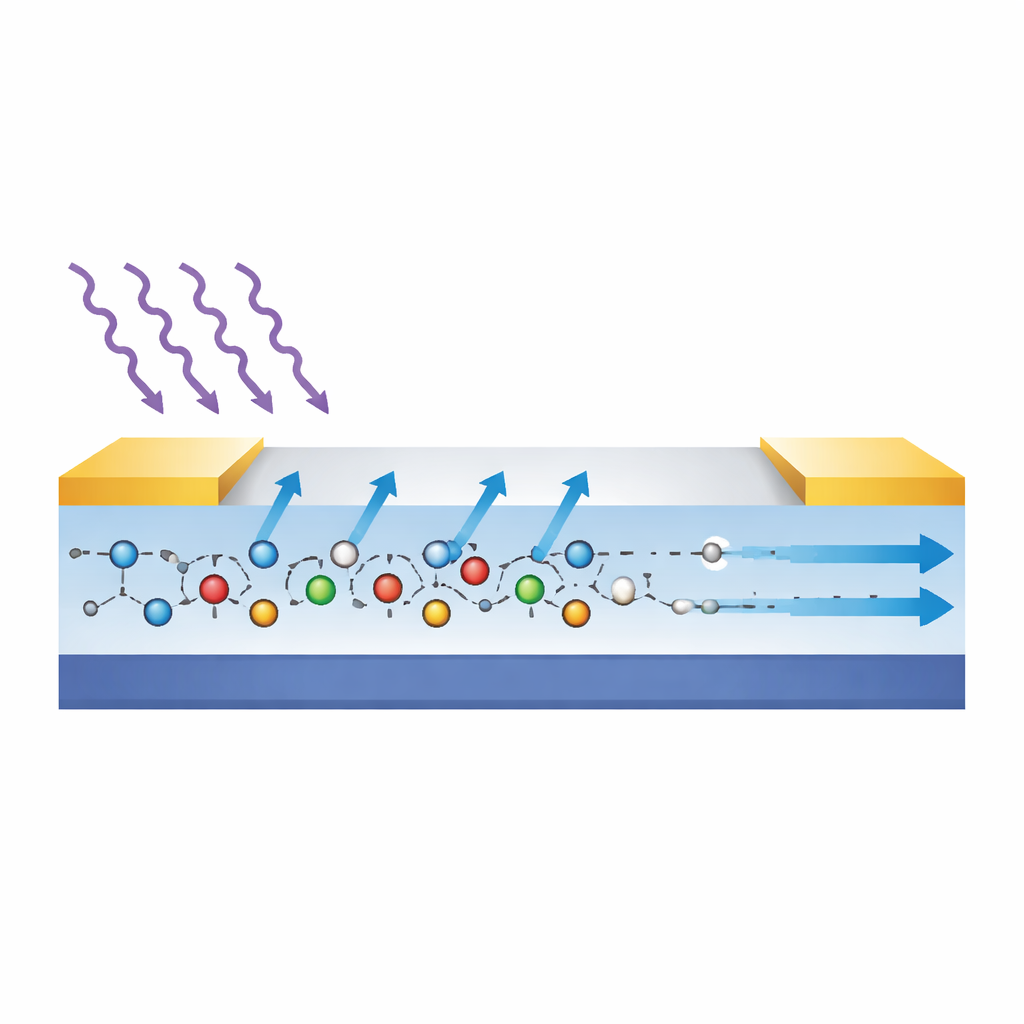
When the researchers shone 254‑nanometer deep‑UV light on the devices, all behaved as straightforward light‑activated resistors: more light produced more current. Yet their performance differed sharply. Devices grown at the highest temperature, with the largest concentration of oxygen‑related defects, showed by far the strongest response. At 900 °C, the detector reached a responsivity of about 4.2 × 10⁴ amperes per watt and an external quantum efficiency far above 100%, indicating that each incoming photon effectively produced many charge carriers in the circuit. The authors trace this gain to defect‑assisted photoexcitation: the oxygen‑related states act as stepping stones that capture and release electrons, extending their lifetime so they can circulate repeatedly through the device before recombining.
The trade‑off between strength and speed
Those same defects that amplify the signal also slow it down. Time‑resolved measurements showed that as growth temperature—and thus defect density—increased, the detectors took longer to return to their “off” state after the light was removed. The rise time when the light was switched on became slightly faster, because abundant defects and higher conductivity helped the current build up quickly. But the decay time stretched out, reflecting electrons being intermittently trapped and then released by defect sites. The result is a detector that is extremely sensitive to weak ultraviolet light but reacts sluggishly to rapid changes, a compromise that may be acceptable or even useful for applications such as low‑intensity UV monitoring or devices that mimic the slow, memory‑like responses of biological synapses.
What this means for future UV eyes
In everyday terms, the study shows that carefully introducing and tuning “good flaws” in a crystal can make ultraviolet cameras far more sensitive, even though those same flaws slightly degrade the crystal’s perfection. By adjusting the growth temperature, the researchers were able to control oxygen‑related defect states that act like temporary holding pens for electrons, turning each flash of invisible ultraviolet light into an outsized electrical response. While this comes with a cost in speed, the work offers clear guidance for designing next‑generation solar‑blind detectors, where the balance between sensitivity and response time can be set simply by how the material is grown.
Citation: Yan, S., Ding, Z., Jiao, T. et al. Boosting the responsivity of β-Ga2O3 metal–semiconductor–metal solar-blind photodetectors through oxygen-related defect states. Sci Rep 16, 10176 (2026). https://doi.org/10.1038/s41598-026-40487-6
Keywords: solar-blind photodetector, beta gallium oxide, deep ultraviolet, oxygen vacancies, photoresponsivity