Clear Sky Science · en
Compact dual-band four-port MIMO patch antenna with inverse U-shaped resonators and defected ground structure for wireless communication applications
Why tiny antennas matter to everyday gadgets
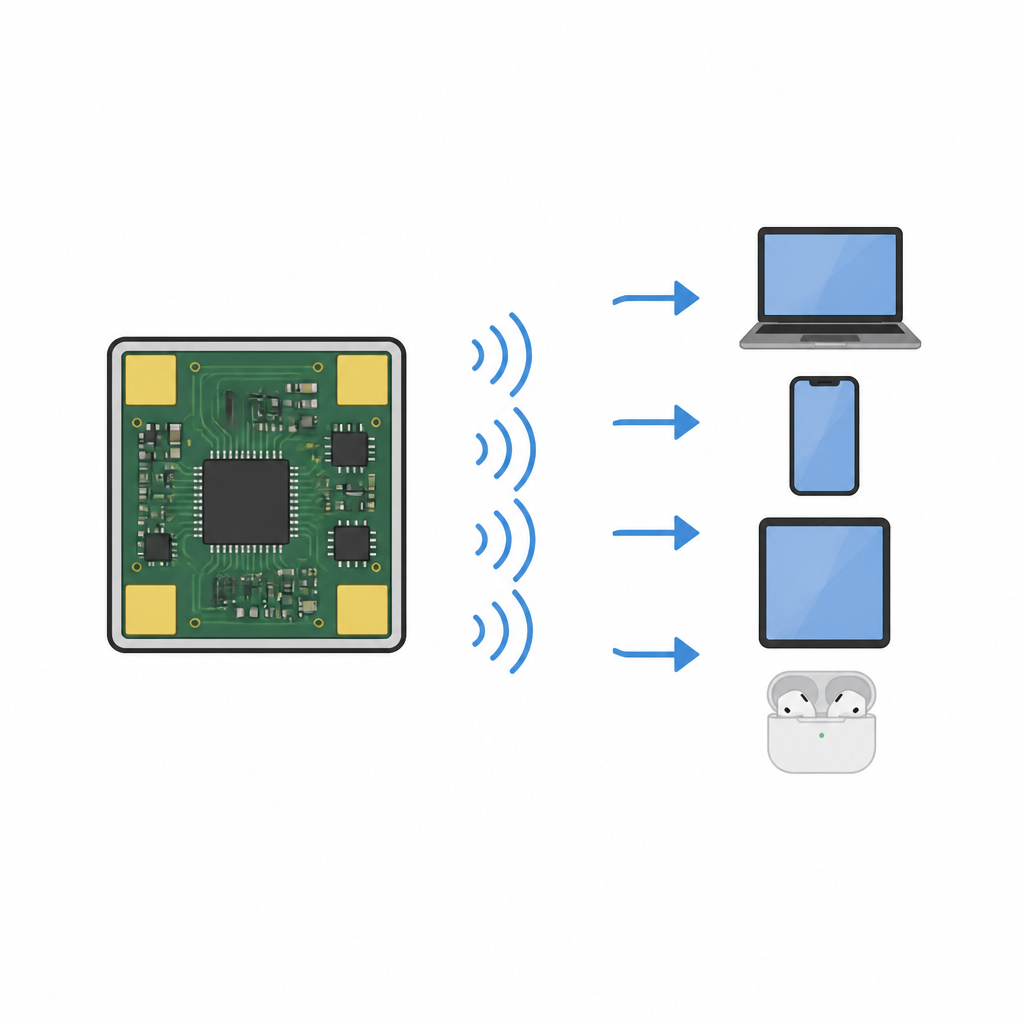
From phones and tablets to smart sensors, modern gadgets depend on antennas that can send and receive more data in less space. This paper describes a very small antenna that can fit inside compact wireless devices yet still handle fast, reliable links on two different frequency bands often used for radar, satellite, and high speed data connections.
A small square that does big wireless work
The researchers designed a four port antenna that fits on a circuit board only 38 by 38 millimeters in size, about the footprint of a small coin. Each of the four antenna pieces is arranged at a right angle to its neighbors so that the signals they send and receive disturb each other as little as possible. The antenna operates in two separate bands, one around 7.9 gigahertz and another around 11 gigahertz, both useful for advanced wireless links. Despite its tiny size, it achieves signal gains that are strong enough for practical communication in crowded electronic devices.
Shaping metal to tune the signals
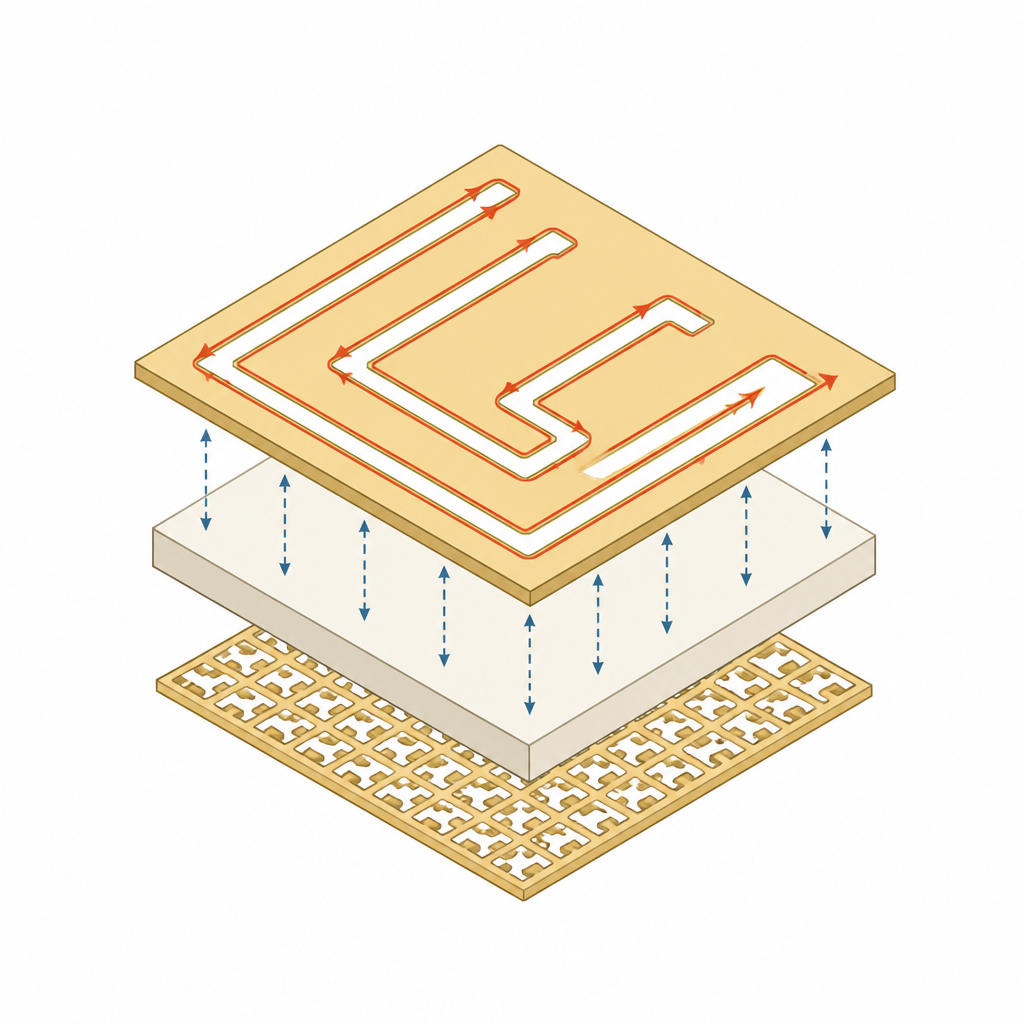
To reach this performance, the team did not just shrink a standard antenna. They sculpted the main metal patch into a staircase like outline and cut three inverse U shaped slots into it. These slots force the electrical currents to follow longer, more complex paths, which naturally produces two clear working bands instead of one. By carefully choosing the slot heights, widths, and spacing, and by adjusting the steps of the patch, they were able to widen the useful bandwidth and raise the gain at both target frequencies while keeping the antenna compact.
Cleaning up the ground to cut interference
Signals in a tightly packed device can leak along the shared metal ground plane and cause the ports of a multi antenna system to interfere with one another. To fight this, the authors reshaped the ground plane into what is called a defected ground structure, adding a slit and a small decoupling strip between the four antenna elements. This modified ground acts a bit like a built in filter: it blocks unwanted currents that would otherwise couple the ports together, while letting the desired radiation into free space. As a result, the isolation between neighboring and opposite ports stays above 25 decibels across both bands, a very high value for such a small layout.
Testing how well the ports cooperate
Because this is a multiple input multiple output system, the team checked not only raw gain but also how independently the four ports behave. They measured key diversity indicators, including how closely the signals from different ports are related, how much combined gain can be achieved, and how much information capacity is lost when several ports are active at once. In both computer simulations and lab measurements, the correlation between ports remained extremely low, the diversity gain stayed near the ideal value, and the channel capacity loss was only a small fraction of a bit per second per hertz. These results show that the four ports can work together without stepping on one another.
What this means for future devices
In simple terms, the study shows that smart shaping of metal on both the top and bottom of a tiny circuit board can deliver a compact antenna that talks on two high frequency bands while keeping four separate channels clean and strong. For a non expert, this means future wireless gadgets can be smaller yet still move data quickly and reliably, even when several antennas are squeezed into the same limited space.
Citation: Naik, K.K., Phaneendra, C.N., Zidan, M.S. et al. Compact dual-band four-port MIMO patch antenna with inverse U-shaped resonators and defected ground structure for wireless communication applications. Sci Rep 16, 15214 (2026). https://doi.org/10.1038/s41598-026-40390-0
Keywords: MIMO antenna, dual band antenna, compact wireless, patch antenna design, defected ground structure