Clear Sky Science · en
Research on the socio-spatial resilience evaluation and evolution of the central area of Chengdu in transitional China
Why the strength of a city’s neighborhoods matters
When a city faces floods, economic slowdowns, or rapid redevelopment, some neighborhoods bounce back quickly while others struggle for years. This study looks closely at that difference in the heart of Chengdu, a fast-growing megacity in western China. By tracing how different kinds of neighborhoods changed between 2000 and 2020, the authors show that resilience is not evenly spread across the map—and that the shift from a planned to a market economy has reshaped which areas thrive and which remain vulnerable.
Looking beyond lines on a government map
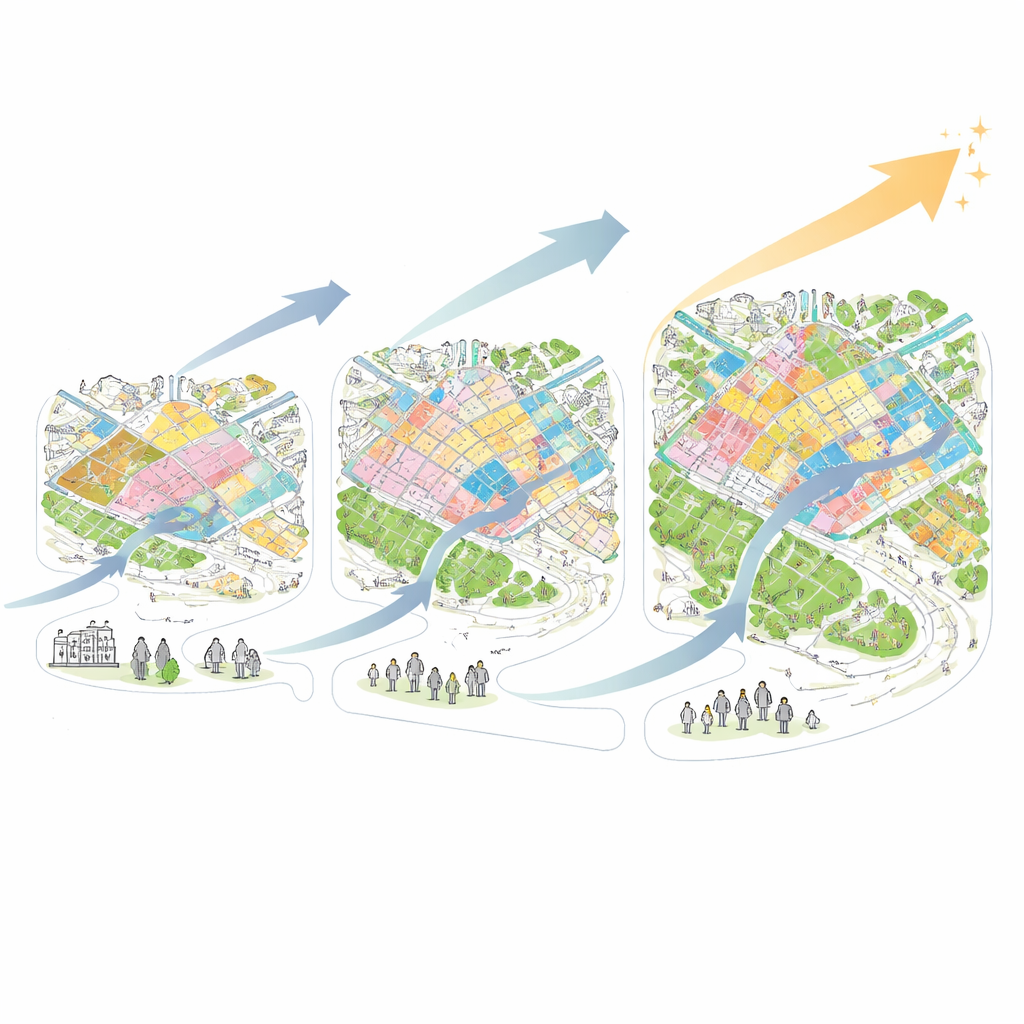
Most city statistics are reported for large administrative units such as districts. The authors argue that these units blur the reality of everyday urban life: people experience risk and support at the scale of their communities, not entire districts. Drawing on three national censuses and planning documents, they regrouped Chengdu’s central area into 12 types of “social areas,” such as middle-class neighborhoods, working-class zones, migrant tenant districts, and ethnic minority communities. For each type, they built a wide-ranging scoreboard of 59 indicators covering eight aspects of resilience, including jobs, population structure, public institutions, social ties, the natural environment, infrastructure, and urban form. Using data-driven weighting and a method that compares each area to the best and worst observed conditions, they tracked how these neighborhood types changed over two decades.
How Chengdu’s urban core became more resilient overall
Across the central city, the combined resilience score rose markedly from 2000 to 2020. The fastest gains came in the 2000–2010 decade, when national programs such as the Western Development Strategy attracted investment and high-tech firms. Economic resilience surged as traditional factories gave way to services, electronics, and cultural industries, and as employment opportunities diversified. Engineering resilience also strengthened: transport links, utilities, and building standards improved, boosting the city’s ability to withstand shocks like earthquakes or extreme weather. However, after 2010 growth slowed, and the main bottlenecks shifted from physical infrastructure to more intangible factors such as community trust and the reach of public institutions.
Winners, strugglers, and the cost of redevelopment
The picture becomes more complex when the focus narrows to specific social areas. Middle-class neighborhoods—with stable jobs, good schools, and strong public services—consistently ranked among the most resilient, especially by 2020. Working-class areas, once held back by declining state-owned factories and layoffs, improved sharply after targeted restructuring programs and new employment zones were introduced. In contrast, zones dominated by migrant commercial workers and low-income tenants remained fragile. These areas often sit at the urban fringe, where infrastructure, safety, and social services lag behind, and where residents move frequently in search of work. Large-scale urban renewal also took a toll: the demolition and rebuilding of old communities broke long-standing local networks, pushing many poorer residents outward and weakening the social glue that helps neighborhoods cope with crises.
The hidden rise, fall, and rebound of community bonds
One of the study’s most striking findings is that social capital—the webs of trust, mutual aid, and local organizations that connect residents—did not rise steadily with economic growth. Instead, it followed a V-shaped curve. From 2000 to 2010, rapid redevelopment and mass relocations eroded neighborhood ties; residents reported more crime and less sense of safety, and participation in community life dropped. Only after 2010, as Chengdu experimented with community-building programs, support for social organizations, and “embedded” multi-ethnic neighborhoods, did social capital begin to recover. By 2020, some working-class and minority areas had developed new forms of cooperation and mediation that made them more capable of handling disputes and everyday risks, even if their material conditions were still catching up.
A city cycling through growth, shock, and renewal
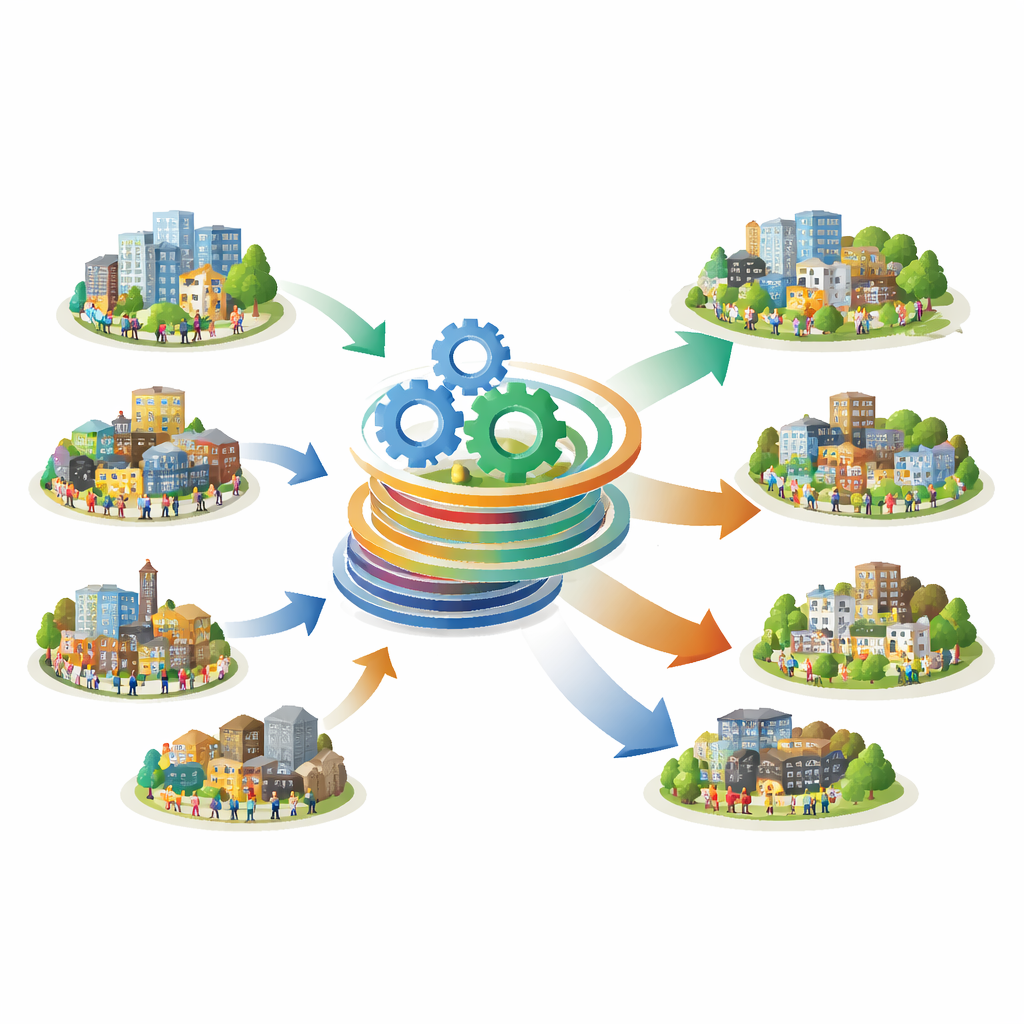
Seen through the lens of resilience theory, Chengdu’s story resembles an ecological “adaptive cycle.” During the early 2000s, capital and infrastructure poured into the city’s core, locking in growth and stability. Then, pressures from redevelopment and inequality triggered a partial release of these rigid structures: low-income and migrant areas, in particular, saw social strain and declining community cohesion. In the most recent decade, a reorganization phase has begun, marked by new institutions, community initiatives, and more fine-grained planning. The study concludes that building a truly resilient city requires recognizing the very different starting points of each social area and crafting tailored policies—strengthening strong neighborhoods without neglecting weaker ones, and pairing economic upgrades with efforts to rebuild trust, inclusion, and local voice.
Citation: Xu, C., Liu, W., Zhang, S. et al. Research on the socio-spatial resilience evaluation and evolution of the central area of Chengdu in transitional China. Sci Rep 16, 11427 (2026). https://doi.org/10.1038/s41598-026-40388-8
Keywords: urban resilience, Chengdu, social inequality, urban renewal, community networks