Clear Sky Science · en
Influence of pore structure on grain bulk modulus of underground rock masses under hydro-mechanical conditions
Rocks That Hold Our Future Underground
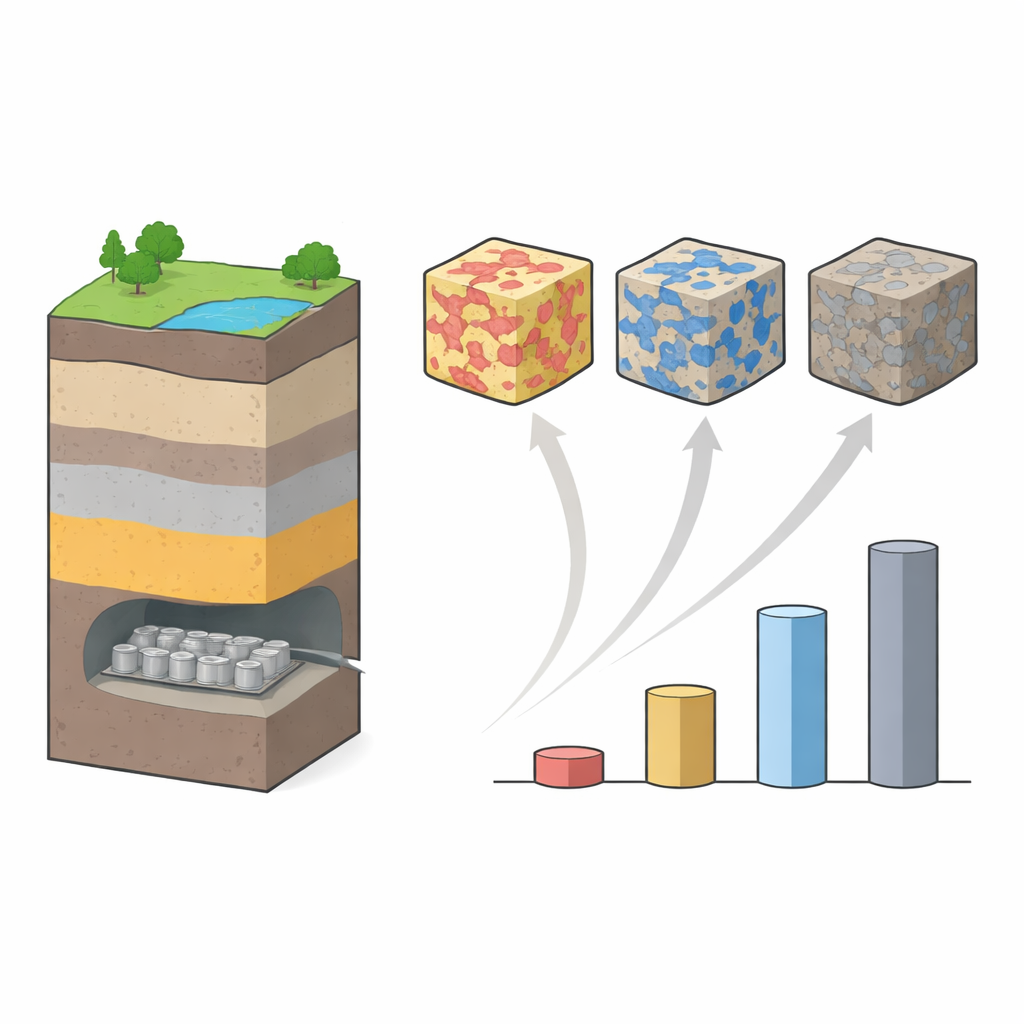
As we look for safe places to store nuclear waste, CO₂, and even liquid hydrogen, we increasingly turn to deep rock formations far below our feet. But these rocks are not solid blocks; they are riddled with tiny pores whose shapes and connections quietly control how the rock squeezes, cracks, and ultimately protects what we put inside. This study asks a deceptively simple question with big consequences: how stiff are the mineral grains inside real rocks, and how much does the hidden architecture of their pores change that answer?
Why Rock Stiffness Matters Underground
Engineers describe how hard it is to compress a material with a quantity called the bulk modulus. For deep geological storage, a special version, the grain bulk modulus, is crucial: it captures how the mineral framework itself shrinks when pore water pressure and surrounding rock pressure change. This number feeds directly into computer models that predict how underground caverns deform, how fractures open or close, and how fluids move over decades to centuries. If we overestimate this stiffness, designs for waste repositories or energy storage sites may look safer on paper than they truly are in rock.
Testing Real Rocks Under Equal Pressure
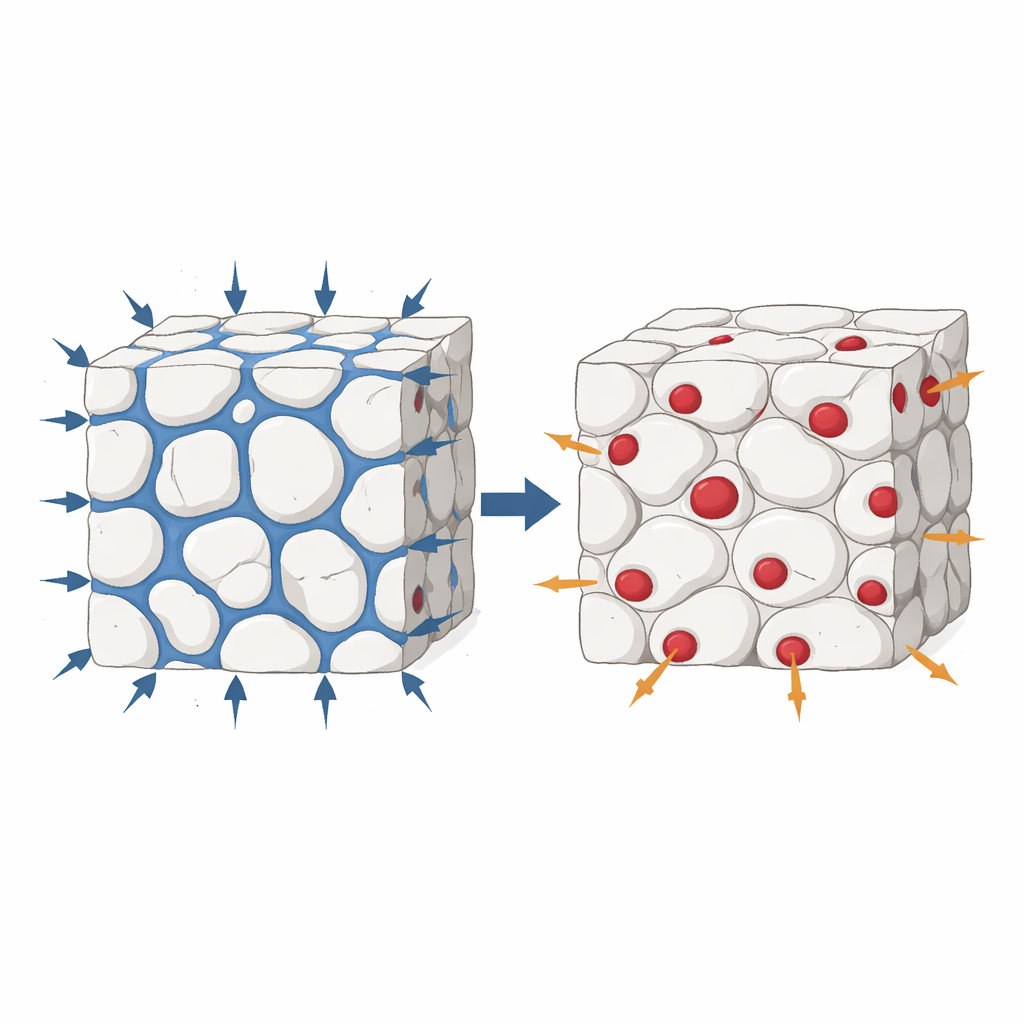
To measure this grain-scale stiffness directly, the authors used a specialized "unjacketed" test on three very different rocks: two porous sandstones (Berea and Idaho) and a dense Korean granite (Hwangdeung). In this test, high fluid pressure is applied at once to the outside of a rock cylinder and to the water in its pores, so the effective stress on the rock frame is zero and only the grains themselves compress. By tracking tiny axial and circumferential deformations with extensometers, the team built precise curves of volume change versus pressure up to 50 megapascals. From the slopes of these curves, they obtained grain bulk moduli of about 29 GPa for Berea sandstone, 33 GPa for Idaho sandstone, and 38 GPa for Hwangdeung granite.
Comparing Minerals to Reality
There is a popular shortcut for estimating grain stiffness: measure which minerals are present in a rock, look up each mineral’s known stiffness, and average them using a mathematical recipe known as Voigt–Reuss–Hill averaging. The team performed detailed X-ray diffraction analyses to determine mineral mixtures in their samples—quartz-rich Berea sandstone, albite- and feldspar-rich Idaho sandstone, and a granite rich in albite, microcline, and biotite. As expected, these calculations predicted that the granite should be stiffest and Berea the softest. But the numbers did not line up: for all three rocks, the theoretical values were higher than the experimental ones, by about 7% for Berea sandstone and over 30% for Idaho sandstone and the granite. Clearly, something in the real rock structure was allowing more compression than the mineral recipe alone would suggest.
Hidden Pores and Extra Squeezing
To uncover the missing piece, the researchers turned to X-ray computed tomography, creating three-dimensional images of the pore networks at micrometer resolution. They then distinguished pores that form continuous pathways (connected pores) from those that are sealed off inside the grain framework (isolated pores). Idaho sandstone turned out to have many more pores overall, but almost all of them were connected; isolated pores were rare. Berea sandstone, in contrast, had far fewer pores in total but a much larger fraction that were isolated. These sealed cavities act like weak spots: under pressure, stress concentrates around them, causing extra local deformation not captured in mineral-based models. The result is a lower effective grain stiffness, even if the overall porosity is similar or lower.
From Laboratory Insight to Practical Use
Recognizing that unjacketed tests are difficult and expensive to perform for every rock type, the authors went one step further. By directly comparing their experimental measurements with theoretical Voigt, Reuss, and Hill estimates, they derived simple linear correction relations. These relations adjust mineral-based predictions downward to better match real rock behavior, implicitly accounting for the effects of isolated pores and other small-scale features. While based on a limited set of rocks, the framework shows how to turn mineralogical data into more realistic stiffness values when full hydro-mechanical testing is not feasible.
What This Means for Storing Energy and Waste
For a layperson, the take-home message is that the way pores are arranged inside rocks strongly influences how those rocks will behave when used to store hazardous or valuable materials underground. Not all pores are equal: a rock packed with well-connected pores can actually be stiffer at the grain level than a rock with fewer but more isolated pores. Ignoring these subtle structures leads to overly optimistic models of underground stability. By combining careful laboratory testing, mineral analysis, and 3D imaging, this study offers a more accurate way to estimate how much rocks will compress, helping improve the safety and reliability of deep repositories for radioactive waste, CO₂, and future underground energy storage systems.
Citation: Kim, MJ., Choi, J., Park, ES. et al. Influence of pore structure on grain bulk modulus of underground rock masses under hydro-mechanical conditions. Sci Rep 16, 11489 (2026). https://doi.org/10.1038/s41598-026-40373-1
Keywords: pore structure, grain bulk modulus, unjacketed test, poroelasticity, deep geological storage