Clear Sky Science · en
Label-free saliva screening platform using M13 bacteriophage-based 3D plasmonic structures for MRONJ diagnosis
Why a spit test for jaw trouble matters
Many people who receive powerful drugs to protect their bones—such as patients with cancer or osteoporosis—face a small but serious risk of jawbone death, a condition called medication-related osteonecrosis of the jaw. It can cause chronic pain, infection, and tooth loss, yet current scans often miss the disease in its early stages. This study introduces a simple saliva test, paired with an advanced sensor and artificial intelligence, that could one day help doctors spot trouble in the jaw before it becomes severe.
A hidden risk from common bone drugs
Jawbone damage linked to antiresorptive and antiangiogenic medicines has puzzled doctors for over two decades. The condition develops through a mix of drug effects and patient factors such as other illnesses, chemotherapy, or steroid use. People receiving high doses of these drugs, especially those with cancer, are at the greatest risk. Today, diagnosis relies on symptoms and imaging scans like X-rays and cone-beam CT. But very early disease may not show clear changes on these scans, particularly before the bone is exposed, which makes it easy to miss or to mistake for something else.
Listening to chemistry in a drop of saliva
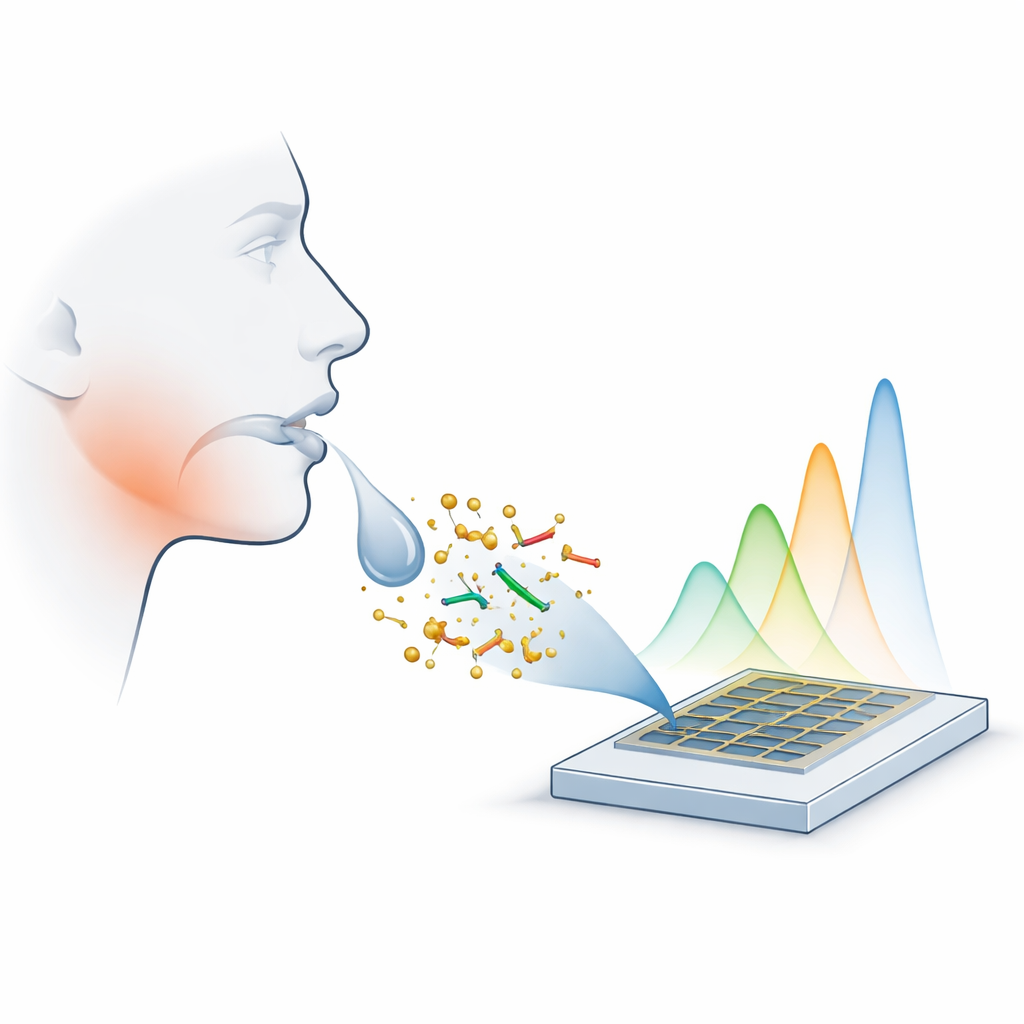
Saliva quietly carries a chemical record of what is happening in the mouth and body, including hundreds of small molecules and proteins. Earlier studies hinted that patients with this jaw condition have distinct patterns in their saliva, but standard lab tools struggled to pick out clear, consistent markers. The researchers turned instead to surface-enhanced Raman scattering, a light-based method that can read the overall pattern of many molecules at once without adding labels. When laser light hits specially prepared metal surfaces, tiny regions called “hot spots” greatly amplify the light signal coming from nearby molecules, making even trace components in saliva easier to detect.
Building a tiny amplifier with virus and gold
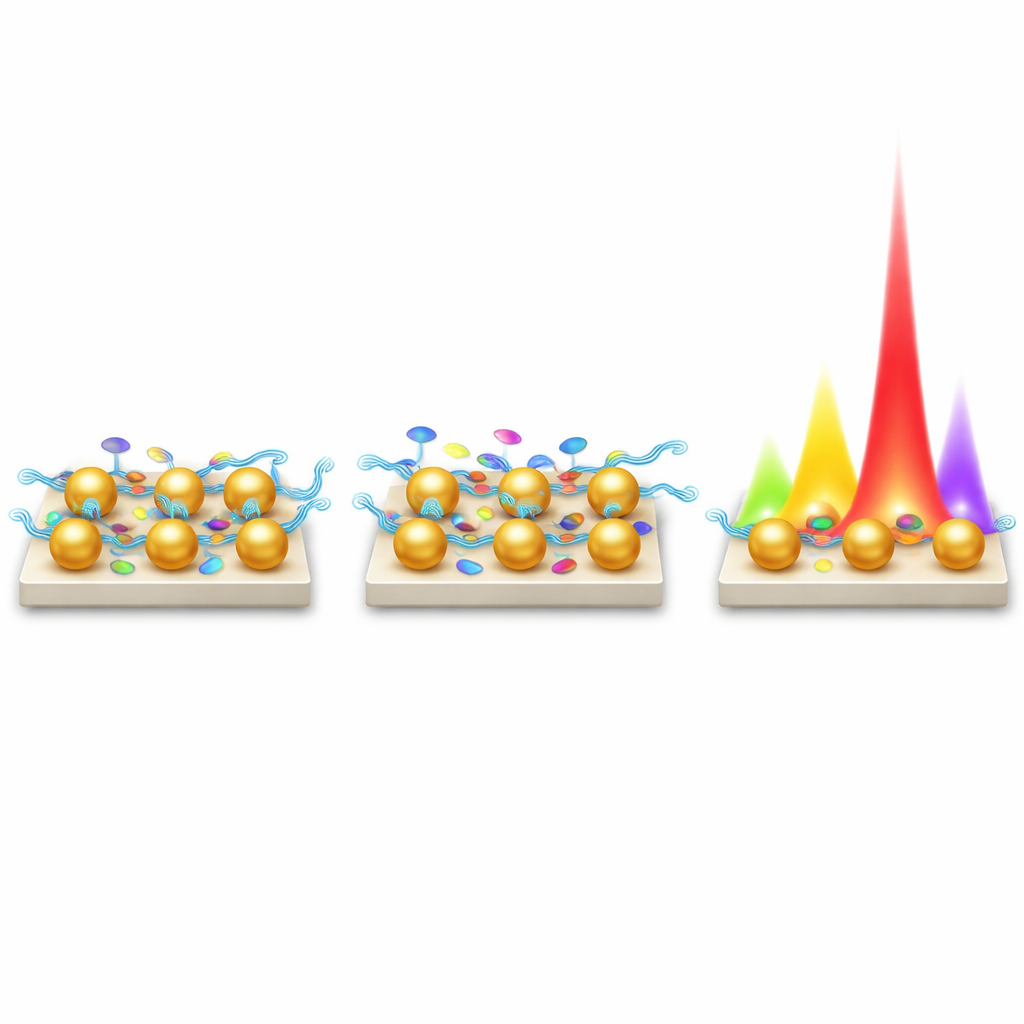
To create a sensitive saliva sensor, the team mixed three ingredients into what they call a “metabolite ink”: gold nanoparticles, a harmless filament-shaped virus called M13 bacteriophage, and a small volume of saliva. Using a controlled coating method, this ink was drawn across a glass-like chip to build a three-dimensional plasmonic structure, a carefully spaced forest of gold particles and virus strands. The gold particles amplify the light signal, while the M13 virus helps keep them from clumping, setting up the ideal gaps where hot spots form. By adjusting virus concentration, the researchers tuned the distance between particles to maximize signal strength and maintain stable, repeatable measurements across the chip.
Cleaning noisy data for machine learning
Because saliva composition can change with diet, stress, and other daily factors, the raw light spectra are messy. The team built a multi-step cleaning pipeline to prepare the data for machine learning. First, they removed rare “spike” artifacts from cosmic rays and smoothed out random noise from the laser and detector. Then they normalized each spectrum to a stable part of the signal so different samples could be fairly compared. Finally, they used a statistical measure called the Pearson correlation coefficient to identify and discard outlier spectra that did not resemble typical samples from their group, trimming away readings likely distorted by temporary conditions or technical glitches.
Teaching a computer to spot sick jaws
With the cleaned spectra in hand, the researchers trained several types of computer models to distinguish between saliva from patients with jawbone damage and from healthy controls. They focused on the portion of the signal richest in biological information and carefully split the data so that all measurements from a single person stayed in either training or testing, but never both. Among three tested approaches, a multi-layer perceptron—a kind of neural network—performed best. After fine-tuning its settings with a search strategy that balances trial and error with probability, the model could correctly flag all patients in the test set (100 percent sensitivity) while correctly reassuring most healthy individuals (about 85 percent specificity), yielding a strong overall performance score.
What this could mean for patients
The study shows that a label-free saliva test, combined with a specialized gold-and-virus sensor and well-designed machine learning, can separate patients with medication-related jawbone damage from healthy peers with high accuracy in this small group. The work is still at an early stage: most patients had mid-stage disease, and the control and patient groups did not perfectly match in age and sex. Larger, more balanced studies will be needed before the method can be used in clinics, especially for catching the earliest, hardest-to-see cases. Even so, this approach points toward a future in which a quick, painless saliva test could help monitor at-risk patients, guide referrals to dental specialists, and potentially be adapted to detect other diseases that leave chemical fingerprints in spit.
Citation: Kim, Y.H., Kwon, JJ., Jang, M. et al. Label-free saliva screening platform using M13 bacteriophage-based 3D plasmonic structures for MRONJ diagnosis. Sci Rep 16, 10378 (2026). https://doi.org/10.1038/s41598-026-40342-8
Keywords: saliva diagnostics, jawbone disease, Raman spectroscopy, plasmonic sensors, machine learning in medicine