Clear Sky Science · en
Euro-Asian hybrids of Echinococcus multilocularis from red foxes in northern and northeastern Poland result from secondary contact between long-isolated populations
Why a fox parasite matters to people
Deep in the intestines of wild foxes lives a tiny tapeworm, Echinococcus multilocularis, that can cause a severe, often deadly liver disease in humans. This study looks at how different genetic varieties of this parasite have met and mixed in northern and northeastern Poland. Understanding where these strains come from and how they spread is crucial for predicting future risk to people, pets, and livestock, and for tracking how human actions have quietly reshaped wildlife parasites across continents.
Two distant families meet again
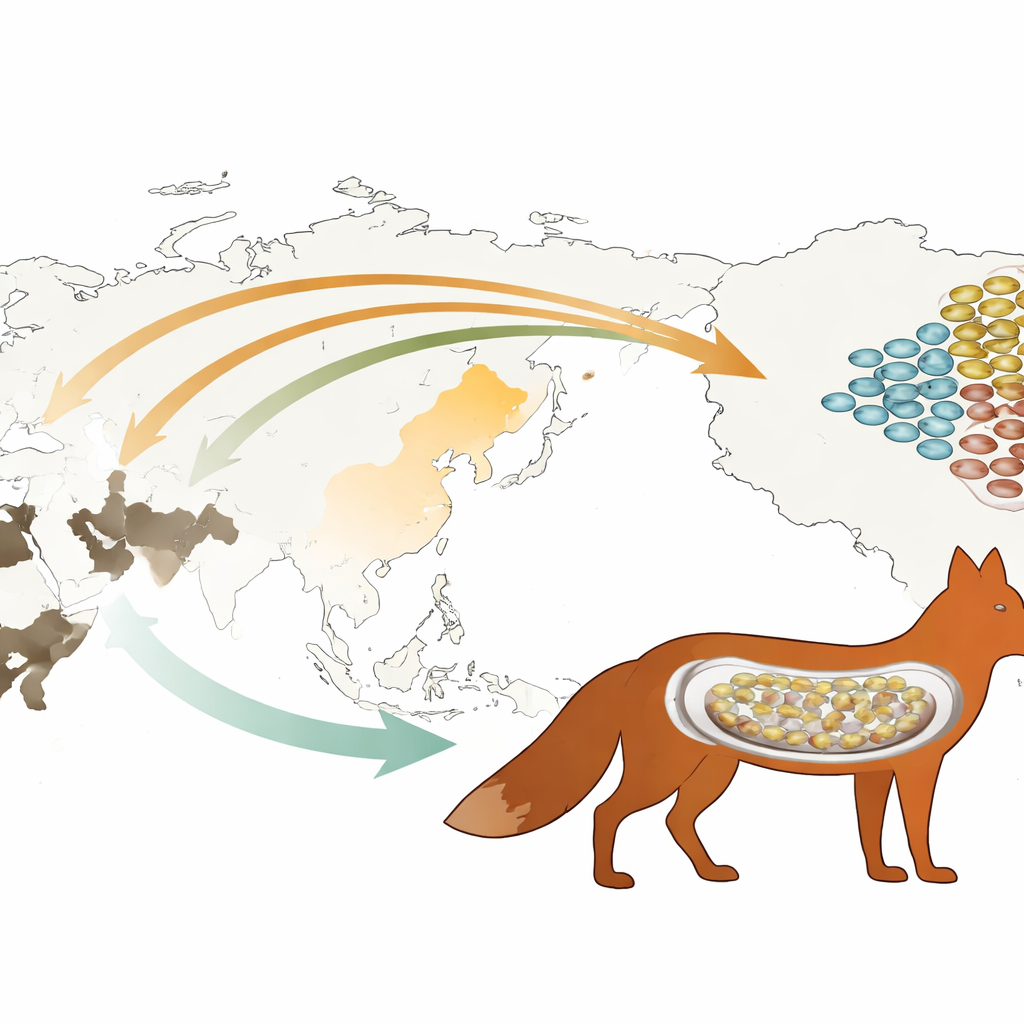
Researchers focused on parasites collected from red foxes in several districts of northern and northeastern Poland. Earlier work had hinted that some local worms carried genetic signatures normally found in Asia, thousands of kilometers away, and that these Asian-like worms could also infect pigs and humans. In this new study, the team sequenced a full mitochondrial gene (cox1) from 252 individual worms and compared those sequences with earlier data from Poland, other parts of Europe, Asia, and North America. They found six distinct genetic variants, or haplotypes, three of them previously unknown, which together formed two clear families: a common European group and a rarer Asian group.
Tracing a long separation and a recent reunion
By examining how often genetic differences appeared between worms, and by building evolutionary trees, the authors reconstructed the parasite’s deeper history. The European and Asian families turned out to be almost completely separated genetically, suggesting they had followed independent paths for tens of thousands of years. A timing analysis estimated their split at around 26,000 years ago, roughly around the last ice age. Yet in present-day Poland, these long-isolated lineages now coexist in the same fox population. The pattern of genetic differences showed two peaks—one reflecting minor variation within each family, and another representing the large gap between them—consistent with a recent “secondary contact” where two once-isolated lineages overlap again.
Hybrids in fox guts
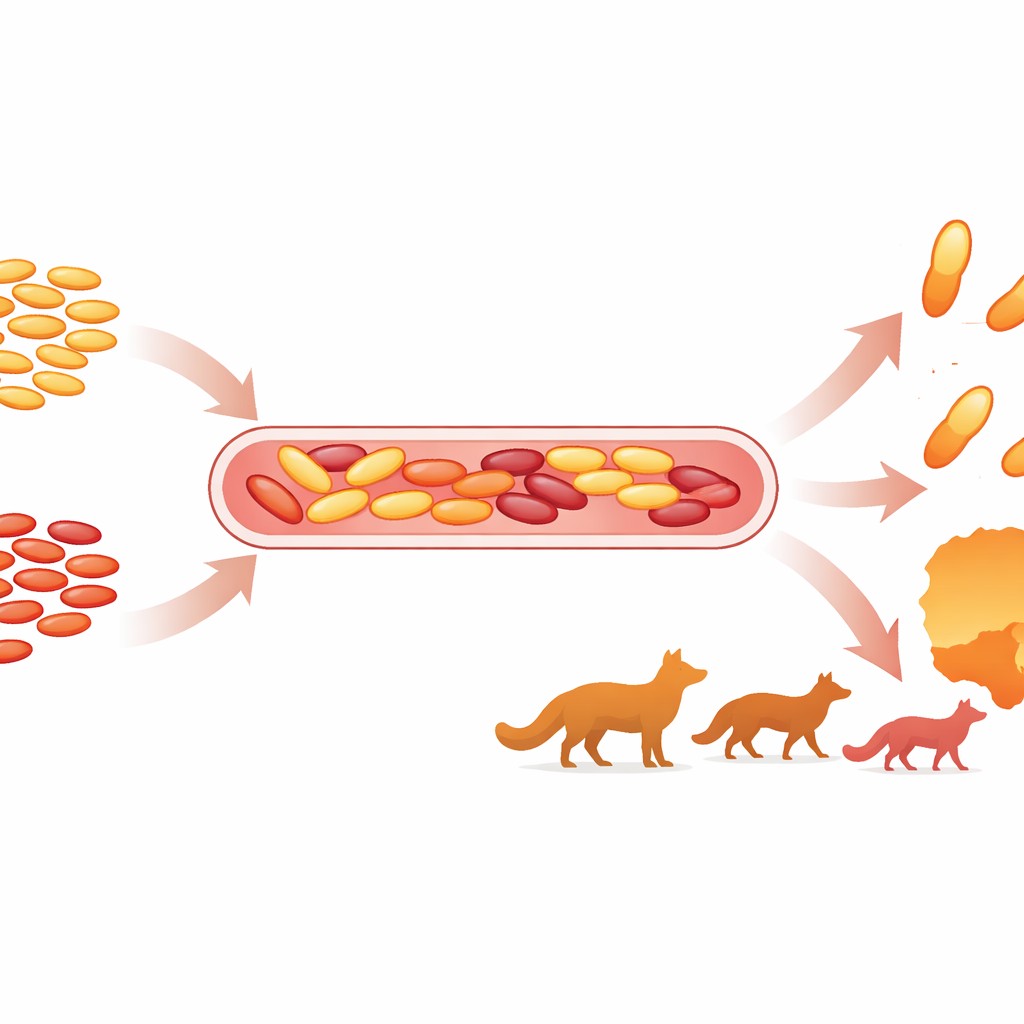
When the team compared mitochondrial data with earlier results from a nuclear DNA marker, they discovered a striking number of mixed-origin worms. About four-fifths of the parasites were purely European, a small fraction were purely Asian, and more than one in ten were hybrids carrying a European signature in one part of the genome and an Asian signature in another. These hybrids were especially common in the study area compared with the rest of Poland. Within individual foxes, some carried only European worms, some only Asian, and others hosted mixtures of European, Asian, and hybrid parasites simultaneously. This local “melting pot” inside fox intestines offers ideal conditions for gene exchange between formerly separate lineages.
How people helped the parasite travel
To explain how Asian-type worms arrived so far west, the authors turned to historical records. During the mid-20th century, raccoon dogs were repeatedly brought from the Soviet Far East and released across Eastern Europe for fur production. These wild canids spread rapidly, crossing borders into Poland and beyond. The genetic patterns in the Polish worms, and their close resemblance to Asian material from China, Japan, and parts of Russia, fit the idea that infected raccoon dogs—or other wild carnivores that later picked up the parasite—carried Asian strains into Europe. The authors also applied a novel, alignment-free analysis that treats DNA sequences as shapes in four-dimensional space; this independent method grouped the same haplotypes and reinforced the picture drawn by standard genetic tools.
What this means for health and ecology
The study concludes that northern and northeastern Poland are now a contact zone where ancient European and Asian tapeworm lineages meet and interbreed, producing Euro-Asian hybrids. While the work does not yet show whether these hybrids are more dangerous to humans, it confirms that parasites can be moved long distances through human actions and then spread silently through wildlife. For public health officials, this underlines the need for surveillance of both wild carnivores and farm animals, especially in regions linked by past animal introductions. For ecologists, it offers a stark example of how historical decisions—such as releasing raccoon dogs nearly a century ago—continue to shape the genetic landscape of pathogens today.
Citation: Gładysz, P., Bielińska-Wąż, D., Wąż, P. et al. Euro-Asian hybrids of Echinococcus multilocularis from red foxes in northern and northeastern Poland result from secondary contact between long-isolated populations. Sci Rep 16, 9986 (2026). https://doi.org/10.1038/s41598-026-40313-z
Keywords: fox tapeworm, parasite genetics, zoonotic disease, wildlife invasions, Poland