Clear Sky Science · en
Research on stability analysis and control technology of roadways in the underlying isolated island working face
Why underground roads matter
Deep below northern China, coal miners rely on underground roadways to move people, air, and equipment. If these tunnels deform or collapse, the mine must slow or stop, putting workers at risk and threatening a major source of energy. This paper examines a particularly tricky situation: a coal panel that sits like an “island” under older, already mined-out areas and leftover coal pillars. The authors show how stresses from these old workings concentrate in the rock and then design a support system that keeps the new roadway stable and safe.
Layers of old and new workings
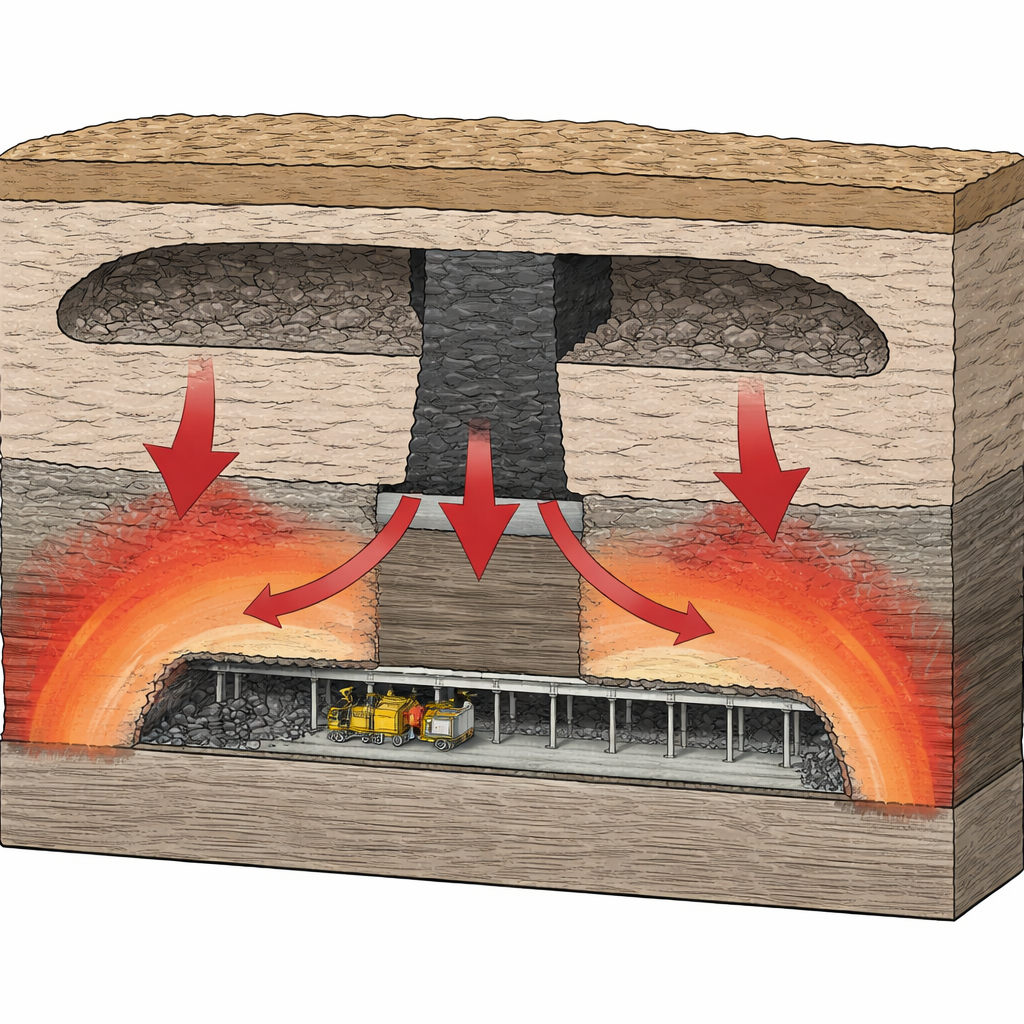
The study focuses on the Yanghuopan coal mine in Shaanxi Province, where a long, narrow coal panel—called the 30,119 working face—lies beneath another seam that has already been mined. Above it are empty voids (goafs) and solid blocks of coal left behind as pillars. This layout creates an “isolated island” face surrounded on three sides by mined-out zones. The roadway of interest, which returns ventilation air from the face, must pass beneath both low-stress goaf areas and high-stress residual coal pillars. Because the roof and floor rocks are relatively strong sandstones and siltstones, but the stress field is highly uneven, a one-size-fits-all tunnel support scheme would be unsafe and wasteful.
How leftover pillars push on lower seams
The researchers first use rock mechanics theory to understand how force from the upper coal pillars is transmitted downward. They treat a pillar as a strip of loaded rock pressing on a much thicker floor and calculate how this concentrated load spreads with depth. Their analysis shows that directly under a residual coal pillar, the lower seam experiences a vertical stress about 1.6 times higher than the natural background level, and this influence extends more than 60 meters sideways along the lower seam. In other words, even though the upper seam has already been mined, the leftover pillar continues to focus weight onto the rocks and tunnels below, creating distinct zones of stress increase and stress relief.
Simulating stress, damage, and movement
To see how these forces play out around the roadway, the team builds a three-dimensional computer model of the rock layers and mining sequence using numerical simulation software. They “mine” the upper seam to create goafs and pillars, then simulate excavation of the lower 3–1 coal seam and the advance of the 30,119 face in stages. The model reveals five clear regions beneath the upper workings: two low-stress zones under goafs, two strong concentration zones under the first and second residual pillars, and a normal-stress zone beneath unmined coal. As the lower face advances, the peak extra load ahead of it consistently appears about eight meters in front of the face, but its size varies sharply with position: stresses are greatest beneath the first residual pillar and somewhat lower beneath the second.
Where the roadway hurts the most
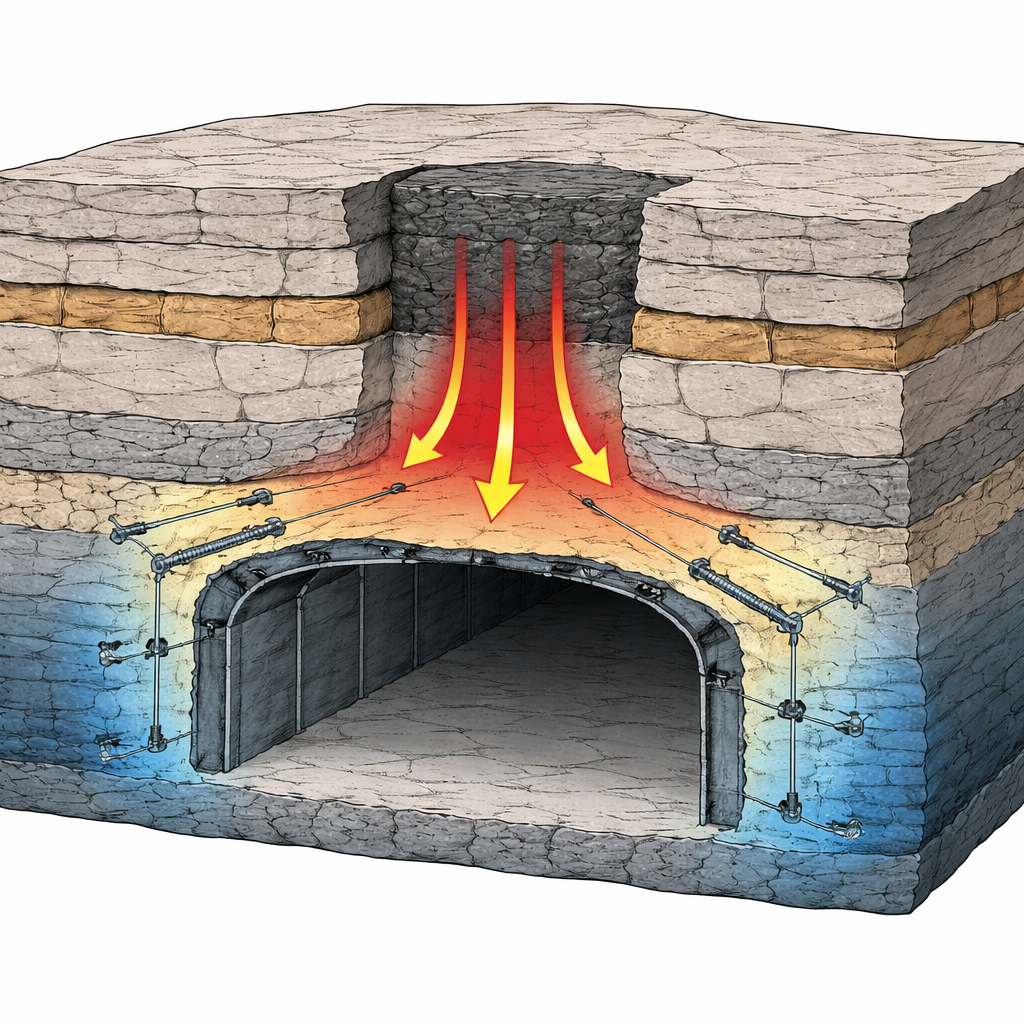
The simulations also track how much of the rock around the roadway yields or cracks (the “plastic zone”) and how much the roof and walls move inward. When the roadway lies under stress-relief regions, damage bands around it are relatively shallow and deformations modest. Under the first residual pillar, however, concentrated load and advancing face pressure combine to deepen the fractured zone in the roof and sidewalls and to drive much larger roof sag and wall convergence. Under the second pillar, the response is still serious but milder: roof movement is about half that beneath the first pillar, and movement of the solid coal wall drops by more than three quarters. These contrasts confirm that roadway behavior is controlled not only by rock type but by the complex stress history imposed by past mining.
Designing support where it is really needed
Guided by these findings, the authors divide the roadway into two types of control zones. In stretches beneath goafs and near-normal stress, they adopt a conventional support pattern using rock bolts, cables, and mesh. Beneath the high-stress reaches influenced by residual pillars, they strengthen the design: denser roof bolts, long cable anchors arranged in a reinforcing pattern, and added sidewall bolts to “stitch” the coal pillar and ribs together. They then verify performance underground by monitoring roof settlement, sidewall convergence, and the loads carried by bolts and cables at several stations as the face advances. Measured roof sag stays within about one centimeter and wall closure within a few millimeters, while support loads remain far below their capacity, indicating a comfortable safety margin.
What this means for safer mining
In practical terms, the study shows that tunnels under isolated island panels can be kept stable if engineers first map how old pillars and goafs reshape the stress field and then tailor support to each zone. Rather than over-reinforcing everywhere or risking failure in hidden hot spots, the approach concentrates heavy support where stress is highest and uses lighter systems where rock is naturally relieved. The result at Yanghuopan is a roadway that stays open and serviceable as mining progresses, offering a template for other mines that must work new coal seams beneath complex networks of older workings.
Citation: Gao, X., Wang, Y. & Li, YM. Research on stability analysis and control technology of roadways in the underlying isolated island working face. Sci Rep 16, 9903 (2026). https://doi.org/10.1038/s41598-026-40307-x
Keywords: coal mine roadway stability, isolated island working face, residual coal pillar stress, numerical mining simulation, underground support design