Clear Sky Science · en
Development and justification of technical solutions for the design of a long-base flat car for the transportation of high-capacity containers
Why smarter freight cars matter
When you buy fresh fruit from abroad or order something online, there is a good chance it spent part of its journey inside a metal container on a train. As trade grows, railways must move more containers faster and at lower cost, without compromising safety. This paper explores how a new type of long, low freight wagon could carry more heavy containers on each trip while staying safe and durable, using modern computer simulation and full‑scale testing to fine‑tune its design.
Making better use of every meter
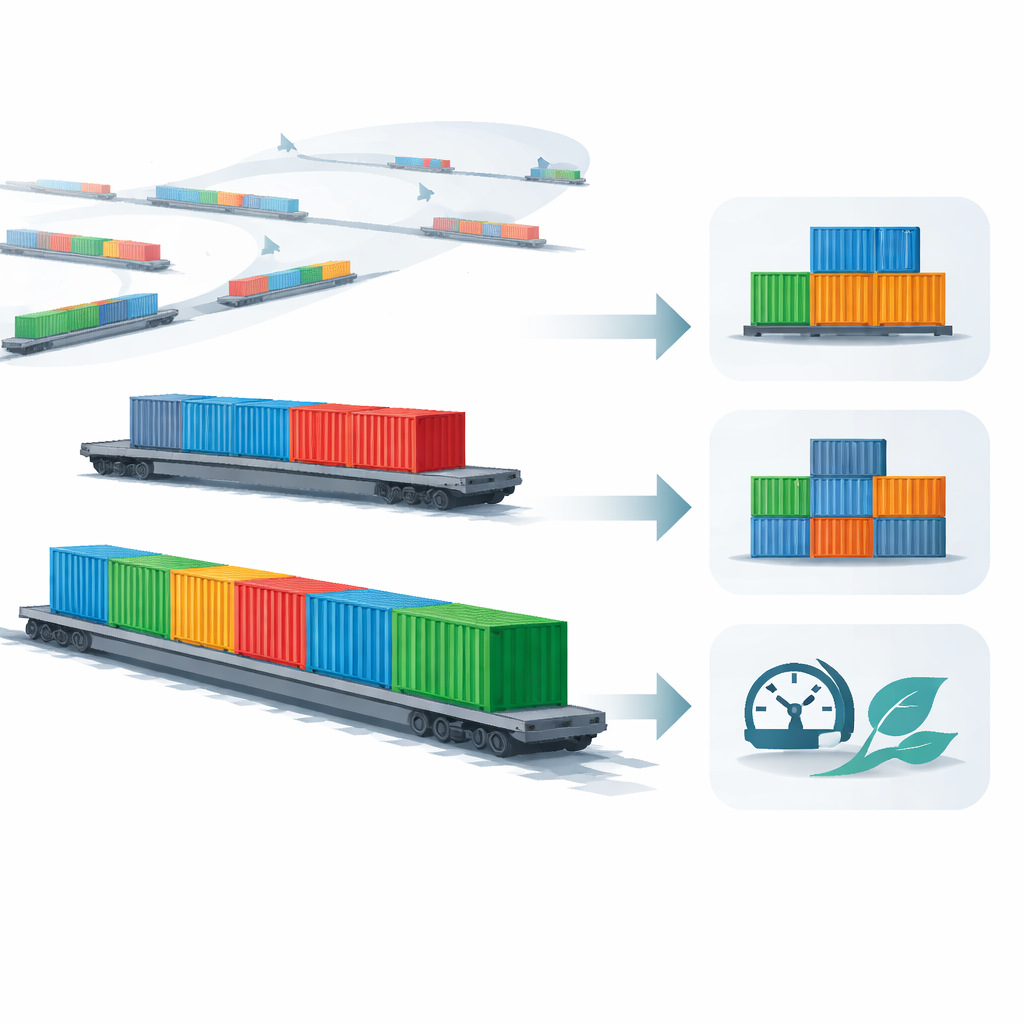
Many flat freight cars now in use in Uzbekistan and neighboring countries can hold either one 40‑foot container or two 20‑foot containers, leaving part of the car’s length empty. That wasted space means the wagon’s allowed carrying capacity is not fully used, so more wagons and trips are needed to move the same amount of cargo. The authors argue that longer flat cars—able to take four 20‑foot containers or two 40‑foot containers plus extra load—can use that space much more effectively, boosting the amount of goods hauled per train and cutting the cost per ton of cargo.
Choosing a practical starting point
Designing a better wagon is not just about squeezing in more cargo. The empty weight of the car, the strength of its frame, and the limits of local manufacturing all matter. The team began by comparing several existing flat‑car models from different manufacturers, looking at how much they can carry, how heavy they are, and how much load each axle must bear. They chose an existing widely used design, known as model 13‑644, as their starting point because it already fits the 1520 mm railway network common in the region and offers a good balance of strength and practicality using steels that local factories can handle.
Redesigning the hidden skeleton
Under the containers, the flat car is essentially a skeleton of steel beams welded together. The authors focused on the key beams that run along and across the car, especially a long central beam that carries much of the load. They evaluated several standard beam sizes made from a tough low‑alloy steel, using engineering software based on the finite element method to predict how these beams bend and stretch under heavy loads. The goal was to find a beam that is light yet strong, with stresses well below the metal’s limits. Their calculations showed that a welded I‑beam about 700 mm high provided the best trade‑off: it kept stresses safely low while reducing the car’s empty weight enough to increase its payload by about one ton.
Putting the new frame to the test
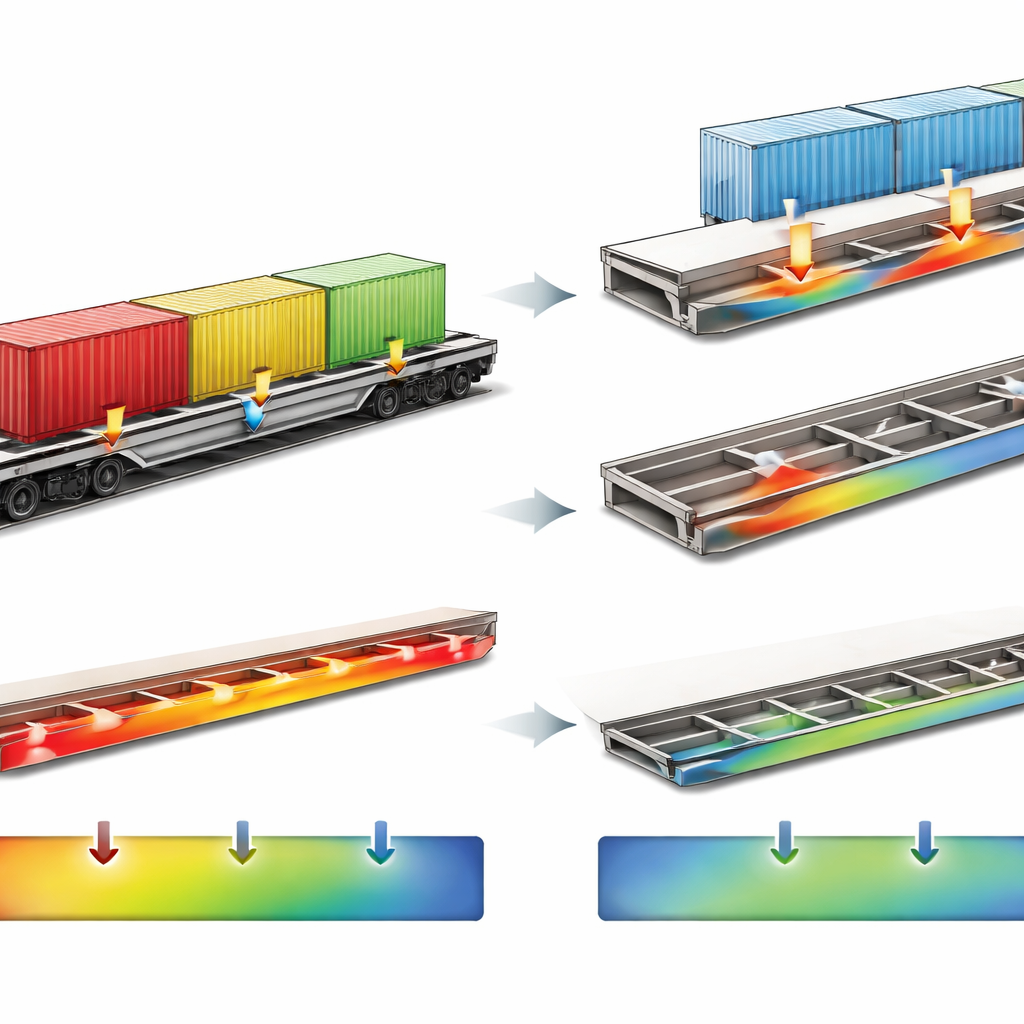
After settling on the main structural elements, the team built a detailed three‑dimensional computer model of the long‑base flat car. They simulated different real‑world situations set out in railway standards—such as hard impacts during shunting, train starts and stops, and running through curves—under two loading patterns: four 20‑foot containers and two 40‑foot containers. Virtual “measurement points” across the frame revealed where stresses peaked and how forces flowed from the containers into the beams. The model showed that all stresses stayed below allowed limits with a comfortable safety margin, and that the pattern of loads was more even with the new design, particularly when containers were arranged as two 40‑foot units.
Checking computer predictions on real tracks
To see whether the simulations matched reality, the researchers built a prototype long‑base flat car and fitted it with dozens of tiny strain gauges—sensors that measure how much a metal surface stretches under load. In factory tests, they pushed and pulled the car with large jacks to imitate the strongest forces expected in service, then measured stresses at critical spots such as the junctions where major beams meet. Later, they ran the loaded car on a test track with straight and curved sections at various speeds up to 80 km/h, again recording how the frame flexed. In both static and running tests, the highest measured stresses remained safely below the limits specified in national standards, and they closely matched the simulated values, differing by less than about eight percent.
What this means for everyday freight
In plain terms, the study shows that a carefully redesigned long flat car can safely carry more heavy containers with only a small increase in structural complexity. By trimming the car’s own weight and reshaping its beams, the engineers gained an extra ton of carrying capacity and achieved more even sharing of forces across the frame, without pushing the steel near its breaking point. Because the materials and methods fit existing manufacturing capabilities in Uzbekistan, the new design has already been put into production as a next‑generation container wagon. For shippers and consumers, such improvements promise trains that move more goods per trip, helping railways handle growing trade more efficiently while keeping transport costs and energy use in check.
Citation: Rahimov, R., Zafarov, D. & Khurmatov, Y. Development and justification of technical solutions for the design of a long-base flat car for the transportation of high-capacity containers. Sci Rep 16, 9868 (2026). https://doi.org/10.1038/s41598-026-40185-3
Keywords: rail freight, container transport, flat car design, structural engineering, finite element analysis