Clear Sky Science · en
Molecular structure and thermal decomposition kinetics of kerogen from the Paleocene oil-shale facies in the Bikaner–Nagaur Basin, western India
Buried Plant Matter as Hidden Fuel
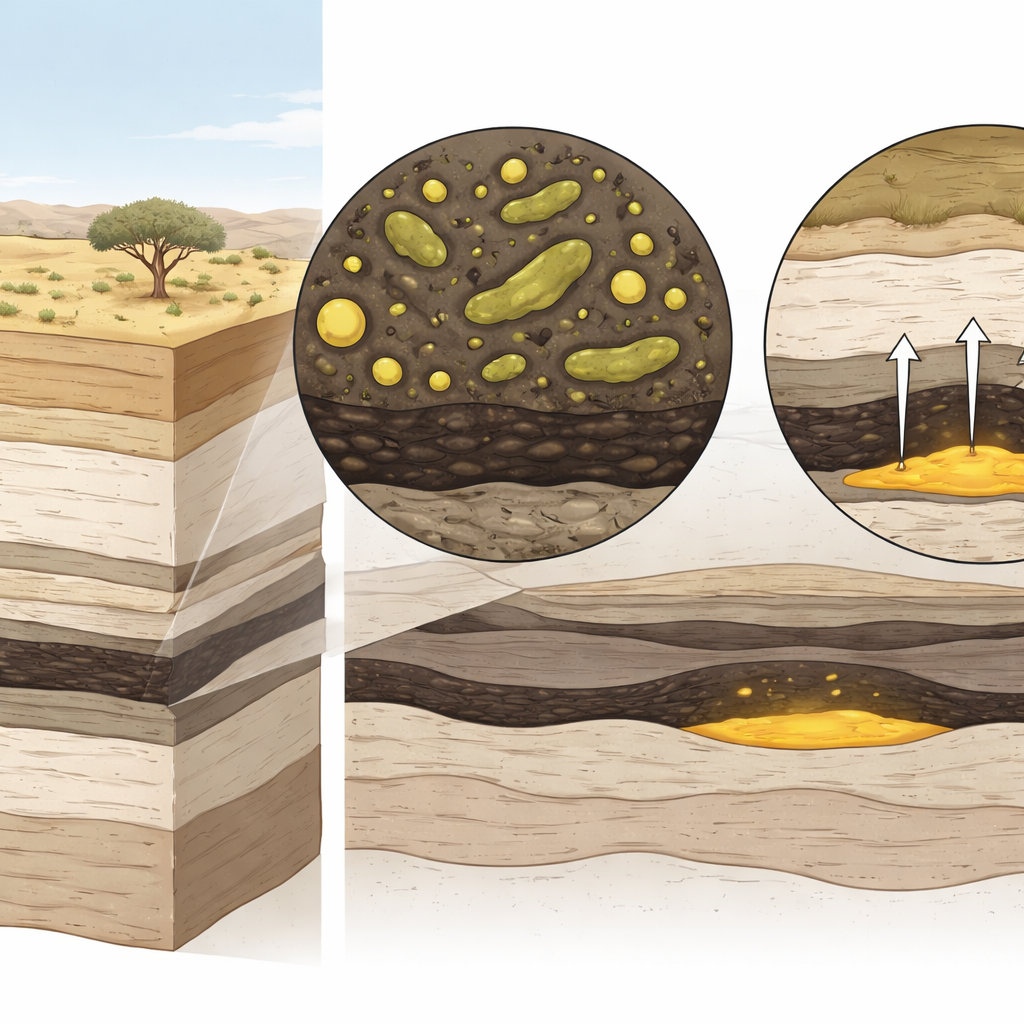
Deep beneath the deserts of western India, dark layers of mud-rich rock quietly store the remains of ancient algae and other tiny organisms. Over millions of years, this organic matter can be cooked by the Earth’s heat and turned into oil. This study explores one such hidden kitchen in the Palana Formation of the Bikaner–Nagaur Basin, asking a simple but important question: what kind of oil could these rocks make, and how easily could they make it?
Ancient Sea-Life Locked in Stone
The researchers focused on "bituminous shales"—dark, organic-rich rocks—exposed in the Gurha mine. Under the microscope, these rocks are packed with the gleaming outlines of fossil algae and other soft organic fragments, far more abundant than woody plant pieces from land. This mixture tells a clear story: during the Paleocene, the area hosted quiet, oxygen-poor waters where plankton and algae settled to the seafloor, were preserved instead of decaying, and accumulated into thick, organic-rich muds. Over time, these muds lithified into shale containing a kind of organic material called kerogen, the starting material for oil and gas.
What the Chemistry Reveals
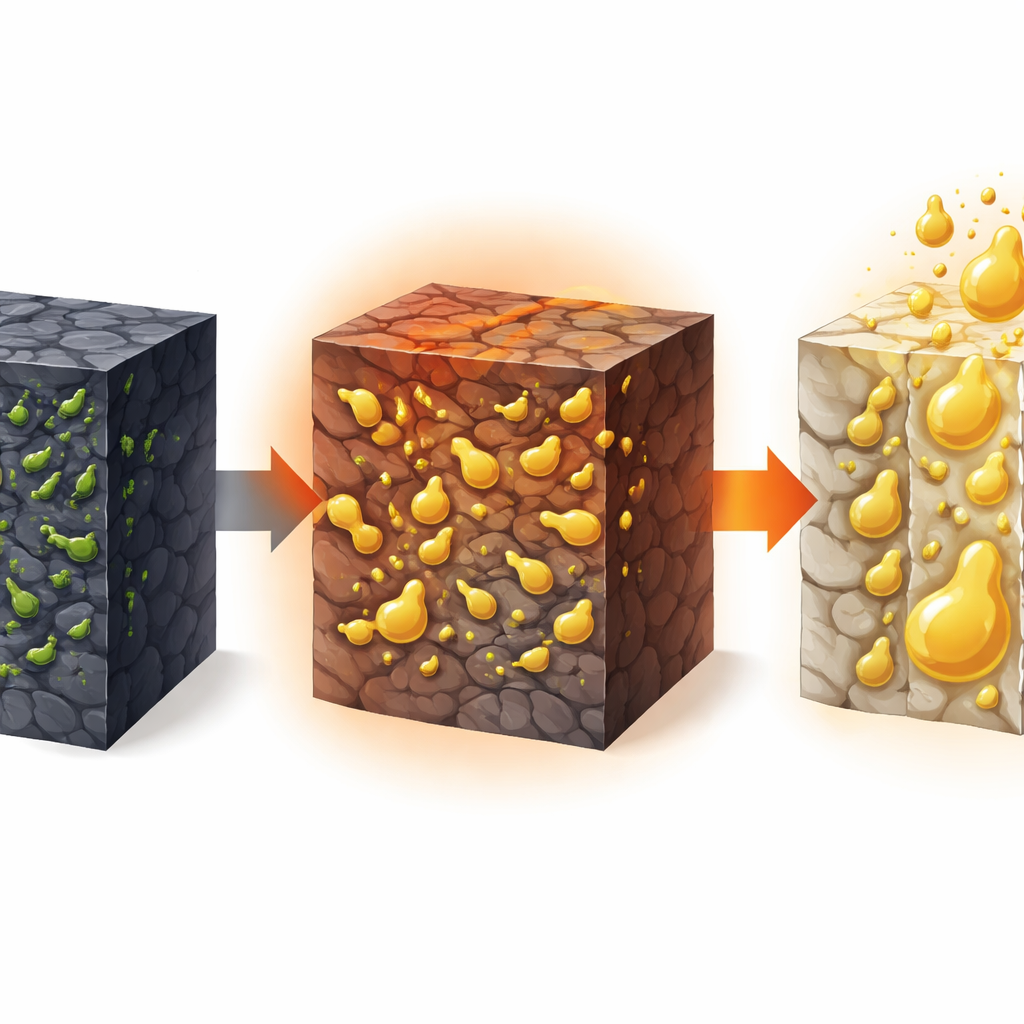
To understand how this kerogen might behave when heated naturally in the subsurface, the team isolated it from the surrounding minerals and examined its chemical makeup. They measured the proportions of carbon, hydrogen, oxygen, nitrogen, and sulfur, and found that the Palana kerogen is unusually rich in hydrogen and comparatively poor in sulfur. This composition matches what geologists call Type II kerogen, typically formed from marine algae and known for its strong oil-generating potential. Additional tests that tracked how the material lost weight as it was heated showed low mineral ash and high volatile content, meaning that much of the organic matter is ready to vaporize and transform into oil and gas rather than remain as stubborn residue.
Molecules on the Move as Heat Rises
The team then probed the kerogen’s internal architecture using infrared spectroscopy and pyrolysis–gas chromatography, tools that reveal what kinds of molecular building blocks are present. The signals point to long, flexible chains of carbon and hydrogen—aliphatic compounds—with relatively few flat, ring-shaped aromatic molecules. When the kerogen was artificially “cracked” in the lab, it released mostly light hydrocarbon fragments and waxy components, implying that in nature it would yield paraffinic–naphthenic–aromatic oils with a high wax content. These are the kinds of oils that can be solid or sticky at room temperature but flow at higher temperatures, a useful detail for predicting how they might behave in a reservoir or during in-situ heating.
Timing the Underground Cooking
To link these molecular traits to real geological conditions, the authors modeled how the kerogen would break down over millions of years under slow heating. By analyzing how fast it decomposes at different laboratory heating rates, they calculated activation energies—essentially how much thermal push is needed to trigger oil generation. Their models suggest that noticeable conversion of the Palana kerogen into oil begins at subsurface temperatures around 107–112 °C and reaches peak efficiency between about 148 and 153 °C. These temperatures match a moderate level of thermal maturity, similar to what is seen in many productive oil source rocks worldwide.
Why This Matters for Future Energy
Taken together, the microscopic images, chemical fingerprints, and kinetic models paint a consistent picture: the Paleocene shales of the Palana Formation contain hydrogen-rich, algae-derived kerogen that is well suited to generating substantial volumes of waxy oil over a realistic range of geological temperatures. For energy planners and geologists, this means that the Bikaner–Nagaur Basin holds a credible shale oil system whose behavior can be predicted with some confidence. The study not only refines estimates of how much oil these rocks might yield, but also provides a scientific foundation for designing in-situ conversion or heating strategies that could tap this ancient organic storehouse with lower exploration risk.
Citation: Hakimi, M.H., Kumar, A., Lashin, A. et al. Molecular structure and thermal decomposition kinetics of kerogen from the Paleocene oil-shale facies in the Bikaner–Nagaur Basin, western India. Sci Rep 16, 12645 (2026). https://doi.org/10.1038/s41598-026-40152-y
Keywords: oil shale, kerogen, shale oil, Bikaner–Nagaur Basin, Palana Formation