Clear Sky Science · en
Achievable rate analysis of orbital angular momentum multiplexing and demultiplexing using E-band metasurfaces
Why this matters for future wireless connections
Our appetite for data keeps growing—think immersive virtual reality, smart factories, and billions of connected devices. Yet today’s wireless networks are already squeezing as much information as they can out of familiar tricks like splitting signals by frequency or polarization. This paper explores a different property of radio waves, called orbital angular momentum (OAM), and shows how specially designed surfaces can use it to pack far more data into the same slice of spectrum, pointing toward ultra‑high‑capacity links for future 6G and beyond.
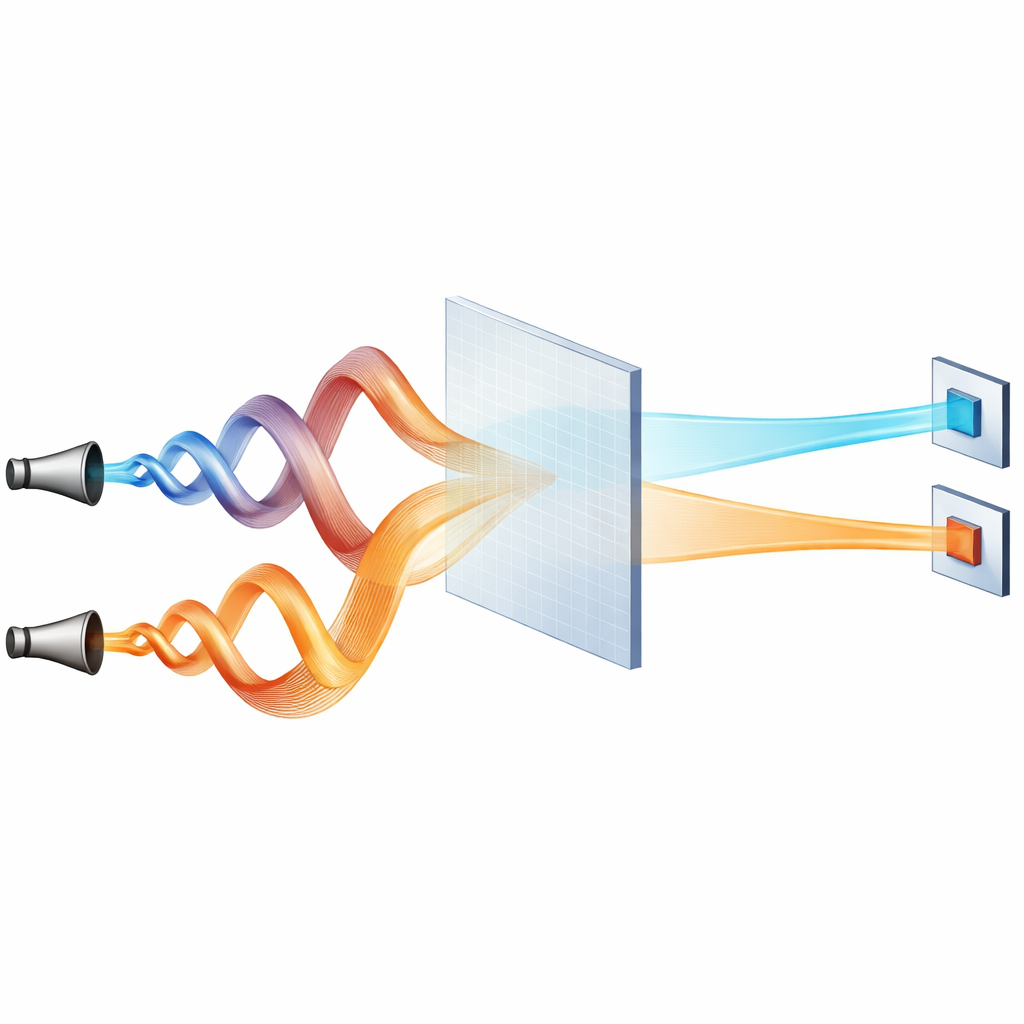
Twisting beams as extra data lanes
Light and radio waves normally spread out like smooth ripples. OAM waves are different: their energy forms a doughnut shape, and their phase winds around like a corkscrew. Different winding patterns—called modes—are naturally orthogonal, meaning they do not interfere with each other in ideal conditions. In principle, each mode can carry its own data stream, creating many invisible “lanes” in the same frequency band. The challenge is to generate, combine, separate, and accurately model these twisted beams in practical hardware, especially at the millimeter‑wave “E‑band” used for ultra‑fast backhaul links.
Flat devices that sculpt radio waves
The authors build on the concept of metasurfaces—ultra‑thin structures made from arrays of tiny patterned metal elements, known as meta‑atoms. By carefully tailoring each element, a flat panel can control the phase and polarization of passing waves at each point, essentially acting as a programmable sheet of lenses and prisms. In this work, the team designs a new type of meta‑atom based on a Fabry–Perot‑like cavity: three copper layers separated by low‑loss dielectric slabs. By adjusting just two geometric angles in the central metal “I” shape, they obtain both high transmission efficiency and full 360‑degree phase control, while keeping losses low across the E‑band.
Building a full twisted‑beam link
Using these improved building blocks, the researchers fabricate two large metasurfaces: one for combining beams (multiplexing) and one for separating them (demultiplexing). At the transmitter, a single E‑band source is split into two Gaussian beams that hit the multiplexing metasurface from different angles. That panel imprints distinct twisting patterns corresponding to two OAM modes, effectively encoding two separate data streams onto overlapping doughnut‑shaped beams that travel along the same line of sight. At the receiver, a second metasurface adds focusing and steering patterns that undo the twisting and send the two data‑carrying beams off in different directions, where simple detectors can pick them up as ordinary, focused beams.
From electromagnetic fields to data rates
To understand how well this system could perform as a communication link, the team goes beyond visual field plots and introduces an “effective channel” model. They simulate how the electric field evolves from the sources, through both metasurfaces, to small detector areas, using an efficient angular spectrum method instead of heavy full‑wave simulations. By integrating the simulated fields over each detector, they define channel coefficients that naturally include desired signal coupling and residual interference between modes. Arranged into a matrix, these coefficients form a model mathematically equivalent to that used for multiple‑input multiple‑output (MIMO) systems, allowing the authors to calculate the theoretical achievable data rate directly from the physics of the beams.
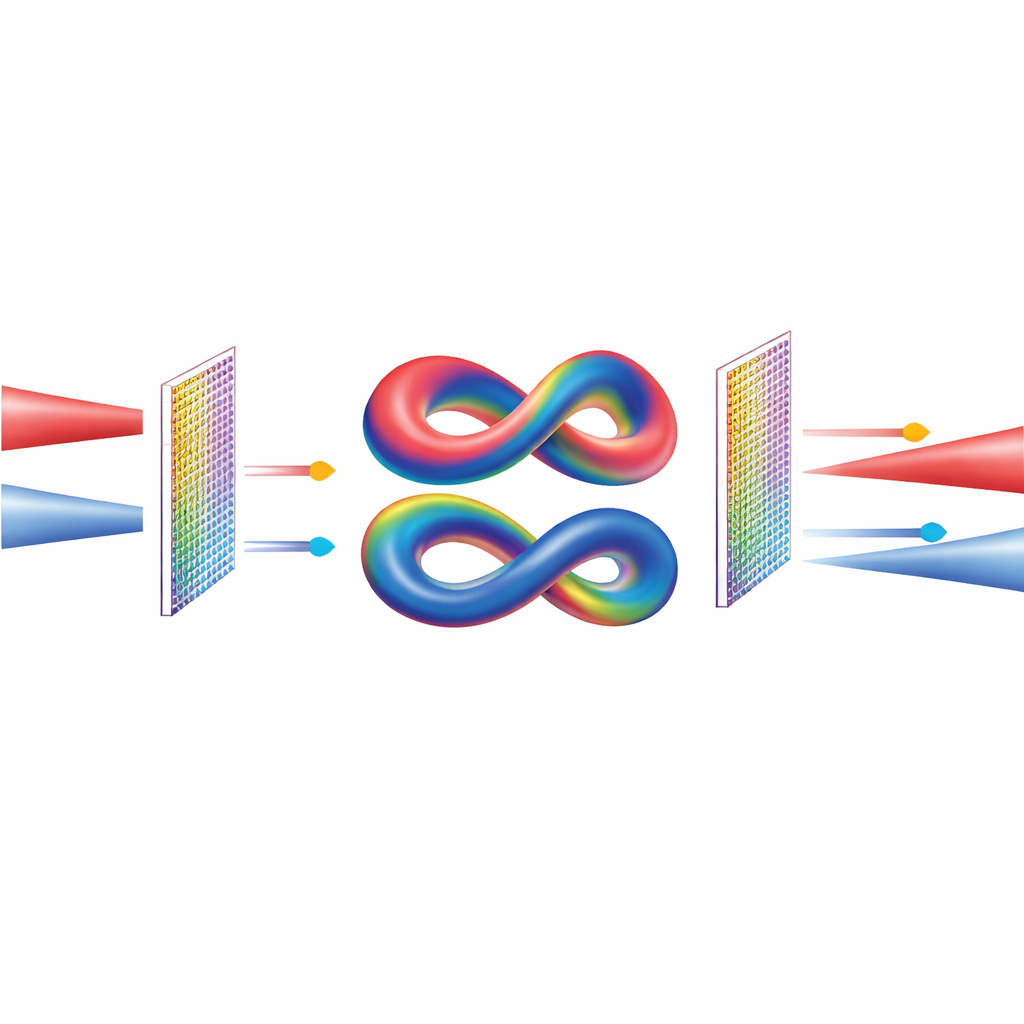
Putting the model to the test
Experimentally, the researchers measure the amplitude and phase of the beams generated and received by their metasurfaces at 83 GHz, confirming clean doughnut profiles and the correct number of twists for the two OAM modes. They then vary the input power over a wide range and, using measured noise levels, extract the achievable rate implied by their effective channel model. The resulting data‑rate curves from experiment and theory closely track each other across signal‑to‑noise ratios, with small discrepancies at very low and very high powers that can be explained by noise uncertainties and minor alignment errors in the setup. At the highest tested power, the system supports an impressive 41.8 bits per second per hertz of bandwidth.
What this means for tomorrow’s networks
In simple terms, this study shows that carefully engineered flat surfaces can twist and untwist radio beams in a controlled way, allowing multiple high‑capacity channels to share the same frequency and line of sight. Crucially, the authors provide a bridge from detailed electromagnetic behavior to standard communication metrics, proving that their metasurface‑based OAM system behaves like a well‑understood multi‑antenna link with very high spectral efficiency. With further work using independent transmitters, more modes, and advanced modulation formats, such metasurface‑enabled OAM links could become practical building blocks for future wireless networks that need to move vast amounts of data through the air.
Citation: Chung, H., Kim, B., Lee, YS. et al. Achievable rate analysis of orbital angular momentum multiplexing and demultiplexing using E-band metasurfaces. Sci Rep 16, 9826 (2026). https://doi.org/10.1038/s41598-026-40149-7
Keywords: orbital angular momentum, metasurfaces, millimeter-wave wireless, mode-division multiplexing, high-capacity communications