Clear Sky Science · en
Performance driven multi objective optimization of 2 MW integrated Pseudo Direct Drive permanent magnet synchronous wind generator
Cleaner power from the wind
Modern wind farms are pushing toward ever larger machines, but traditional gearboxes inside their nacelles remain a weak link, needing frequent maintenance and repair. This study explores a different way to connect slow-turning blades to a fast-spinning generator, using magnetic forces instead of meshing metal teeth. By smartly optimizing this new machine, the authors show it can deliver more torque in a smaller space and at lower material cost, making future multi‑megawatt turbines more efficient and reliable.
From clunky gears to magnetic motion
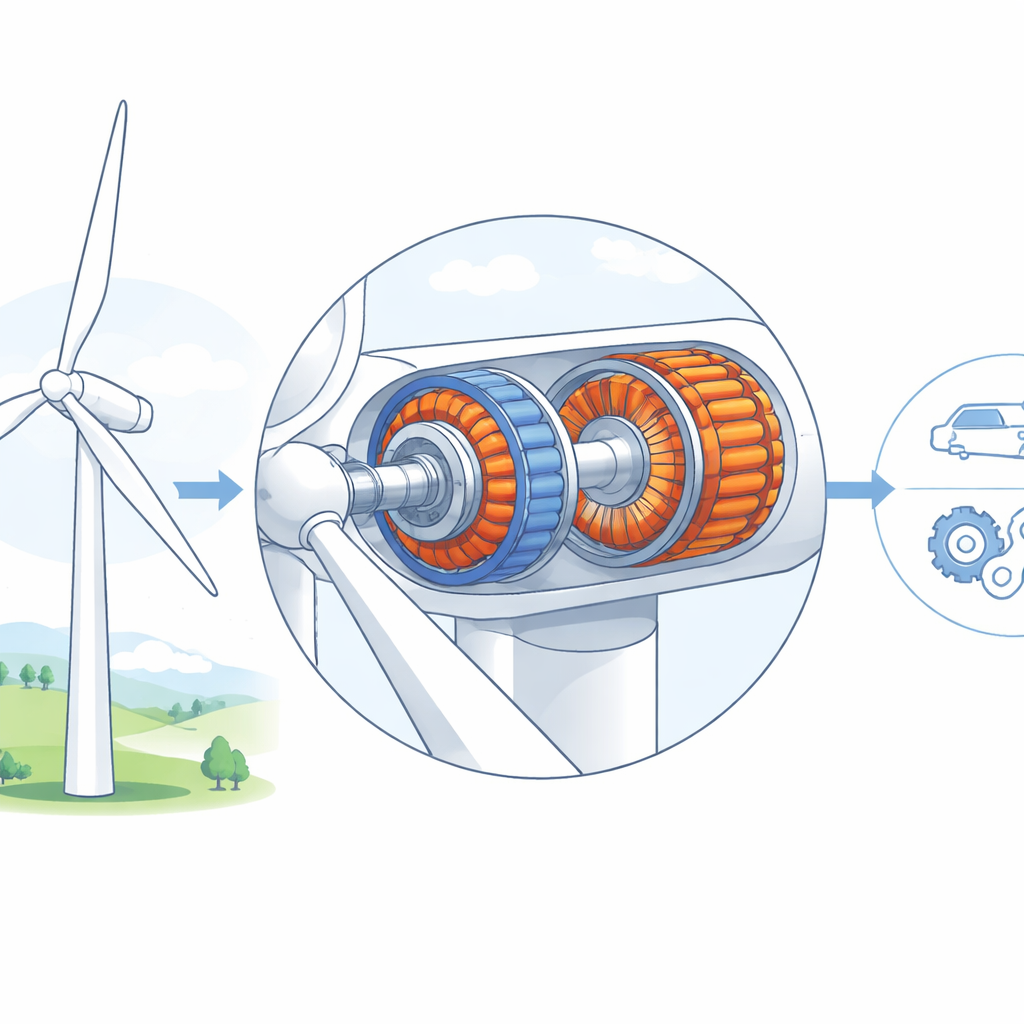
Conventional wind turbines with gearboxes rely on direct contact between steel teeth to boost the slow rotation of the blades up to the high speed a generator needs. These parts are noisy, wear out, need lubrication, and are among the most failure‑prone components in a turbine. Magnetic gearboxes work differently: they use interacting magnetic fields to pass torque from one rotating part to another without physical contact. In this work, the researchers integrate such a magnetic gearbox directly into a permanent‑magnet generator, creating a compact system called an Integrated Pseudo‑Direct‑Drive Permanent Magnet Synchronous Generator (IPDD‑PMSG) tailored for a 2‑megawatt wind turbine.
How the new drive system works
At the heart of the design is a coaxial magnetic gearbox, made of three concentric rings: an inner rotor carrying magnets, an outer rotor with magnets of opposite pattern, and a fixed ring of iron pieces in between that steers the magnetic flux. As the slow rotor linked to the blades turns, magnetic forces transmit and multiply torque to the faster rotor connected to the generator windings. Because the parts do not touch, there is no tooth wear, lubrication demand drops, and the system naturally slips instead of breaking if overloaded. The generator windings sit around this magnetic core, turning the boosted mechanical power into electricity with high efficiency and very high torque per unit volume.
Building and checking a realistic virtual machine
Designing such a machine by trial and error would be impractical, so the authors first create an analytical model that links physical dimensions, materials, and magnet arrangement to key outcomes such as torque, losses, and cost. They then validate this model using finite‑element simulations, a numerical method that maps magnetic fields and forces in fine detail. The simulated flux levels, voltages, and torque closely match the analytical predictions, giving confidence that the model reflects real‑world behavior. This virtual twin of the 2‑MW IPDD‑PMSG becomes the playground for exploring countless design variants without building hardware.
Letting algorithms search for the best design
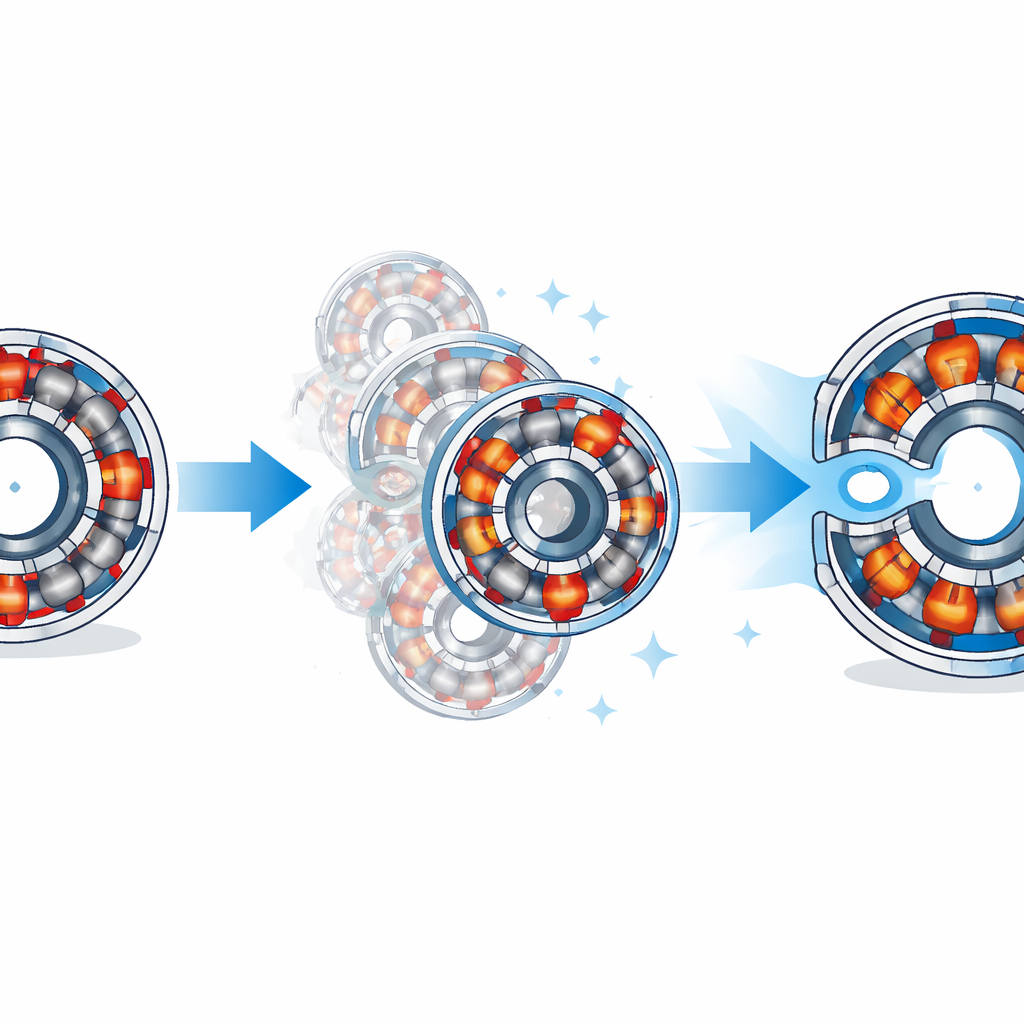
The central question is how to simultaneously maximize volumetric torque density (how much twisting force the machine can produce per unit volume) and minimize the cost of active materials such as copper, steel, and magnets. These goals compete: adding more magnet or copper may increase torque but also raises cost. To handle this trade‑off, the authors use two nature‑inspired search methods, Genetic Algorithms (GA) and Particle Swarm Optimization (PSO). Both run on populations of candidate designs, gradually improving them based on performance. GA, which mimics evolution through selection and mutation, proves better at homing in on extreme high‑torque, low‑cost designs. PSO, which imitates a flock of birds sharing information, explores a broader spread of options, revealing many different cost‑versus‑performance compromises engineers might choose from.
What the numbers mean for real turbines
After optimization, the integrated magnetic‑gear generator achieves a volumetric torque density of about 77,500 newton‑meter per cubic meter—far above figures reported for several state‑of‑the‑art wind generators with similar power ratings—and does so with an estimated active‑material cost around 68,500 dollars, less than many competing designs. Finite‑element checks confirm that magnetic fields stay within safe limits and that torque ripple, which can cause vibration, is reduced in the optimized machine. For a layperson, this means that by smartly shaping magnets, steel parts, and windings, and letting advanced algorithms tune their dimensions, the team has designed a wind‑turbine generator that is smaller, more powerful, and potentially cheaper to build and maintain. Such advances could help make large offshore and onshore wind farms more reliable and cost‑effective, easing the path toward a cleaner energy grid.
Citation: Abdeljalil, D., Krichen, M., Benhalima, N. et al. Performance driven multi objective optimization of 2 MW integrated Pseudo Direct Drive permanent magnet synchronous wind generator. Sci Rep 16, 10130 (2026). https://doi.org/10.1038/s41598-026-40096-3
Keywords: wind turbines, magnetic gearbox, permanent magnet generator, multi-objective optimization, renewable energy systems