Clear Sky Science · en
Research on a point cloud registration method based on the combination of hash functions and the grey wolf optimizer
Bringing 3D worlds into sharper focus
From self-driving cars to virtual museum tours, many modern technologies rely on "point clouds"—dense swarms of dots that capture the shape of real objects and scenes in 3D. To make sense of these data, computers must align multiple point clouds taken from different angles as if they were snapping together puzzle pieces. The article explores a new way to do this alignment faster and more accurately, promising crisper 3D reconstructions and more reliable digital twins of the physical world.
Why lining up 3D dots is so hard
A point cloud is simply a collection of points in space, each recording where a laser beam or depth sensor hit a surface. When engineers scan an object or a room from several viewpoints, each scan becomes its own point cloud. To build a complete model, these clouds must be brought into the same coordinate system—rotated and shifted so they overlap correctly. Traditional methods search for matching points between scans and gradually adjust the alignment, but they often struggle with huge data sets, noisy measurements, and poor starting guesses. The result can be slow computation, mismatches, or the algorithm getting stuck in a less-than-ideal alignment.
A smarter way to find key points
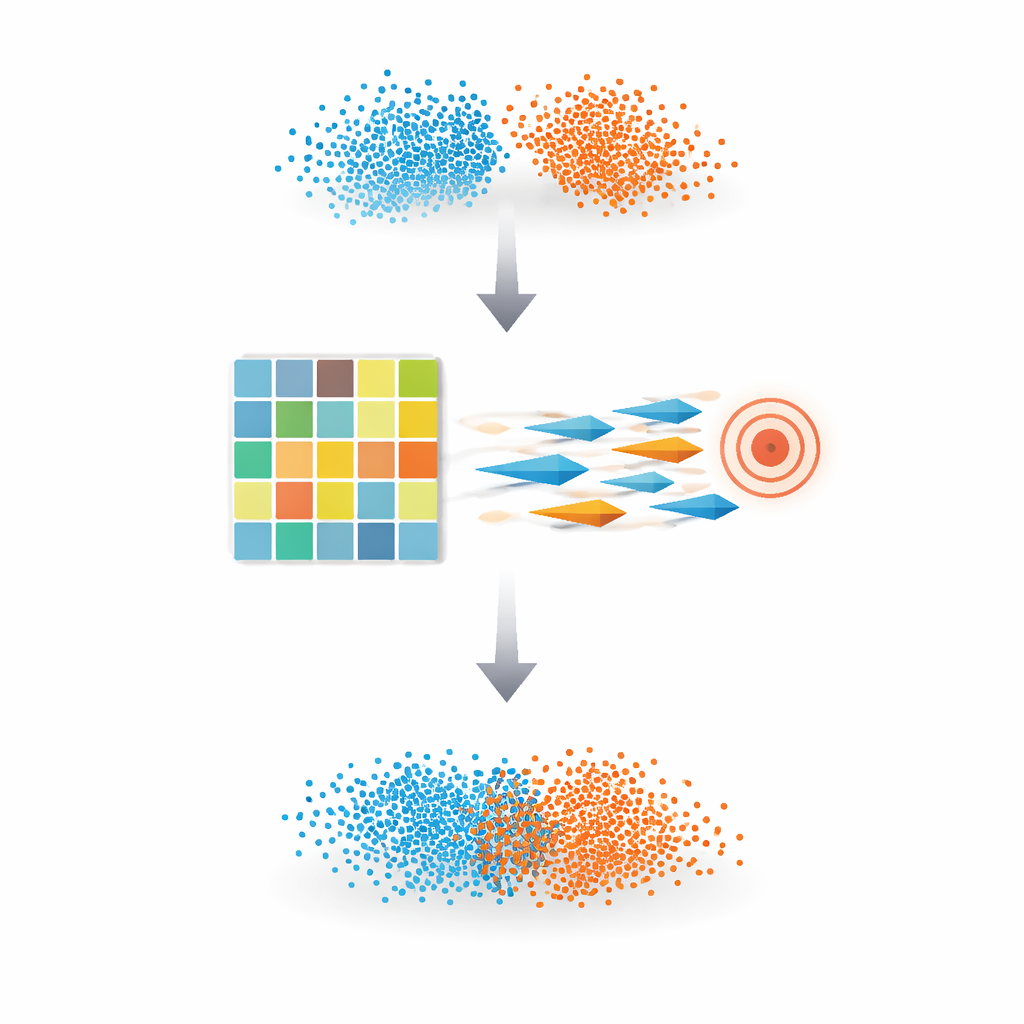
The authors propose a hybrid method that tackles both speed and accuracy. First, they avoid working with every single point by using an approach called ISS to pick out only the most informative spots—sharp corners, edges, and other geometrically distinctive areas on the surface. These feature points carry much of the shape information while greatly reducing redundancy. Next, instead of comparing each feature point with all others (which would be painfully slow), the method uses hash functions to place points into spatial "buckets" based on their location and surface orientation. Points that fall into the same or nearby buckets are likely to correspond between scans, so the search for matches becomes dramatically more efficient.
Letting a virtual wolf pack refine the fit
Once a rough alignment is found from these matched feature points, the method hands the job over to an optimization algorithm inspired by grey wolf hunting behavior. In this scheme, each "wolf" represents a different guess at the rotation and translation needed to align the point clouds. The best current guesses play the role of leaders, guiding the rest of the pack as they circle around an optimal solution. Over many iterations, the pack collectively homes in on the transformation that minimizes the distance between the matched points. A gradual tightening of the search mimics how real wolves close in on prey, helping the algorithm escape poor local solutions while still converging efficiently.
Proving the gains on classic 3D models
To test their approach, the researchers used standard 3D models widely known in computer graphics—such as the Stanford Bunny, Buddha, Dragon, and Armadillo. They compared their method with three popular registration techniques: SAC-IA, FPCS, and NDT, as well as a more recent optimization-based method. Across these benchmarks, the new framework consistently reduced alignment error to roughly one-third to one-half of that produced by the traditional algorithms, while also shortening computation time. Careful ablation studies showed that each component—feature selection, hashing, normal-direction checks, and the grey wolf optimizer—contributes meaningfully, and that removing any one of them either slows the process or noticeably worsens accuracy.

Sharper 3D alignment for real-world systems
In everyday terms, the study demonstrates a way to snap together multiple 3D views more cleanly and more quickly by combining selective attention (choosing only the most informative points), clever indexing (hash buckets), and a nature-inspired search strategy (grey wolf optimization). For applications such as 3D mapping, robotics, cultural heritage preservation, and industrial inspection, this means more precise digital models with less waiting time. The authors see future work in further trimming the optimization time and possibly teaching machines to learn better point correspondences automatically, but their current results already mark a strong step toward faster, more reliable 3D vision systems.
Citation: Zhang, C., Xu, Q., Sun, X. et al. Research on a point cloud registration method based on the combination of hash functions and the grey wolf optimizer. Sci Rep 16, 13423 (2026). https://doi.org/10.1038/s41598-026-40011-w
Keywords: point cloud registration, 3D reconstruction, hash-based matching, metaheuristic optimization, grey wolf optimizer