Clear Sky Science · en
Research on numerical simulation of surrounding rock stability of deep roadway with advanced strain softening model based on Hoek-Brown criterion
Why the ground around tunnels matters
As mines and underground transport tunnels reach ever greater depths, the rock around these openings is pushed close to its breaking point. When that rock starts to crack and swell, it can buckle steel supports, flood tunnels with debris, and put workers at serious risk. This study asks a practical question with big safety and economic stakes: can smarter computer models help engineers predict how deep rock will behave after excavation, so they can design support systems that actually match reality?
Looking beyond simple rock behavior
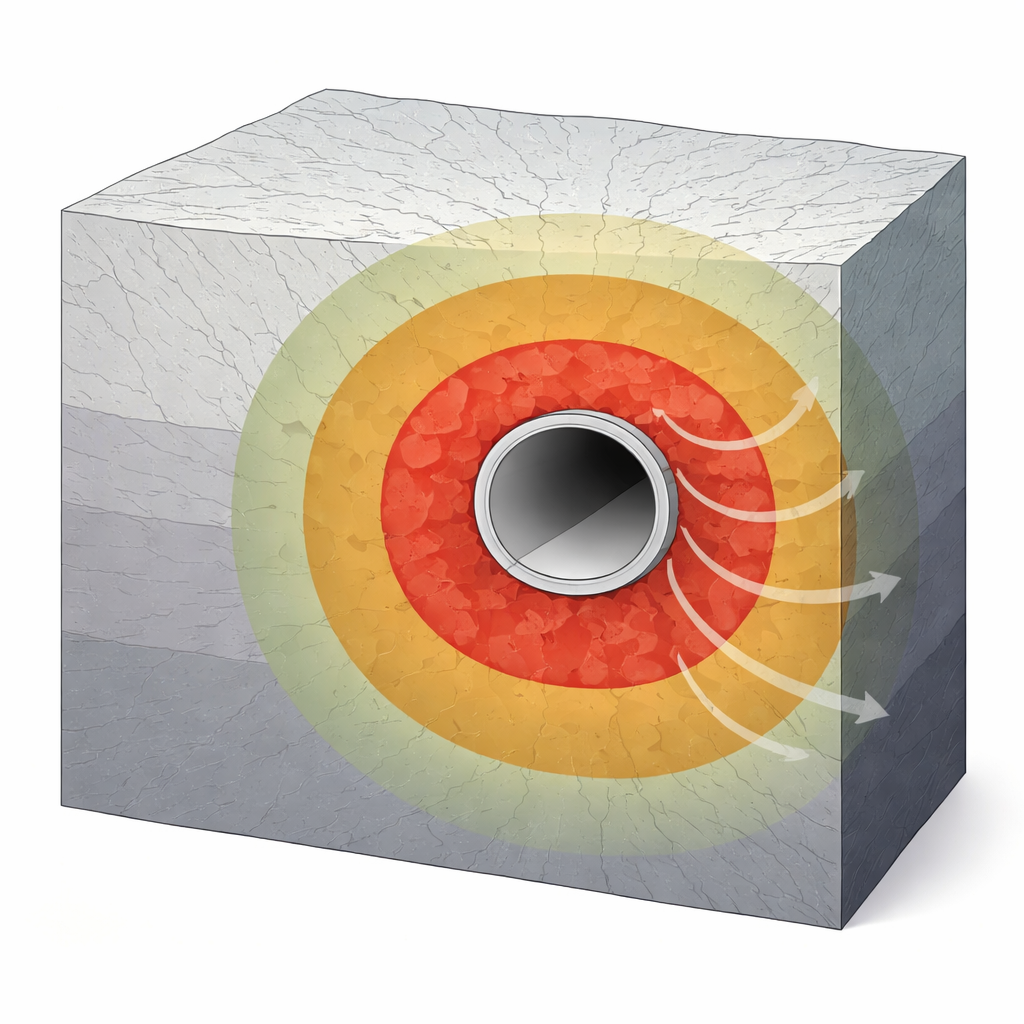
Traditional design methods often treat rock as if it were a simple, almost elastic material that weakens in a straightforward way once it fails. But observations from deep mines show something more complicated: after the peak strength is reached, rock can lose stiffness, shed strength, crack, and even puff up in volume as broken fragments shift and dilate. The authors focus on an “advanced strain softening” model called IMASS, which was built on a widely used rock strength rule known as the Hoek–Brown criterion. IMASS tries to capture four key behaviors after failure: loss of cohesion and tensile strength, an increase in friction between broken pieces, gradual softening of stiffness, and a transition from brittle breakage to more ductile, plastic-like flow.
How the new model represents cracking rock
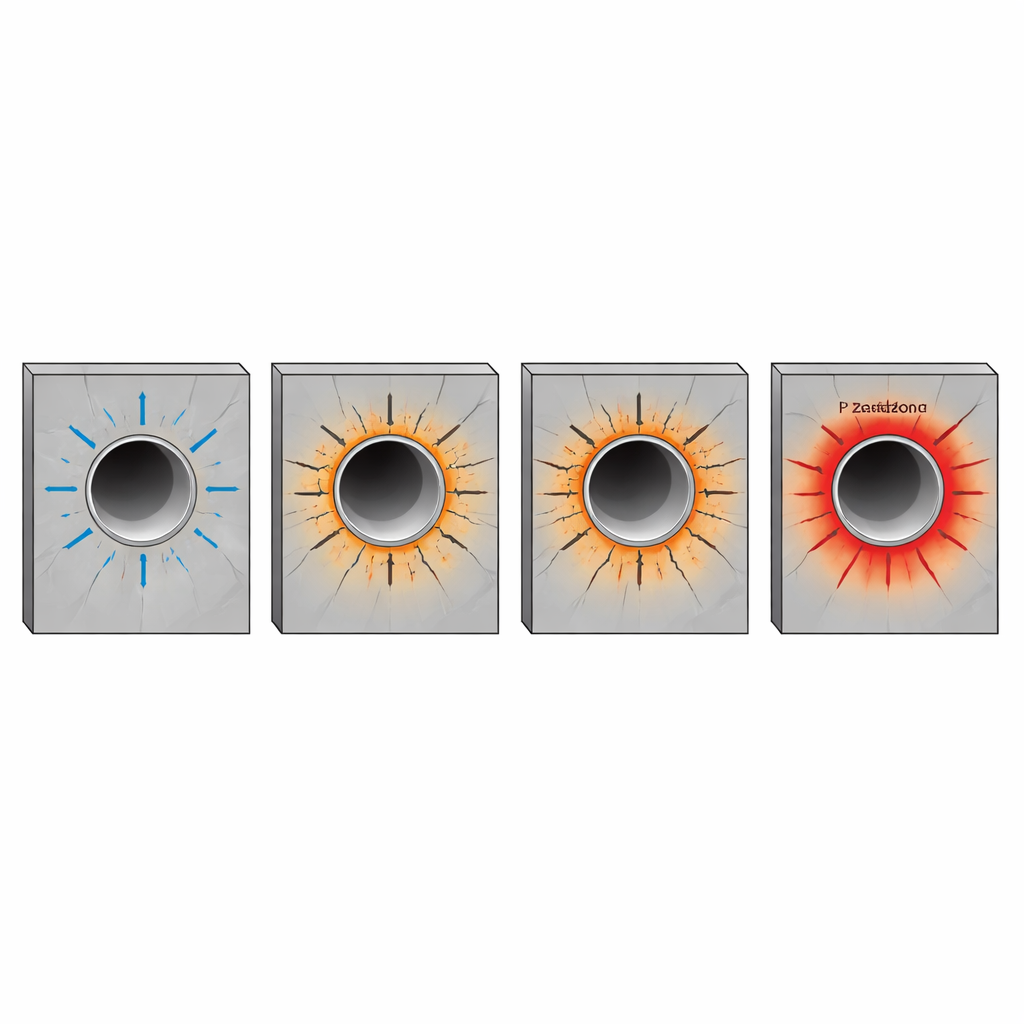
The IMASS model represents the life story of a rock mass around a tunnel in stages. First comes the intact peak strength state, where the rock is still solid. Once the stress becomes too high, the material enters a post-peak stage: cracks form, cohesive strength drops, but the fragments are still interlocked and relatively dense. With further deformation, the system moves toward an ultimate state, where the broken pieces have rearranged, porosity can reach roughly 40%, and the rock behaves more like a granular pile. The model links these stages to measurable quantities such as geological strength index (a rating of rock mass quality), lab-measured compressive strength, and a parameter that describes how quickly plastic shear strain accumulates. It also allows the elastic stiffness and the tendency of the rock to dilate—expand in volume during shearing—to evolve with damage.
Testing which rock properties matter most
To see how these ingredients influence tunnel stability, the authors built a three-dimensional numerical model of a deep roadway about 1,000 meters below ground, with a typical semicircular cross-section. They ran systematic simulations while varying one group of properties at a time. By changing rock quality from poor to good, they observed how cohesion and tensile strength degraded, how internal friction increased, and how the extent of plastic (permanently deformed) zones and displacements around the tunnel evolved. They then turned modulus softening on and off, explored the impact of shear dilatancy (how much the rock mass puffs up as it shears), and adjusted a brittleness parameter that controls how quickly the material jumps from strong and stiff to fully softened. The results show that displacement and damage are very sensitive to modulus softening and dilation when the rock is weak and brittle, but far less so when the rock mass is stronger and more continuous.
Combining many warning signs into one score
Rather than relying on a single indicator like tunnel wall movement or a theoretical “loose circle,” the authors propose a combined stability index that fuses several measures into one score between 0 and 1. They include the size of the plastic zone, total deformation, the level and distribution of peak stress, how much cohesion has weakened, and how strong the dilatancy is. Using a structured decision-making method (analytic hierarchy process) corrected by an entropy-based weighting scheme, they assign rational weights to each factor, giving most importance to the size of the plastic zone and to stress concentration. After normalizing all quantities, they compute a single index that can classify the tunnel as stable, marginal, critically unstable, or at high risk of collapse, and guide corresponding support measures.
Putting the model to work in a real mine
The team then applied both the advanced IMASS model and a more conventional strain-softening model to a deep soft-rock roadway in China’s Quandian coal mine, where the rock is heavily fractured sandstone. They compared simulated displacements, failure depths, stress patterns, and dilation with field measurements. The conventional model predicted significantly less deformation and a smaller failure zone than observed on site, giving an overly optimistic stability index with a deviation of about 162% from the measured value. In contrast, the IMASS simulations produced larger displacements, wider plastic zones, stronger dilation, and a much closer match to reality; its stability index differed from the measured value by only about 26%, and it correctly identified the roadway as in a high-risk state.
What this means for safer tunnels
For non-specialists, the message is straightforward: rock around deep tunnels does not simply crack and stop—it softens, swells, and gradually reorganizes, and these subtleties matter for safety. The IMASS model, by tracking stiffness loss, dilation, and brittleness, provides a more realistic picture of how damage spreads around an excavation and how close the system is to instability. When combined into a single stability index, this richer description allows engineers to choose stronger or more economical support schemes with more confidence. While the authors note that future work must include dynamic loads, groundwater, and time-dependent effects, their study shows that more nuanced numerical models can substantially narrow the gap between prediction and what actually happens underground.
Citation: Wang, R., Wu, R., Xu, J. et al. Research on numerical simulation of surrounding rock stability of deep roadway with advanced strain softening model based on Hoek-Brown criterion. Sci Rep 16, 11910 (2026). https://doi.org/10.1038/s41598-026-39882-w
Keywords: deep roadway stability, rock mass softening, numerical simulation, underground support design, Hoek-Brown criterion