Clear Sky Science · en
Cocktail of genetically diverse lytic phages reduces uropathogenic Escherichia coli colonization in mouse urinary tract
Why tiny viruses may help with common bladder infections
Urinary tract infections are among the most frequent bacterial illnesses, especially in women and older adults. Many of these infections are caused by a strain of Escherichia coli that has learned to thrive in the urinary tract and is increasingly resistant to antibiotics. This study explores whether carefully chosen viruses that attack bacteria, called phages, can work together as a “cocktail” to knock down these stubborn germs in the bladder and kidneys without stirring up harmful inflammation. 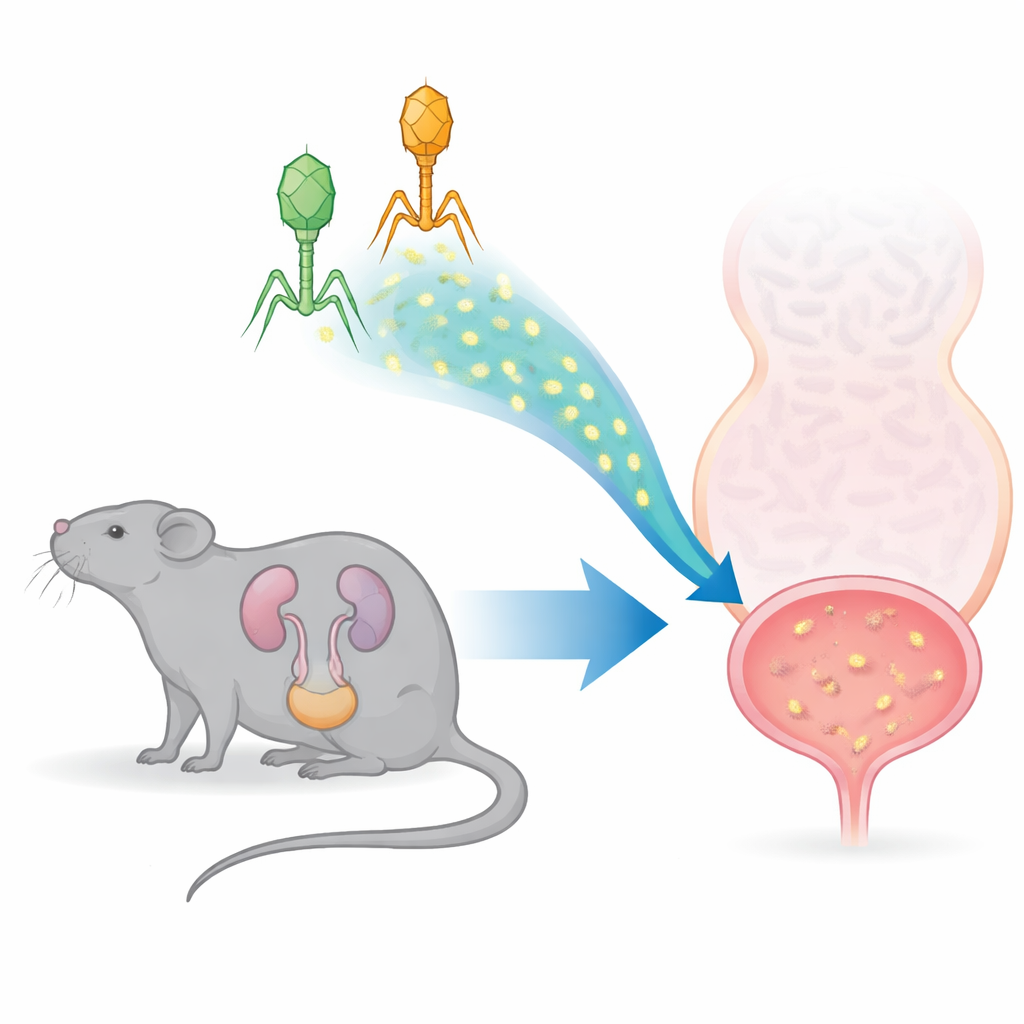
The problem of hard-to-treat urinary infections
Most people think of E. coli as a gut microbe, but certain forms, known as uropathogenic E. coli, readily move from the intestine to the urinary tract. Once there, they can latch onto bladder cells, burrow inside, and form sheltered pockets that are hard for antibiotics and immune cells to reach. These infections can come back again and again, and when the bacteria are resistant to multiple drugs, doctors have few treatment options. The authors of this paper focused on whether phage therapy—a century‑old idea now enjoying a revival—could provide a new way to control such infections.
Designing a targeted virus cocktail
The team previously discovered two naturally occurring phages from freshwater in Thailand, named SR02 and SR04. Both are “lytic,” meaning they infect and burst open bacteria rather than quietly hiding in them. Importantly, they are genetically distinct and latch onto E. coli in different ways, which raises the chance that a mixture of the two will hit bacteria more effectively and make it harder for the microbes to evolve resistance. In this study, the researchers tested each phage alone and as a 1:1 cocktail in human bladder cells grown in the lab and in a mouse model of an acute urinary tract infection.
Testing in human bladder cells and mouse urinary tracts
When human bladder cells were infected with uropathogenic E. coli and then treated with the phages, all phage treatments reduced the number of bacteria that managed to invade the cells. SR04 and the cocktail were more effective than SR02 alone, showing a clear benefit from combining distinct phages. The researchers also looked at signals of inflammation in these cells. Overall, the phages did not strongly trigger alarm signals on their own, and even during infection they caused only modest changes in a few inflammatory markers, suggesting that the treatment is unlikely to overstimulate human bladder cells.
How the cocktail behaved inside living animals
To see what happens in a whole organism, the team introduced uropathogenic E. coli directly into the bladders of female mice and, two hours later, delivered either SR02, SR04, the cocktail, or a harmless buffer through the same route. A day after infection, there was little difference in the number of free‑floating bacteria in the urine among groups. However, the cocktail sharply reduced bacterial counts attached to bladder tissue and in the kidneys compared with untreated mice, while each single phage alone consistently lowered kidney infection levels. SR04 tended to persist better than SR02 in the urinary tract, and the combination showed a synergistic effect specifically in the bladder. Despite these changes in bacterial burden, measures of inflammatory gene activity in bladder and kidney tissue remained largely similar between phage‑treated and untreated animals.
Subtle effects on tissue inflammation
The authors also examined thin sections of bladder and kidney tissue under the microscope to look for signs of damage and immune cell buildup. Infection with E. coli predictably drew in many white blood cells. Phage treatment did not dramatically reverse this pattern over the 24‑hour window. Intriguingly, mice that received SR04 alone showed more immune cell clustering in the bladder but somewhat less in the kidney, while the cocktail avoided this bladder increase. These findings hint that individual phages can have slightly different footprints on local inflammation, even when they are all targeting the same bacteria. 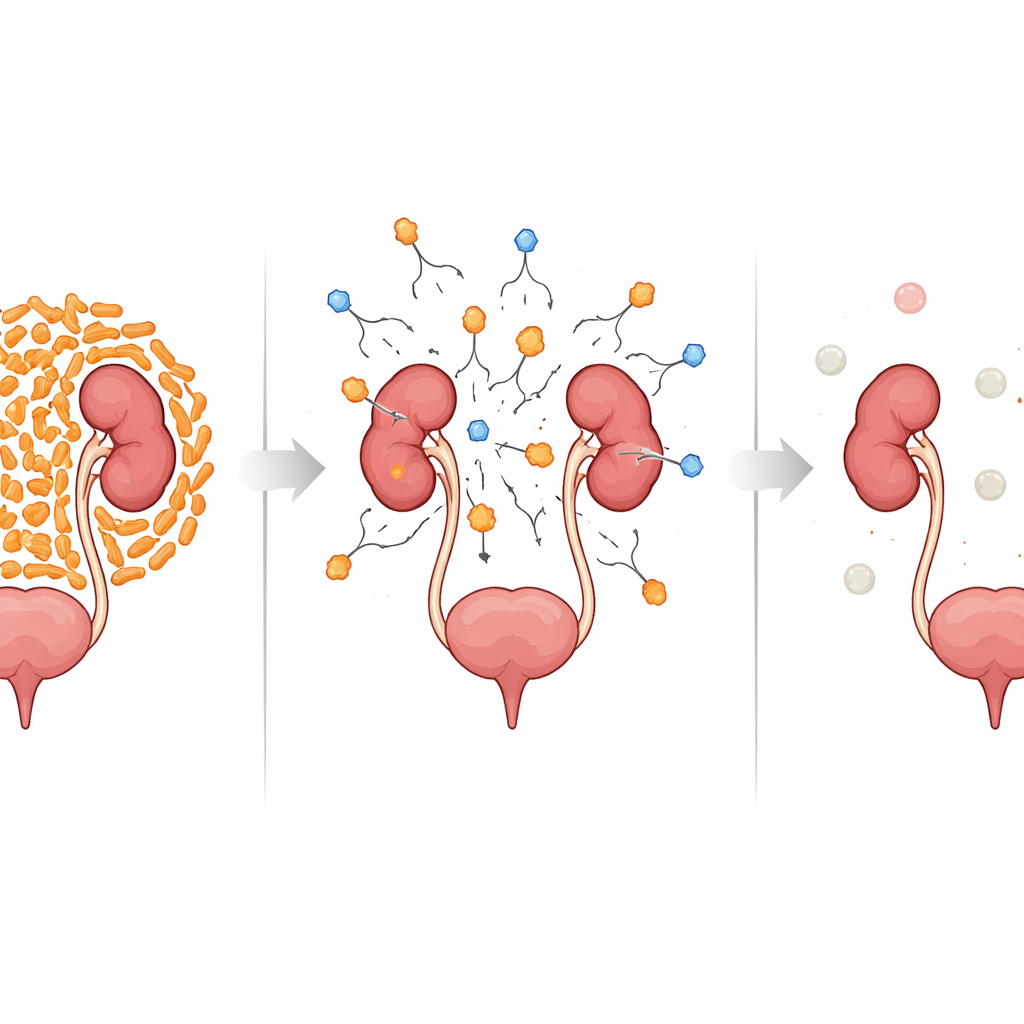
What this could mean for future treatments
In plain terms, this study shows that a mix of two carefully selected phages can work together to cut down disease‑causing E. coli in the bladder and kidneys of mice, without provoking a major inflammatory backlash. One phage, SR04, appears particularly powerful, but the cocktail performs best in the bladder and may buffer against unwanted tissue irritation. While more work is needed to fine‑tune phage combinations, understand long‑term effects, and translate dosing from mice to humans, the results support phage cocktails as promising candidates to help manage urinary tract infections that no longer respond well to standard antibiotics.
Citation: Mongkolkarvin, P., Sukjoi, C., Suyapoh, W. et al. Cocktail of genetically diverse lytic phages reduces uropathogenic Escherichia coli colonization in mouse urinary tract. Sci Rep 16, 9869 (2026). https://doi.org/10.1038/s41598-026-39877-7
Keywords: urinary tract infection, bacteriophage therapy, antibiotic resistance, Escherichia coli, mouse infection model