Clear Sky Science · en
Research on the frictional contact behaviors of high-speed motorized spindle bearing with oil-air lubrication
Keeping Fast Machines Running Smoothly
From dental drills to high-speed machine tools that cut metal for airplanes and smartphones, many modern devices rely on tiny ball bearings that spin at astonishing speeds. If these bearings rub too hard or get too hot, they wear out quickly, cause vibration, and ruin precision. This study asks a simple but crucial question: what is the best way to feed lubricant into these fast-moving parts so they last longer and run cooler?
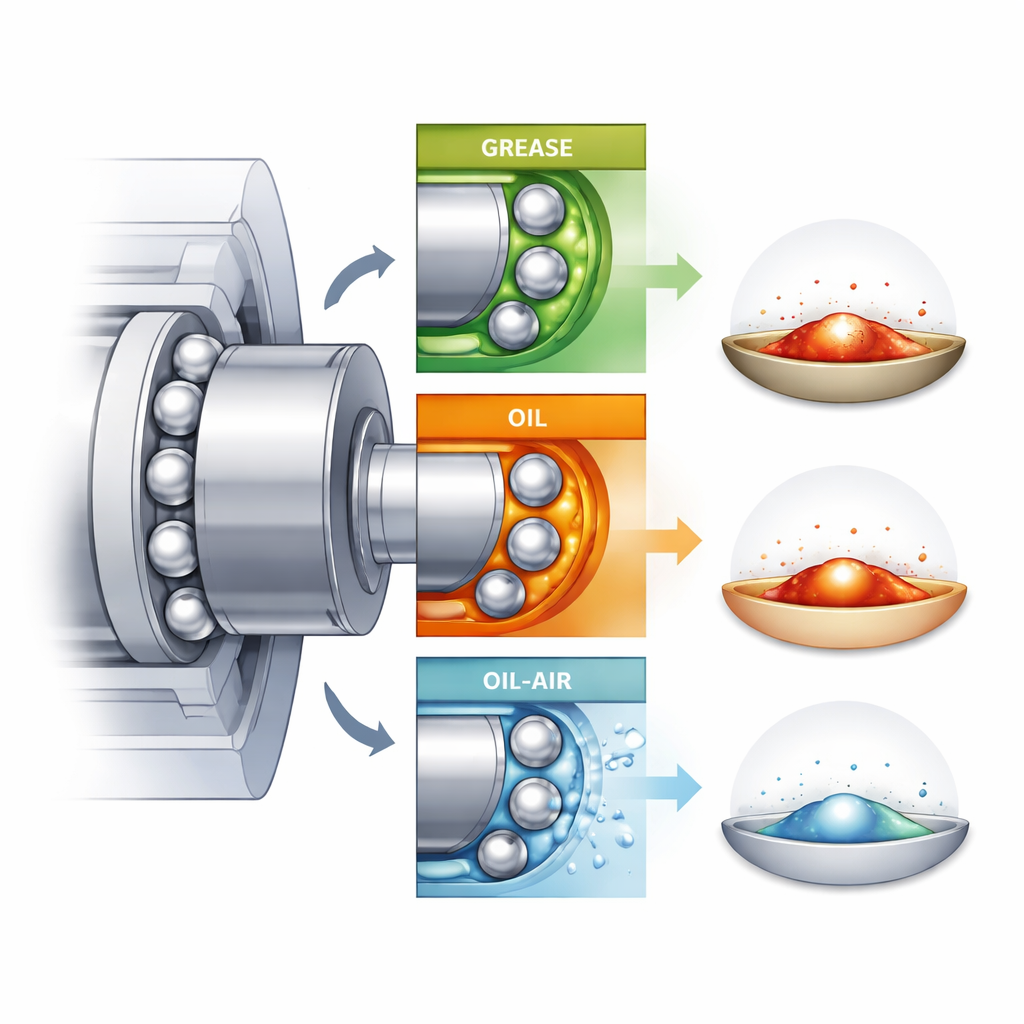
Three Ways to Feed a Spinning Bearing
The researchers focused on the contact between a steel ball and a flat steel disc, a simplified stand‑in for the internal surfaces of a real bearing. They compared three common ways to lubricate this contact: grease, plain oil, and a mixture of oil and compressed air known as oil‑air lubrication. Grease is easy to apply but tends to sit in place, oil can be dripped in but may not stay where it is needed, and oil‑air uses a fine mist of droplets carried by air to the contact zone. By carefully controlling the speed of rotation, the force pushing the ball onto the disc, the amount of oil delivered, and the air pressure, the team could see how each method affected friction, temperature, and wear.
Measuring Heat, Drag, and Wear
During hour‑long tests at speeds up to several thousand revolutions per minute, the team measured the friction force between the ball and disc and used an infrared camera to track how hot the contact became. After each test they examined the worn marks—called wear scars—under a microscope to see how wide and deep they were, and calculated how much material had been lost. This combination of real‑time measurements and detailed post‑test imaging let them link operating conditions directly to how quickly the surfaces were being damaged.
Why Oil and Air Together Do Better
The results clearly favored oil‑air lubrication. Compared with grease and plain oil, the oil‑air mixture produced the lowest friction and kept the contact much cooler—around room temperature instead of climbing above 40 degrees Celsius. Microscopic images showed that oil‑air also left the narrowest and shallowest wear scars, with wear volume cut by more than 80 percent. The key is that the flowing air continuously brings fresh, tiny droplets of oil right into the contact, building a smooth film that separates the metal surfaces while the moving air itself carries heat away. Grease, by contrast, can be squeezed out of the contact so that metal surfaces touch directly, and plain oil gradually runs off or is flung away as the disc spins.
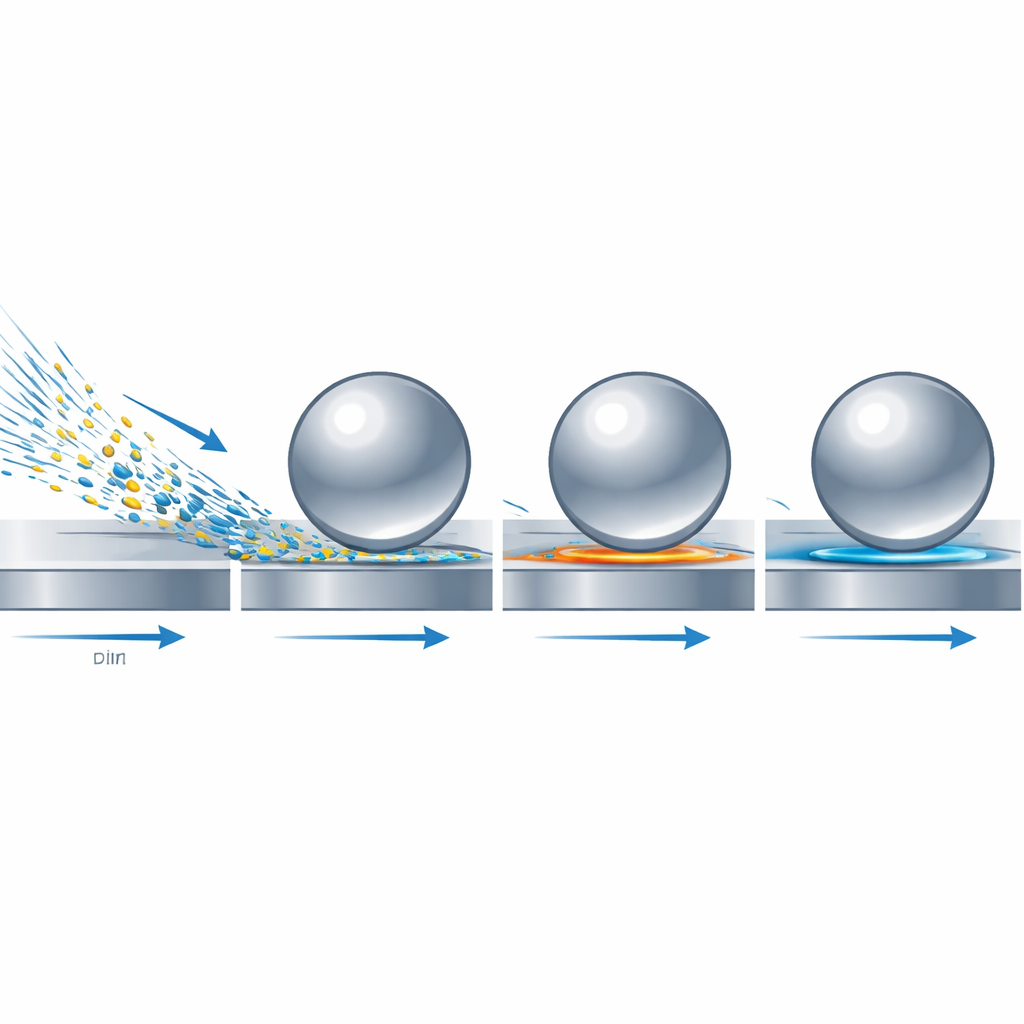
Finding the Sweet Spot for Operating Conditions
Even with oil‑air lubrication, how the system is run matters. Higher speeds helped reduce friction slightly by strengthening the oil film, but also increased heat and wear because the surfaces slid past each other more often and the oil had less time to stay in place. Increasing the load first raised friction and wear, then reduced friction again once the pressure was high enough to stabilize the oil film; at the same time, higher loads still tended to raise temperature. Extra air pressure acted like a stronger cooling fan, steadily lowering temperature without much changing friction. Adding more oil beyond a moderate level did not significantly change friction, but too much oil actually made cooling worse by forming a thicker layer that trapped heat, even though it reduced the size of the wear scars.
What This Means for Real Machines
In everyday terms, the study shows that mist‑feeding a small, steady stream of oil carried by compressed air is a superior way to protect fast‑spinning bearings. It cuts the drag that wastes energy, keeps temperatures safely low, and dramatically slows the wearing away of metal surfaces. By tuning speed, load, air pressure, and oil flow so that a thin, stable film forms between the moving parts, designers can extend the life and precision of high‑speed spindles used in advanced manufacturing, while using relatively little lubricant and avoiding overheating problems.
Citation: Jia, W., Guan, J., Gao, F. et al. Research on the frictional contact behaviors of high-speed motorized spindle bearing with oil-air lubrication. Sci Rep 16, 14352 (2026). https://doi.org/10.1038/s41598-026-39860-2
Keywords: bearing lubrication, oil air lubrication, friction and wear, high speed spindles, machine tool reliability