Clear Sky Science · en
Non-ideal penetration of shaped charge jet into spaced plate based on drift velocity and gap effects
Why this study matters
Shaped charges are explosive tools that can punch neat, deep holes through tough materials such as armor, concrete, and rock. They are used in military systems, oil and gas wells, and even to mimic space debris. Designers typically assume that the jet of metal they create flies straight like a needle. This paper shows that in real life, the jet is messier: it bends, breaks into pieces, and spreads out. Those imperfections become crucial when the jet must pierce several metal plates with air gaps between them—a common protective setup. Understanding this more realistic behavior helps engineers design both better penetrators and better armor.
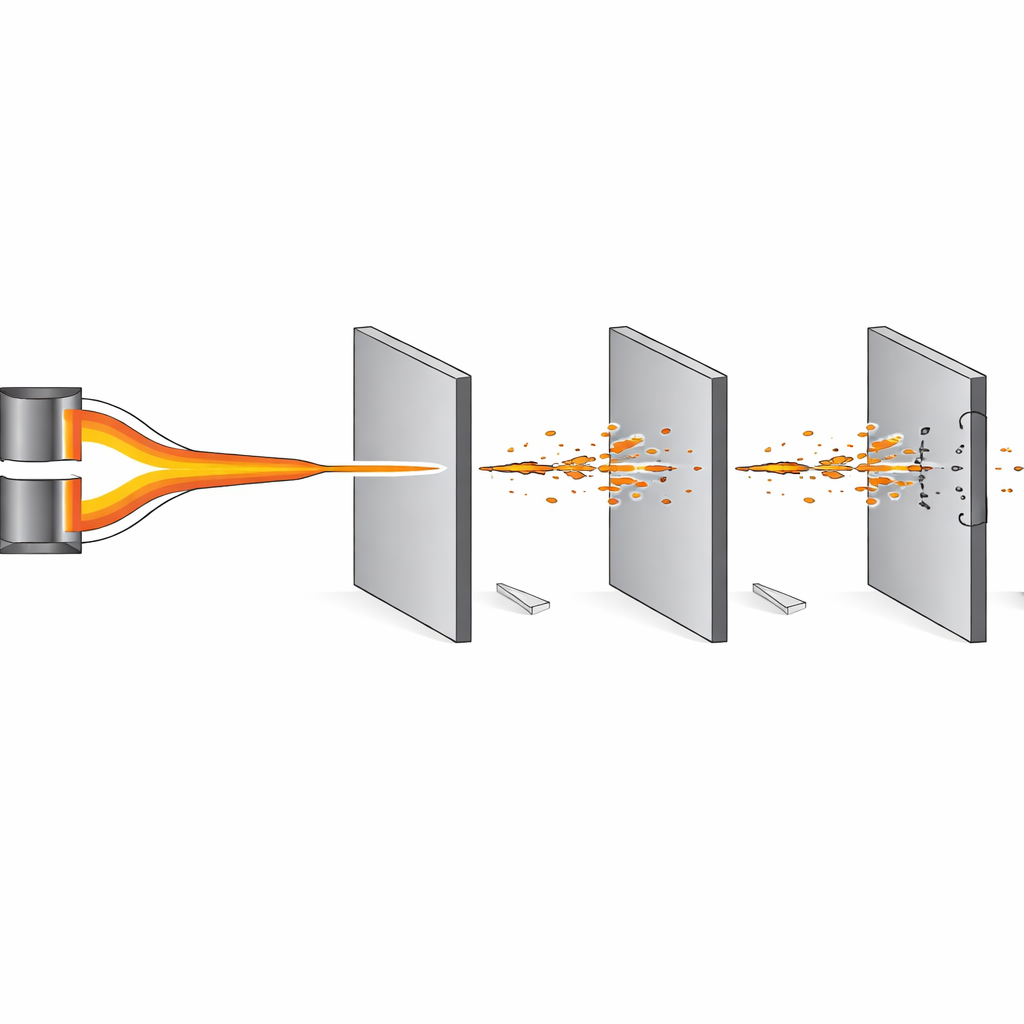
How shaped charges punch through metal
A shaped charge is built so that, when it explodes, a conical metal liner collapses inward and is squeezed into a very fast, narrow jet. The front of this jet can travel at several kilometers per second and normally drills a deep, thin crater into a solid target. Classic "ideal" theory assumes the jet stays perfectly straight along the charge axis and remains continuous. Using that picture, one can calculate how deep the jet should go for a given distance between the charge and the target (the stand-off). However, decades of experiments have hinted that real jets behave differently, especially when they must cross long gaps or a stack of separated plates.
When the jet bends and breaks
In practice, small defects in manufacturing and the violent breakup of the jet cause each tiny piece of metal to pick up a sideways speed, called drift. As the jet stretches and fragments, the pieces become like a string of high-speed particles rather than a smooth rod. The authors draw on earlier work to describe this drift in terms of two contributions: one from machining inaccuracy and one from the breakup process. As the sideways speed grows, particles wander away from the narrow crater they are boring. If a fragment strays far enough, it slams into the crater wall instead of the bottom, so it no longer adds to the hole’s depth. At the same time, growing gaps between successive particles further reduce how effectively they can bore ahead.
Building a more realistic model
To capture these effects, the researchers extend penetration theory to include both radial drift and particle spacing. First, they use computer simulations and simple penetration experiments in steel blocks to work out how the crater’s diameter grows and how the jet slows as it digs in. They then fit key parameters that describe how fast particles drift sideways and how sensitive penetration depth is to their spacing. With these values in hand, they calculate how a non-ideal, particle-like jet should behave when it strikes several steel plates separated by large air gaps—mimicking layered armor or structural shields.
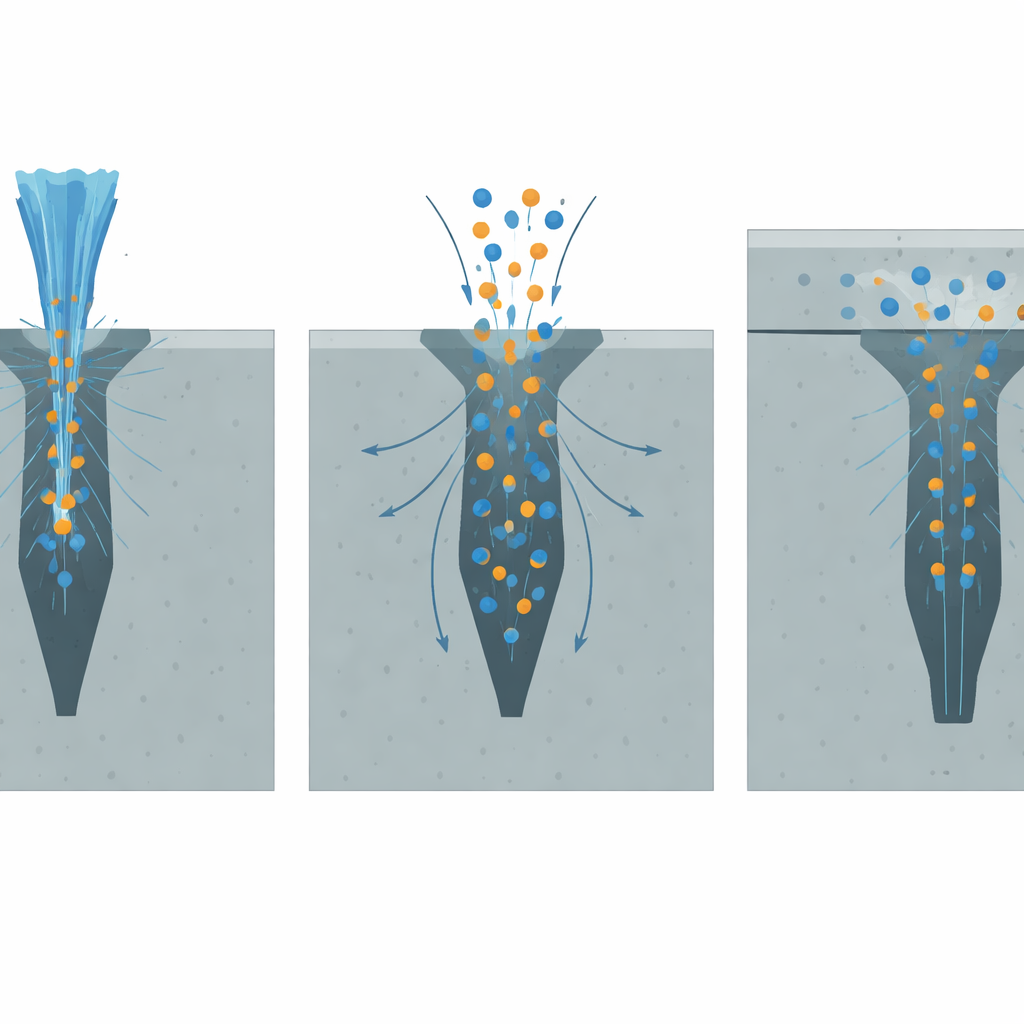
Putting plates in the way
The team tested their model using a three-plate steel target set at an angle, with sizable gaps between plates and a final witness plate behind them. High-purity copper liners and a standard military explosive produced the jets. In the experiments, the jet easily perforated all three plates, but only a small portion of it reached the witness plate, leaving several shallow holes with an average total depth of about 23 millimeters. Careful analysis showed that particles in the "tail" of the jet—those moving more slowly—were lost along the way. Their sideways drift was large enough that they hit crater walls or flew off-axis, so they never contributed to further penetration.
What the results reveal
The new model, which accounts for drifting and gapped particles, predicted that only fragments with speeds between roughly 5.15 and 6.25 kilometers per second could make it through the spaced plates and still affect the witness plate. It also forecast a penetration depth of about 22 millimeters in the witness plate—strikingly close to what was measured. By contrast, traditional ideal-jet theory would expect the entire residual jet to pass through, giving a much larger depth than observed. This agreement shows that treating the jet as imperfect, curved, and broken is essential for realistic predictions.
Takeaway for real-world designs
For non-specialists, the key message is that tiny imperfections in a shaped charge jet have big consequences once that jet is asked to cross multiple gaps or layers. Sideways drift and spacing between fragments quietly rob the jet of its punching power, especially over large distances. The authors’ non-ideal model provides a practical way to predict how much of a jet truly survives layered defenses and how deep it will go in the final plate. That insight can guide the design of more effective armor systems and safer, more reliable use of shaped charges in engineering and industry.
Citation: Xiao, Q.Q., Zu, X.D., Huang, Z.X. et al. Non-ideal penetration of shaped charge jet into spaced plate based on drift velocity and gap effects. Sci Rep 16, 10072 (2026). https://doi.org/10.1038/s41598-026-39841-5
Keywords: shaped charge jet, spaced armor, penetration mechanics, explosives engineering, ballistic protection