Clear Sky Science · en
Explainable analysis of the complex maze magnetic domain structure through extension of the Landau free energy model by adding an entropy feature
Why twisting magnetic patterns matter for everyday energy use
Electric motors are everywhere—from cars and trains to factory robots—and a surprising amount of their power is lost as heat inside the magnetic cores that drive them. Much of this waste comes from how tiny magnetic regions inside the metal flip their direction when the motor runs. In some soft magnetic materials, these regions form intricate maze-like patterns whose behavior changes with temperature. This paper introduces a new way to "read" those patterns and explain, step by step, how they waste or save energy, opening a path to more efficient motors and electronic devices.
From simple stripes to tangled mazes
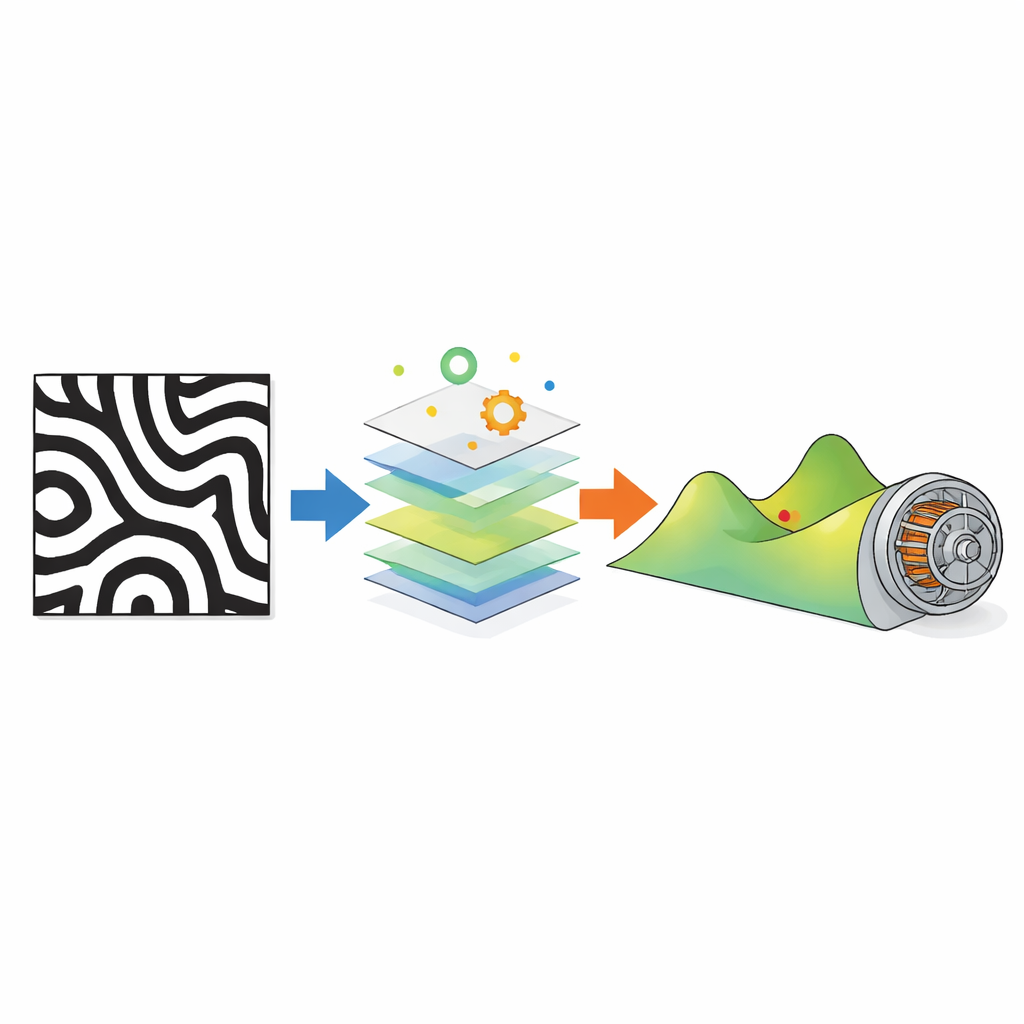
Inside a magnetic film, the material splits into small zones, or domains, where many atomic magnets point in the same direction. In the rare-earth iron garnet studied here, these domains line up perpendicular to the film surface and form black-and-white stripe patterns that can twist into complex mazes. As temperature rises and an external magnetic field is swept back and forth, domains appear, stretch, branch, and finally disappear. This microscopic dance creates the familiar magnetic hysteresis loop—a measure of how much energy is lost when the magnet is cycled. But because the patterns are so tangled and change so quickly, it has been very hard to say exactly which shapes and rearrangements are responsible for the losses.
A new map for magnetic complexity
The researchers tackle this challenge with a physics-guided data analysis framework they call the entropy-feature-extended Ginzburg–Landau, or eX-GL, model. They first record thousands of high-resolution domain images at different temperatures and magnetic fields using a Kerr microscope, which can see whether each tiny patch of the film points up or down. Then they use a mathematical tool called persistent homology to translate each noisy black-and-white maze into a compact fingerprint that captures where stripes connect, where they narrow, and how many twists and turns they contain. These fingerprints act as structural coordinates in an abstract space, where each point represents one magnetic pattern.
Balancing energy, order, and disorder
On top of this structural space, the team builds an energy landscape using a classic free-energy expression that adds together three ingredients: demagnetization energy (how much the pattern fights against stray magnetic fields), exchange energy (how costly it is to create and bend domain walls), and an explicit entropy term that measures how disordered the overall up–down arrangement is. By treating the maze pattern as a simple two-state system—each pixel is either up or down—they derive a compact formula for this configurational entropy and fit it to the experimental data. Principal component analysis then reduces the many structural descriptors to a single dominant axis that tracks both the progression of magnetization reversal and changes in these energy terms.
Following the path of reversal through energy barriers
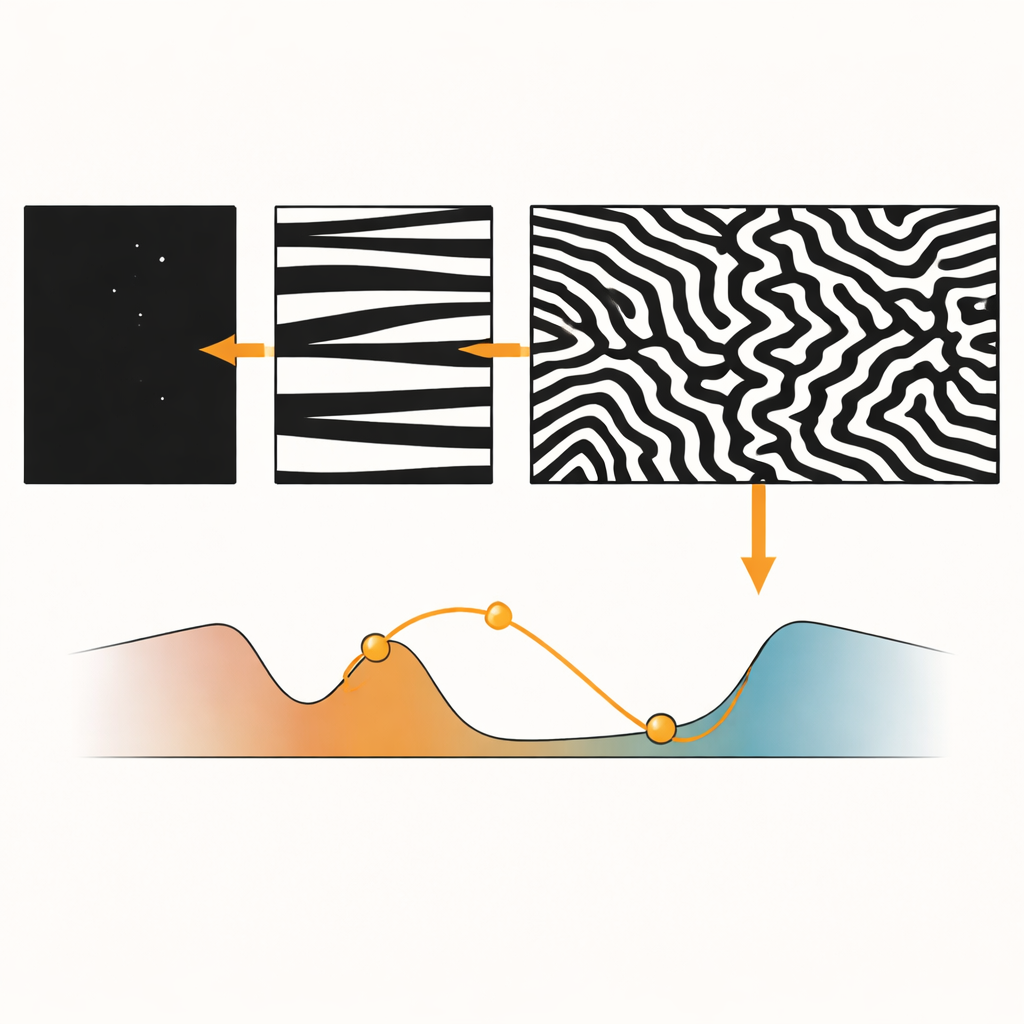
When the authors plot total energy and its components along this structural axis, magnetization reversal appears as a path over a series of hills and plateaus. Near the coercive point, where the net magnetization crosses zero, the total energy landscape flattens, meaning the domain pattern can rearrange with little extra cost—behavior typical of soft magnets. By looking at the local slopes of each energy term, they identify four key barriers that mark distinct stages: the birth of tiny reversed domains, the switch from simple stripe elongation to widening maze patterns, and later stages where walls become increasingly jagged. At the latter barriers, demagnetization energy is released while exchange energy and entropy rise together, showing that the system lowers its overall energy by creating more, rougher walls and a more disordered arrangement.
Seeing hidden structure in the entropy
Finally, the team projects the entropy-related features back onto the original images, highlighting exactly which parts of each maze contribute most to rising disorder. For one barrier, the hotspots trace long zig-zagging domain walls, while for another they cluster around curved regions and medium-range textures that are hard to spot by eye. This shows that entropy is not an abstract number but is tightly linked to the real geometry of the domain network. The key message for non-specialists is that the most wasteful stages of reversal are those where the magnetic landscape grows highly intricate: domain walls proliferate and twist, and the material pays an energetic price for that complexity. By making this connection explainable and quantitative, the eX-GL approach offers a roadmap for designing magnetic materials and processing routes that steer domain patterns away from such costly states, helping future motors and transformers run cooler and more efficiently.
Citation: Masuzawa, K., Foggiatto, A.L., Kunii, S. et al. Explainable analysis of the complex maze magnetic domain structure through extension of the Landau free energy model by adding an entropy feature. Sci Rep 16, 12889 (2026). https://doi.org/10.1038/s41598-026-39617-x
Keywords: magnetic domains, energy loss, soft magnets, entropy, data-driven materials