Clear Sky Science · en
Reactive power planning based on a proposed voltage stability index in power systems with renewable energy resources
Keeping the Lights On in a Changing Power Grid
As more wind turbines, solar farms, and hydro stations feed electricity into our power grids, keeping voltages steady across thousands of kilometers of wires becomes both harder and more important. If the voltage at some points in the grid drops too low or rises too high, it can trigger blackouts or damage equipment. This paper presents a new, faster way to find the vulnerable spots in a power network and decide where to install support devices so that the grid can handle renewable energy, heavy demand, and sudden failures without losing stability. 
Why Voltage Can Suddenly Become Unstable
Electric power systems are built to deliver energy at a nearly constant voltage, much like plumbing pipes are sized so water pressure stays within limits. In reality, every line, transformer, and generator interacts, and small changes in demand or supply can push parts of the grid toward a tipping point known as voltage collapse. Traditional methods to check how close the system is to this cliff rely on repeatedly simulating the network while gradually increasing the load. Engineers track curves that relate power and voltage to see where solutions stop existing. Although accurate, these approaches are slow, demand many calculations, and can be awkward to use when planners must evaluate many scenarios and configurations involving renewables.
A Simple Score for Weak Spots in the Grid
The authors introduce a new numerical score, called a bus voltage stability index, that can be computed for every node where lines meet in the grid. Instead of solving complex sets of equations over and over, this index is written as a compact algebraic expression. It uses information that is already available from a single standard power-flow calculation: the voltages, flows of active and reactive power, and the electrical characteristics of the connecting lines. A higher value of the index flags a weaker node that is more likely to run into trouble if conditions change. Crucially, the index approaches a value of one as the system nears voltage collapse, giving planners a clear warning signal without heavy computation.
Planning Where to Add Support Devices
With this index in hand, the researchers design a step-by-step strategy for installing and sizing static VAr compensators, or SVCs—electronic devices that can quickly inject or absorb reactive power to keep local voltage in check. Starting from today’s operating condition, they first run a single power-flow study, calculate the index at every node, and pick the one with the highest score as the best candidate for an SVC. A sensitivity calculation then estimates how much reactive power that device must provide to bring voltages back into an acceptable band. The procedure is repeated under tougher conditions: heavy loading, single-line or generator outages, and very light loading, where too much reactive support can push voltages uncomfortably high. 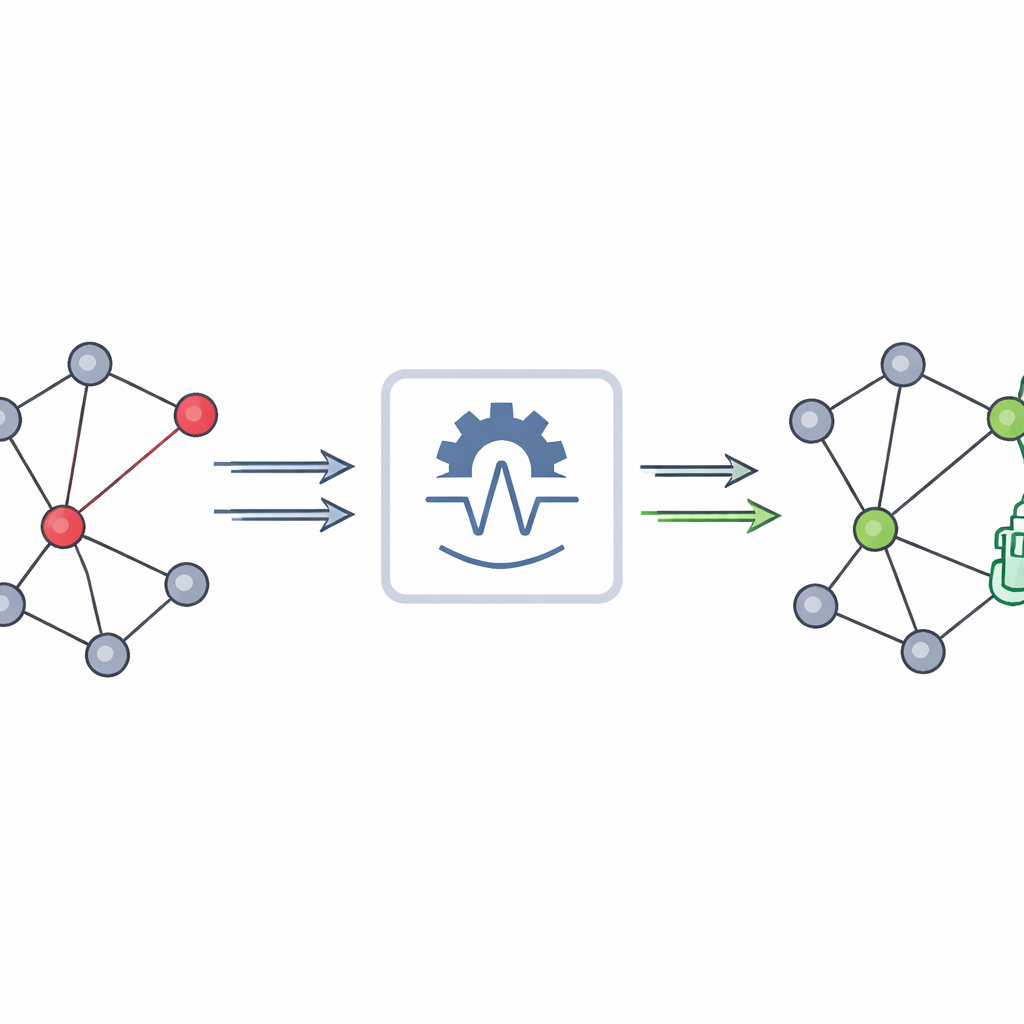
Testing on Standard and Renewable-Rich Networks
The method is exercised on three well-known benchmark networks with 9, 14, and 39 nodes, and then on modified versions where several conventional generators are replaced by wind and solar plants with more limited voltage support. In every case, the new index correctly identifies the same weak locations highlighted by more established, but more laborious, techniques. Using the sequential planning strategy, the authors determine where to place SVCs and how large they must be so that all voltages stay within agreed limits under normal operation, during the loss of any single line or generator, and at low demand. Compared with popular search-based optimization methods inspired by swarms of particles or packs of wolves, the proposed approach achieves similar or better improvements in voltage quality and power losses while requiring smaller total SVC capacity and lower investment cost.
What This Means for Future Power Grids
In plain terms, this work offers grid planners a quicker calculator to find the weak links in a complex, renewable-heavy network and a practical recipe for reinforcing those points with just enough equipment. Because the index can be evaluated from one standard simulation and does not depend on fragile mathematical tricks, it is well suited for routine planning studies and even for monitoring in near real time. By guiding the targeted placement of SVCs and related devices, the method helps keep voltages steady, reduce wasted energy, and cut the cost of grid upgrades—supporting a more reliable and economical transition to cleaner electricity systems.
Citation: Sonbol, M., Abdalla, O.H., Shaheen, A.M. et al. Reactive power planning based on a proposed voltage stability index in power systems with renewable energy resources. Sci Rep 16, 11355 (2026). https://doi.org/10.1038/s41598-026-39508-1
Keywords: voltage stability, reactive power planning, renewable energy grids, static VAR compensator, power system reliability