Clear Sky Science · en
Developmental warming induces severe deformities and mortality in a thermally tolerant fish species
Why hotter water matters for tiny fish
As the planet warms, lakes, rivers and streams are heating up too. For cold-blooded animals like fish, whose bodies closely track the surrounding water, these shifts can be a matter of life or death. This study asks what happens when baby fish grow up in water just a few degrees warmer than usual, revealing hidden limits that even very hardy species may not be able to cross.
A tough invader put to the test
The researchers focused on the eastern mosquitofish, a small freshwater species introduced around the world to eat mosquito larvae. These fish are famous for coping with a wide range of conditions, from cool ponds to steamy tropical shallows. That reputation makes them a useful test case. If a rugged species like this struggles with future heat, more sensitive native fish could fare far worse. The team collected wild adults from tropical waterways in northern Australia and bred them in the lab at a comfortable 27 °C, thought to be the local sweet spot for their health and reproduction.

Raising young fish in warmer water
Newborn mosquitofish from each family were split into three groups and raised at different temperatures: 27 °C as a control, 30 °C as a warmer but still natural condition, and 33 °C to push the edge of what these fish can tolerate. The young were tracked for more than seven months. Whenever a fish died, its tiny skeleton was carefully stained and imaged so the team could check for bending or kinks in the spine. A subset of live fish from each group was also sampled at the same age, allowing fair comparisons between temperatures and family lines.
Striking deformities and heavy losses
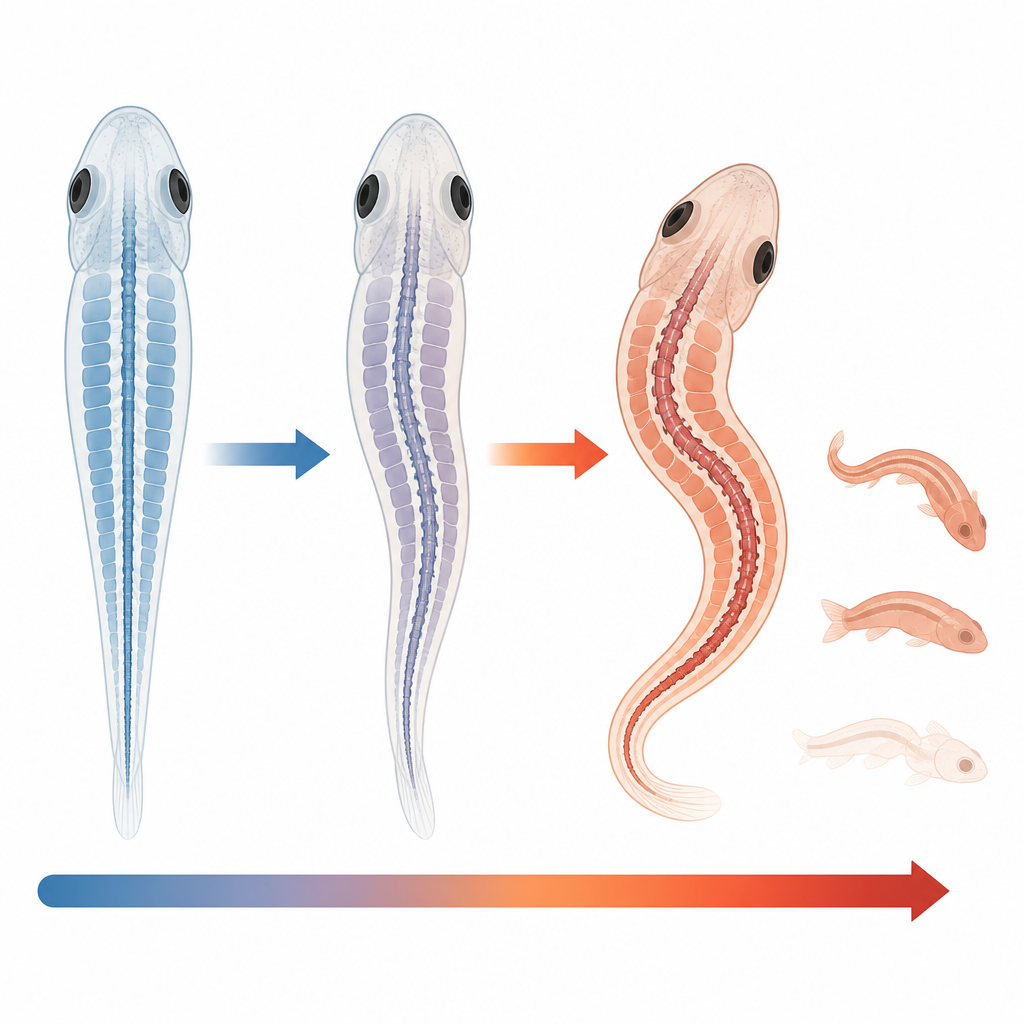
The results were stark. At 33 °C, 84 to 86 percent of the fish developed severe spinal deformities, and every single fish in this hottest group was dead by 135 days of age. Many had spines that curved sharply, which would likely hamper their ability to swim, feed or escape predators. At 30 °C, a smaller share of fish showed abnormal spines and their curvature was milder, but survival still dropped: by the end of the 220-day study, only about 38 percent of this group remained alive, compared with much higher survival at 27 °C. This means that even a modest, long-term temperature increase can quietly trim numbers, with or without obvious deformities.
Why warm beginnings bend bones
Although the exact cause of the bent spines is not fully pinned down, several clues emerge. Warmer water speeds up growth and metabolism in young fish, which could make their developing muscles pull more strongly on still-forming bones, twisting the spine past its limits. Temperature also influences the activity of many genes and signaling molecules that guide how the skeleton and muscles take shape. Similar patterns of heat-linked skeletal problems have been reported in farmed sea bream, clownfish and other species, suggesting that this is not a quirk of mosquitofish but part of a broader biological vulnerability.
What this means for wildlife and people
In the wild, the streams and lakes where these mosquitofish live already reach summer averages near 30–32 °C, and in some spots water exceeds 33 °C for much of the day. Adults may handle these hot spells, but this work shows that their offspring do not. As climate change pushes temperatures higher and makes heatwaves more frequent, the window of safe conditions for early life could shrink, leading to declines even in tough, invasive fish. That has worrying implications for more fragile native species and for human food security, since fish are a key protein source worldwide. The study highlights that to foresee climate impacts, we must look closely at how chronic warming affects animals during their most delicate life stages.
Citation: Aulsebrook, L.C., Hosler, T.L. & Donelson, J.M. Developmental warming induces severe deformities and mortality in a thermally tolerant fish species. Sci Rep 16, 15114 (2026). https://doi.org/10.1038/s41598-026-39489-1
Keywords: climate change, fish development, thermal tolerance, spinal deformities, mosquitofish