Clear Sky Science · en
Development and characterization of coaxial two-way switch for RF plasma discharge experiments
Why this matters for future clean energy
To turn the dream of fusion power into reality, scientists must precisely control huge bursts of radio-frequency (RF) energy that help ignite and shape super‑hot plasmas inside donut‑shaped fusion machines called tokamaks. This paper presents a new kind of RF "traffic director"—a robust coaxial two‑way switch—that lets engineers redirect powerful RF waves quickly and reliably between experimental devices and test equipment, saving both time and cost while protecting delicate hardware.
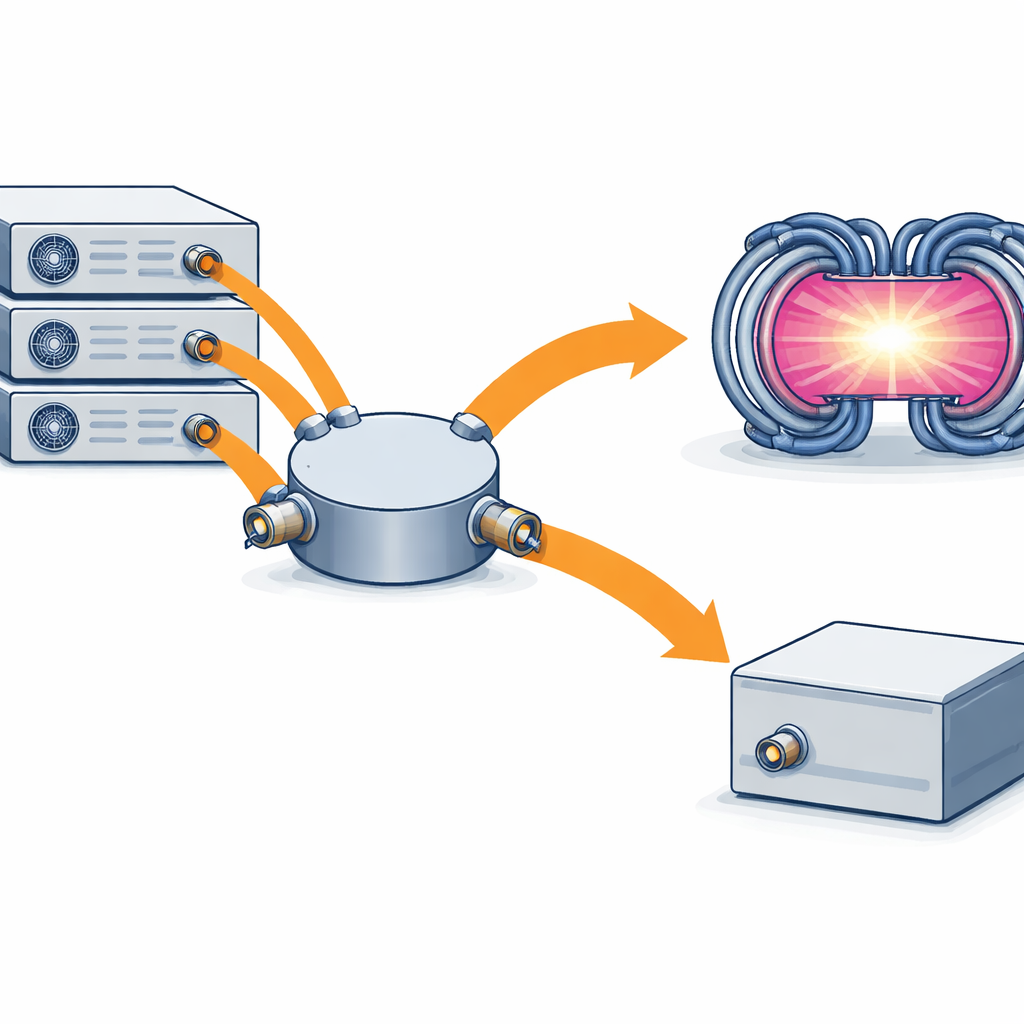
Guiding powerful radio waves
In large fusion experiments such as the ADITYA and SST‑1 tokamaks in India, RF waves in the tens of megahertz range are used for several critical jobs: gently starting up a plasma, cleaning the vacuum walls, and heating ions through a process called ion cyclotron resonance. All of these rely on long chains of RF amplifiers feeding power through thick metal pipes known as coaxial transmission lines. Traditionally, switching that power between a working experiment and a test load required single‑direction switches and often physical re‑routing of rigid copper pipes—operations that are slow, inflexible, and expensive.
A switch that does twice the work
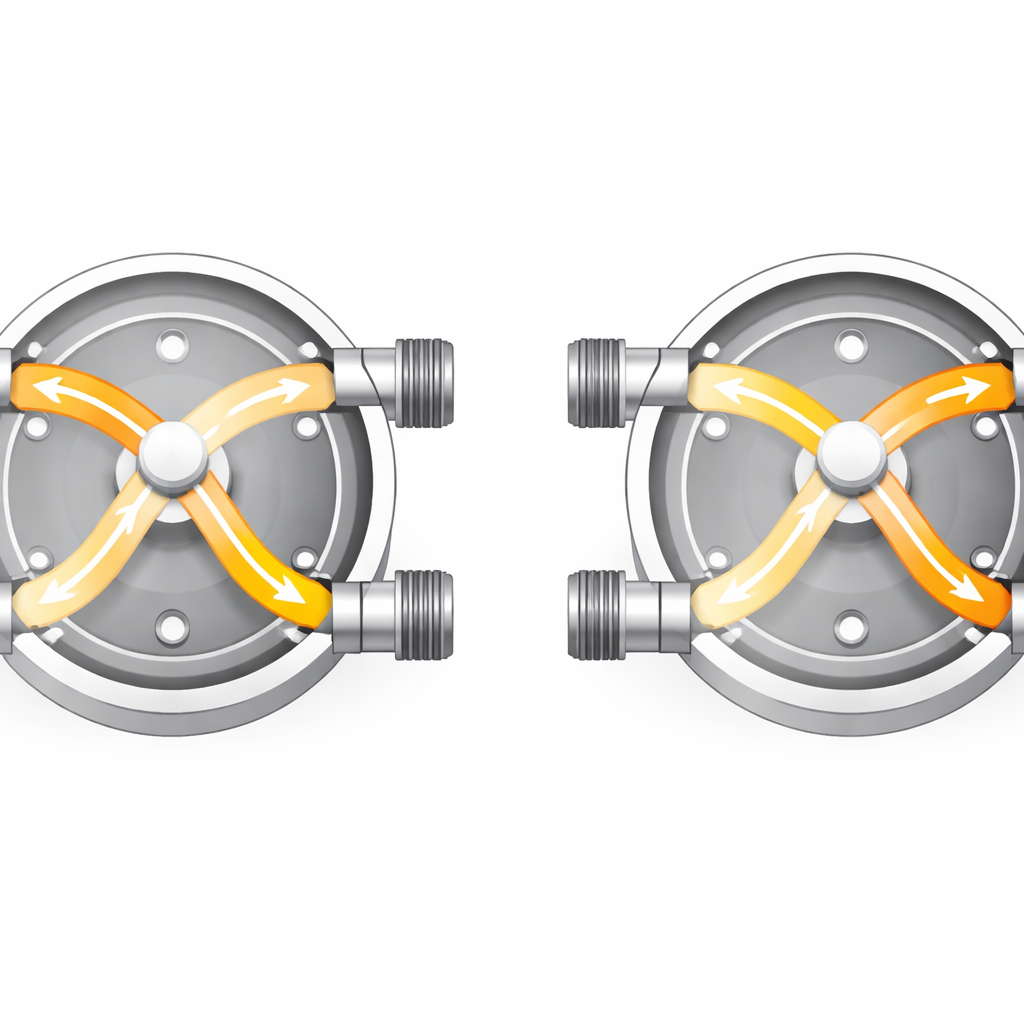
The device introduced in this study is a 3‑1/8‑inch coaxial two‑way switch designed specifically for these fusion RF systems. Instead of allowing only one connection at a time, as in a standard single‑pole double‑throw switch, this design can make two independent connections at once between its four ports. That means RF power can simultaneously flow from one amplifier stage to the next and to a separate line used for testing or smaller plasma experiments. The same RF load can therefore serve many roles, from a modest 2 kilowatt stage up to a 1.5 megawatt system, greatly improving how efficiently existing hardware is used.
Engineering a precise metal crossroads
Because the switch is itself a short length of coaxial line, its internal geometry must closely match the rest of the 50‑ohm transmission system so that almost all the RF power passes through instead of bouncing back. The authors describe how they designed the inner and outer conductors, bends, and junctions so that the electromagnetic waves see a smooth path. A rotating brass shaft carries a set of copper conductors that can be turned between two positions, joining either one pair of opposite ports or an alternate cross‑pair. Spring‑loaded "finger" contacts press against the stationary ports to maintain good electrical contact while allowing motion, and a carefully chosen plastic support keeps the inner conductor centered without adding much loss.
Putting the design to the test
The team used computer simulations to predict how well the switch would perform across 10–100 megahertz, the range relevant for their fusion experiments. They focused on three measures: how much power reflects back (return loss), how much is lost in the switch itself (insertion loss), and how well the unused ports are blocked (isolation). The simulations showed extremely small losses and strong isolation in both connection states. They then built the switch and measured it with a network analyzer, confirming low losses—fractions of a decibel—and isolation typically tens of decibels or better between unconnected ports. Additional low‑power tests up to 100 watts showed that only a tiny fraction of the power was reflected, indicating a very good match to the rest of the RF system.
A flexible tool for fusion laboratories
In simple terms, the authors have created a sturdy RF junction box that can steer large radio‑frequency currents to different destinations inside a fusion lab with minimal waste. By combining careful mechanical design with detailed electromagnetic modeling and measurement, they demonstrated a compact switch that is economical, quick to reconfigure, and gentle on valuable RF amplifiers. For laboratories pushing toward practical fusion energy, such hardware offers a practical way to get more science out of each high‑power RF source while reducing downtime and costly re‑plumbing of massive copper lines.
Citation: Singh, R., Gahlaut, V., Babu, V.V. et al. Development and characterization of coaxial two-way switch for RF plasma discharge experiments. Sci Rep 16, 10255 (2026). https://doi.org/10.1038/s41598-026-39452-0
Keywords: fusion tokamak, radio frequency power, coaxial switch, plasma heating, RF engineering