Clear Sky Science · en
Factors influencing herders’ willingness to engage in grassland ecological restoration in Ruoergai County
Why grasslands and herders matter to all of us
On China’s high Tibetan Plateau, vast grasslands support both wildlife and centuries-old herding cultures. Yet these pastures are under growing strain from climate change and heavy use, threatening local livelihoods and a key ecological buffer for Asia. This study looks beyond satellite images and government policies to ask a human question: what makes herders themselves willing to restore damaged grasslands? By unpacking the values, worries, and emotional ties that shape their choices, the research offers clues for designing restoration programs that work with people’s motivations instead of against them.
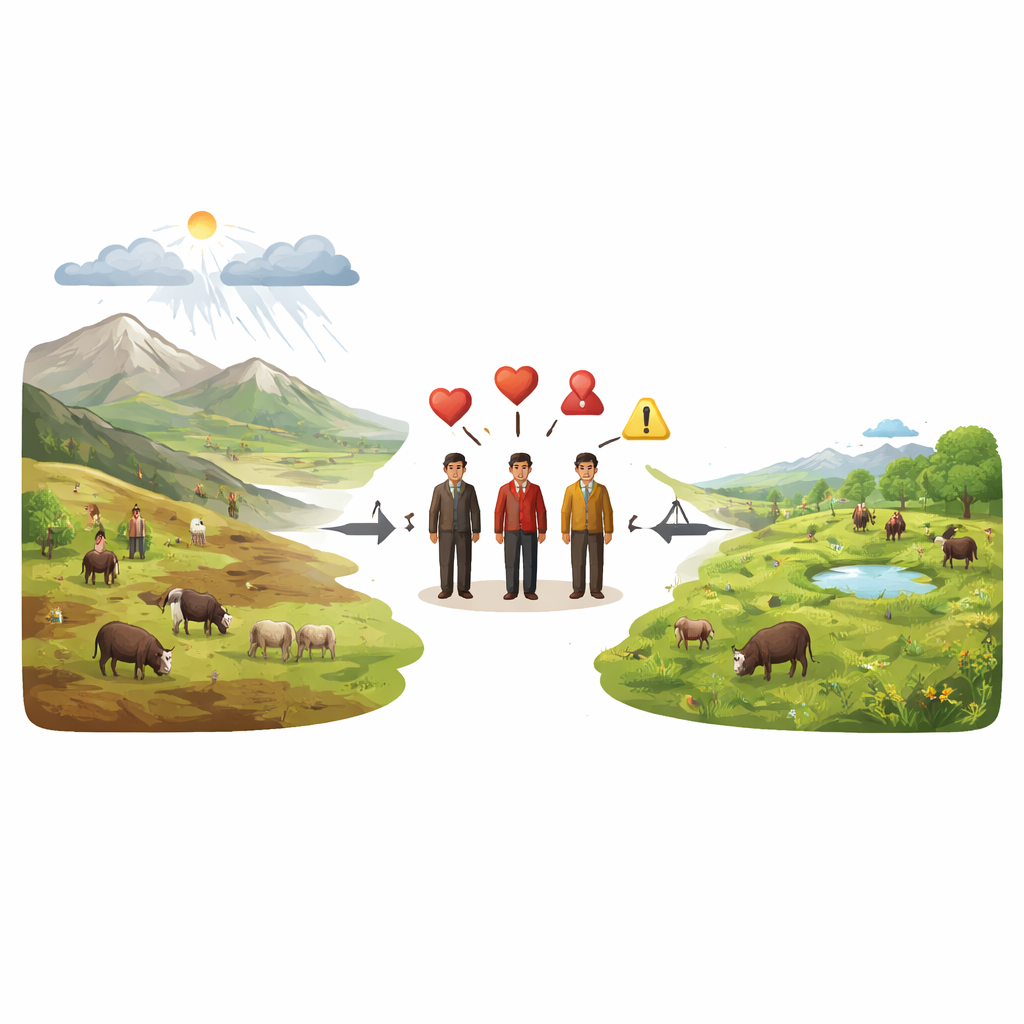
The problem of fading pastures
China’s grasslands cover nearly half the country and are vital for both ecological security and rural economies. In places like Ruoergai County, on the eastern edge of the Qinghai–Tibet Plateau, years of overgrazing, wetland shrinkage, and shifting climate patterns have led to bare soil, poorer water regulation, and rising risks for herders’ animals and income. The government has responded with large restoration programs, including grazing bans, rotational grazing, and payments for ecological protection. But officials have learned that rules and subsidies alone are not enough: the long-term success of these efforts hinges on whether herders feel internally motivated to care for the land, not just compelled to follow orders.
Looking inside herders’ minds and hearts
To understand that inner motivation, the authors draw on a framework from environmental psychology known as the Value–Belief–Norm theory. In simple terms, it suggests that people’s actions for the environment grow out of three steps: what they value, what they believe about environmental problems and responsibility, and the moral rules they set for themselves. The study extends this framework by adding two powerful influences that are especially relevant for pastoral life: how strongly herders perceive ecological and livelihood risks, and how deeply they feel attached to their home grasslands as places of identity and dependence.
Surveying lives on the plateau
The team designed a detailed questionnaire tailored to local culture and language, then gathered responses from 620 herders across Ruoergai through a mix of online and in-person surveys. They measured several hidden psychological factors: views about the value of restoration (including concern for one’s own family, the wider community, and nature itself), perceived environmental, economic, and animal health risks, emotional and practical attachment to the grassland, beliefs about the consequences of degradation, feelings of personal responsibility, and willingness to join restoration activities. Using statistical models, they tested how these pieces fit together, and then applied a complementary method that looks at combinations of factors rather than single causes.

How values, fears, and attachment drive action
The results show a clear chain from what herders value to what they feel morally obliged to do. When herders see grassland restoration as important for their own wellbeing, their community’s future, and the rights of plants and animals, they are more likely to believe degradation has serious consequences and that they share responsibility for fixing it. Those beliefs, in turn, strengthen a sense of personal duty, which then boosts their stated willingness to engage in restoration. At the same time, two other forces act both indirectly and directly. Herders who feel strong emotional and practical attachment to the grassland, and those who keenly perceive the risks of continued degradation to income, grazing space, and livestock health, are more inclined to believe in restoration and to say they intend to act, even beyond moral reasoning alone.
Many paths to strong or weak willingness
When the researchers looked at combinations of conditions, a striking pattern emerged. High willingness to restore the grassland appears when five elements line up together: strong value recognition of restoration, high risk perception, deep place attachment, firm belief in the need and effectiveness of restoration, and a strong personal sense that protecting the grassland is the right thing to do. If all five are weak, willingness is correspondingly low. No single factor is sufficient on its own. This means that policies focused only on money, rules, or information campaigns are unlikely to sustain restoration unless they also nurture people’s values, emotions, and moral commitments tied to place.
What this means for saving grasslands
For non-specialists, the main takeaway is that ecological restoration on the Tibetan Plateau is not just about fencing off land or changing grazing schedules. It is about aligning conservation goals with herders’ lived realities and inner worlds. The study suggests that the most effective strategies will combine material incentives with education that links restoration to family security, programs that honor cultural and spiritual ties to the grassland, and communication that makes ecological risks concrete and visible. When herders see the grassland as central to who they are, grasp the dangers of inaction, and feel personally responsible for its fate, their willingness to restore it becomes both stronger and more enduring.
Citation: Shen, C., Wang, K., Huang, L. et al. Factors influencing herders’ willingness to engage in grassland ecological restoration in Ruoergai County. Sci Rep 16, 12411 (2026). https://doi.org/10.1038/s41598-026-39449-9
Keywords: grassland restoration, pastoral herders, Qinghai–Tibet Plateau, environmental values, place attachment