Clear Sky Science · en
Theoretical investigation of fast illicit drug detection via ternary photonic crystals
Why Faster Drug Checks Matter
From airport security lines to hospital emergency rooms, being able to spot illegal drugs quickly and reliably can save time, money, and lives. Today, many confirmation tests for drugs still rely on large laboratory machines that are slow and expensive. This paper explores a new kind of light‑based sensor that could one day help detect illicit substances more rapidly, using a tiny layered structure that fits on a chip and reads out changes in light instead of relying on chemical labels or lengthy preparation.
Stacking Tiny Layers to Control Light
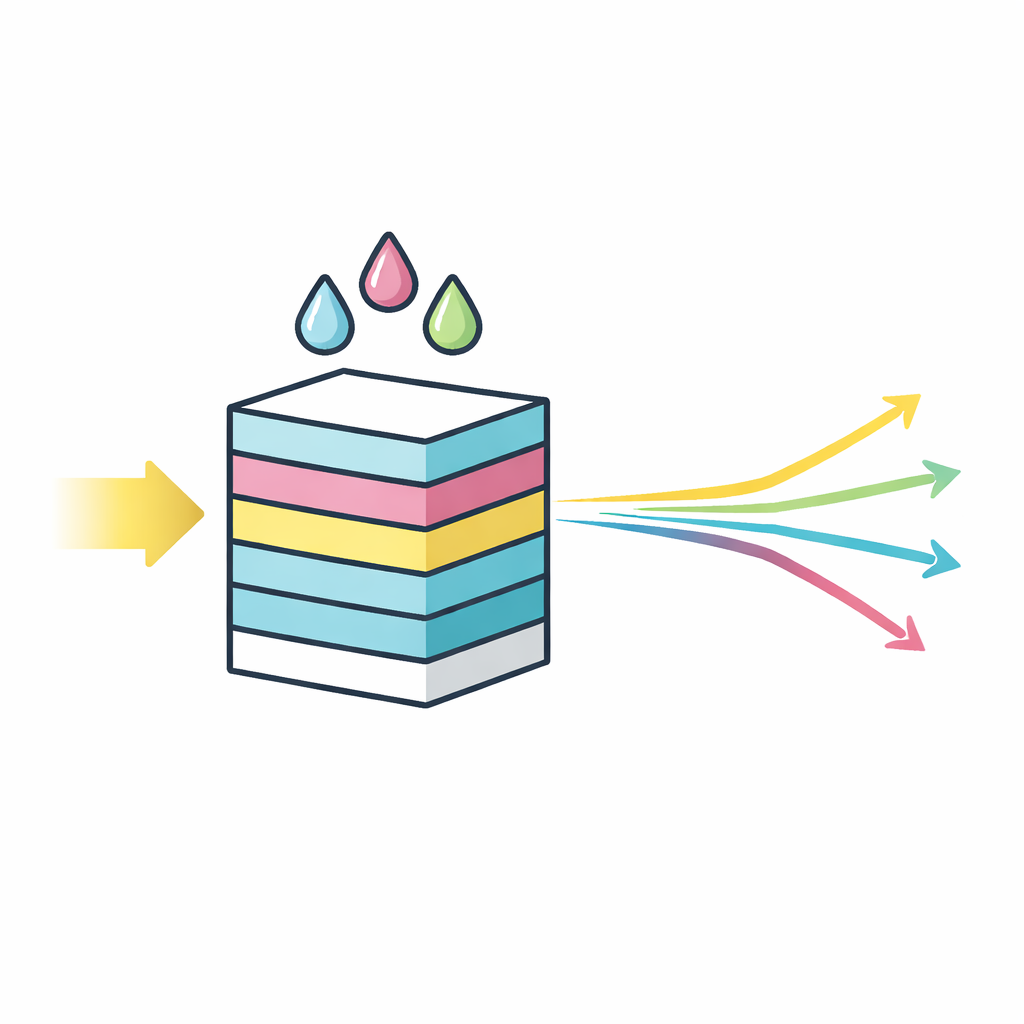
At the heart of the study is a carefully engineered stack of ultra‑thin films called a one‑dimensional photonic crystal. Imagine a microscopic layer cake made from three repeating ingredients: a conductive plastic, a semiconductor containing lead, and a special class of nanosized crystals known as quantum dots. In the middle of this stack, the designers leave a slightly different “defect” layer—essentially a narrow pocket that can be filled with a liquid sample such as blood or a dissolved drug. When light passes through the stack, most colors are blocked, but a specific color is allowed to sneak through thanks to that central pocket, making the whole device behave like an extremely sharp color filter.
Turning Optical Shifts Into Drug Signals
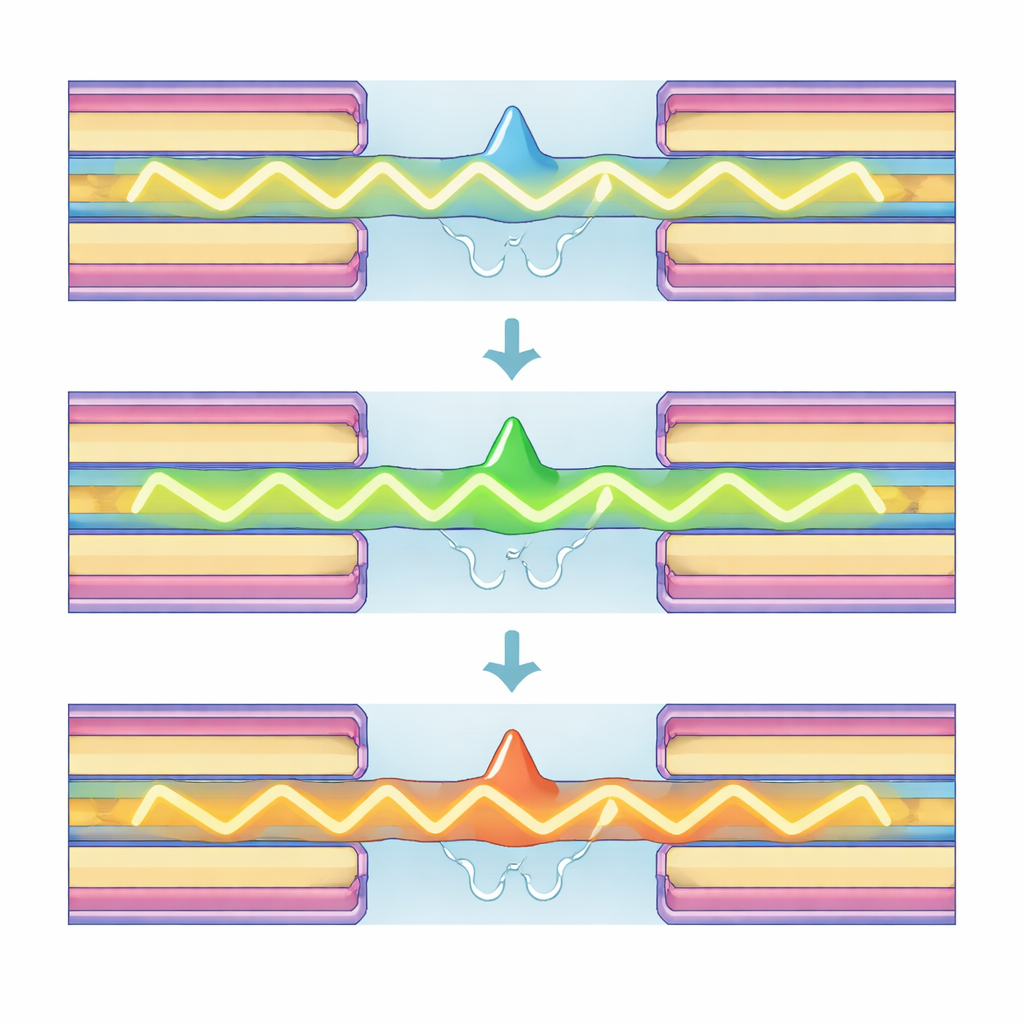
The key idea is that the exact color of the transmitted light depends on how easily light travels through the sample in the defect layer, a property linked to its refractive index. Different drugs dissolved in the same solution change this property in slightly different ways. The authors simulate what happens when the defect layer is first filled with normal human blood and then separately with alcohol, heroin, cocaine, amphetamine, or ketamine. Each substance shifts the transmitted color by a distinct amount toward longer or shorter wavelengths, like moving the needle on a highly precise color dial. Because the shift is large compared with the tiny change in refractive index, the sensor can, in theory, tell these drugs apart without any added dyes or labels.
Tuning the Layer Cake for Maximum Response
To make the color shift as strong and clean as possible, the researchers systematically adjust several design knobs. By changing how much aluminum is mixed into the quantum dots, they can fine‑tune how strongly the layers interact with light and thus boost the sensitivity. They also study how the angle at which light enters, the number of repeated layer groups, and the thickness of the central pocket affect performance. Larger entry angles and a thicker central layer make the allowed color shift more dramatically when the sample changes, while using fewer repeated periods increases how strongly the light “feels” the presence of the drug. Through these simulations, they identify a combination of parameters that makes the device especially responsive.
How Well the Virtual Sensor Performs
Under the best simulated conditions, the proposed structure produces exceptionally large color shifts for small changes in the sample’s optical properties. The authors quantify this using standard sensing metrics and find that their design surpasses the sensitivity of several recent optical drug sensors reported in the literature. In their model, alcohol in particular produces a very strong and sharp response, while other drugs are still clearly distinguishable. The sharpness of the transmitted peak, the ability to separate nearby colors, and the low estimated detection limit all suggest that such a device could, in principle, pick up even faint traces of target substances once it is built and calibrated.
From Theory to Real‑World Testing
Although the work is theoretical and based entirely on computer calculations, it points to a promising route toward compact, rapid drug screening tools. By exploiting the way a finely layered structure traps and channels light through a tiny sample pocket, the sensor turns subtle optical changes into clear, measurable signals. The authors note that real‑world challenges—such as fabrication imperfections, temperature swings, and complex biological mixtures—still need to be addressed in future experiments. If these hurdles can be overcome, this kind of photonic crystal device could form the backbone of next‑generation, label‑free drug detectors for forensic, clinical, and security applications.
Citation: Mohamed, B.A., Aly, A.H., Mobarak, M. et al. Theoretical investigation of fast illicit drug detection via ternary photonic crystals. Sci Rep 16, 11240 (2026). https://doi.org/10.1038/s41598-026-39408-4
Keywords: illicit drug detection, photonic crystal sensor, optical biosensing, quantum dots, refractive index