Clear Sky Science · en
Design of a photonic bolometric sensor using microring resonators for high-energy radiation detection
Watching invisible storms in space
High above Earth, bursts of high‑energy radiation flash past our planet with little warning. These events matter for astronauts, satellites, and even power grids on the ground, yet the instruments we use to watch them are often bulky and power‑hungry. This paper presents a new kind of tiny light‑based sensor that could ride on small satellites and quietly track these invisible storms by feeling the faint warmth they leave behind.
Why tiny satellites need new eyes
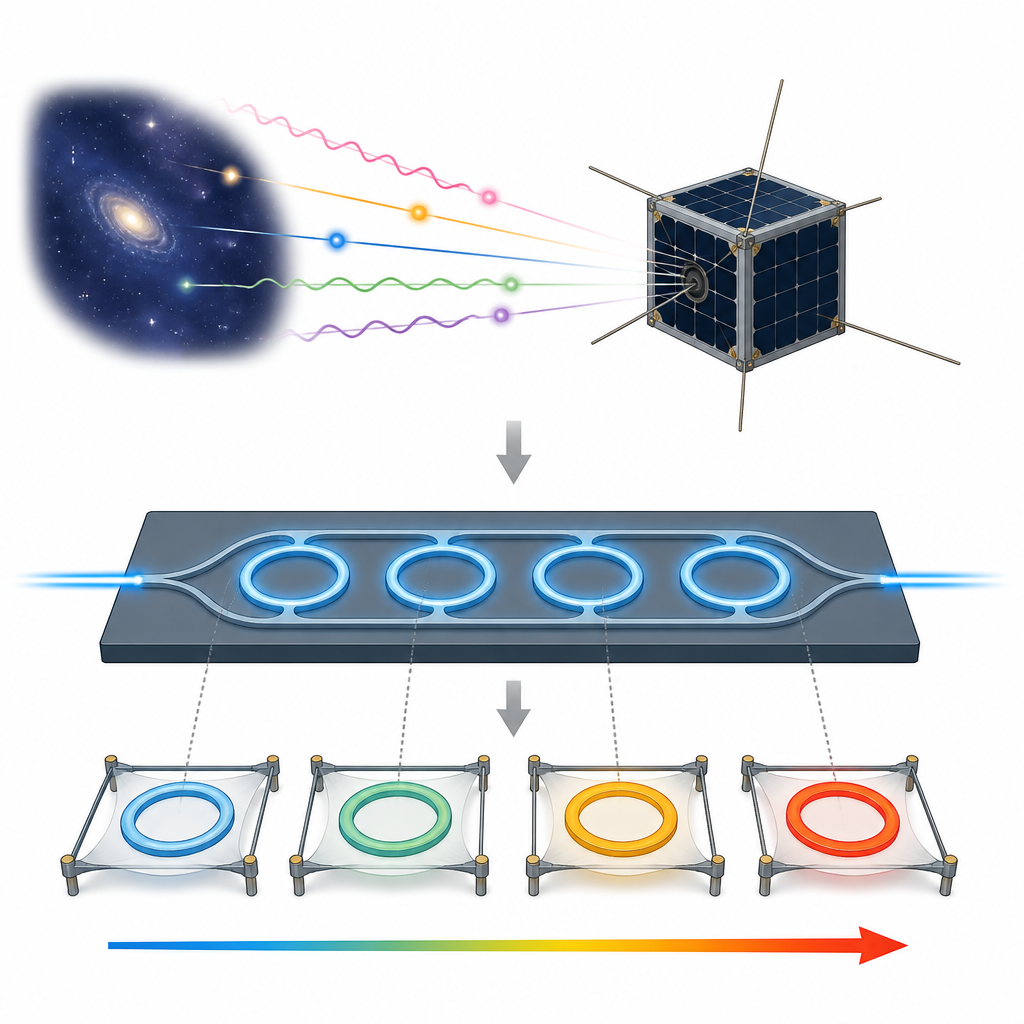
Space is filled with energetic particles and gamma rays from our Sun, from lightning storms in the atmosphere, and from distant cosmic explosions. To monitor them properly, detectors must fly in space rather than sit safely on Earth. Traditional gamma‑ray instruments rely on large gas chambers, heavy crystals, or solid‑state chips that can age under intense radiation and often require complex electronics. These systems are hard to fit on CubeSats and other miniature spacecraft, whose size, weight, and power budgets are extremely tight. The authors ask whether a compact, integrated light‑based detector can offer similar sensitivity while taking up only a tiny corner of a satellite.
A light ring that works as a tiny heat sensor
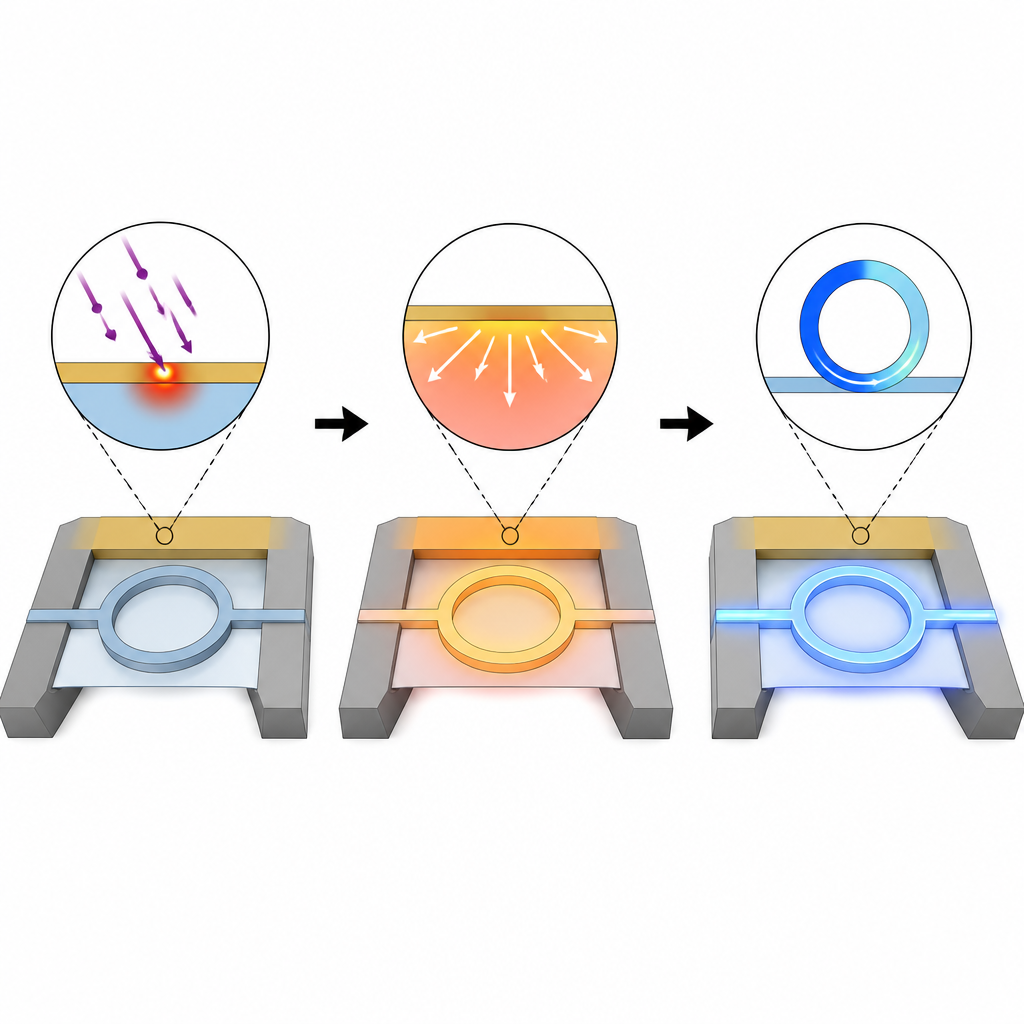
The proposed device is built around microscopic rings that guide laser light on a silicon chip. Under normal conditions, each ring lets certain colors of light pass while blocking others, much like a sound box that echoes at specific notes. The rings sit on a thin glass‑like membrane and are covered by a very thin layer of gold that acts as a target for incoming radiation. When a gamma‑ray or energetic particle hits the gold, it deposits energy as heat, warming the nearby ring by a tiny amount. That slight temperature rise subtly changes how the ring guides light, shifting the favored color. By watching how the transmitted light intensity changes at a fixed color, electronics on the satellite can infer how much energy has been deposited.
How well the sensor absorbs and feels the heat
Using detailed computer models, the authors compare several metals to find the best absorber for high‑energy radiation. Gold stands out, capturing a large fraction of gamma‑ray energy in the range important for flashes linked to thunderstorms, while staying compatible with standard chip fabrication. Simulations show that a 10‑micrometer‑thick gold layer can absorb from a few percent up to nearly all of the incoming low‑energy gamma photons, and it also works well for energetic electrons. A second set of models tracks how the deposited heat spreads through the tiny structure. The temperature across the ring becomes uniform within about ten microseconds and cools back to its starting value in less than a hundredth of a second, fast enough to follow short‑lived bursts of radiation. The change in the ring’s favored color grows roughly in step with the incoming energy, which makes the device easier to calibrate.
Built to survive the ride to space
Because the absorbing layer is dense and the membrane is thin, mechanical strength is a key concern. The team therefore tests how the structure would vibrate under launch‑like conditions. Their models show that the first mechanical resonances sit far above the frequencies typically experienced by a small satellite riding a rocket, even when the gold layer is made thicker. The parts that move the most during vibration are placed away from the optical pathways, so the tiny light guides remain well aligned. Overall, the structure combines strong thermal isolation, needed for sensitivity, with enough stiffness to stay intact and functional in orbit.
What this could mean for watching space weather
The analysis suggests that this microring sensor could detect energy deposits of only a few dozen thousand electron volts, while remaining small, light, and compatible with room‑temperature operation. Arrays of such rings, each tuned or coated differently, could watch for different types of radiation on the same chip, improving the awareness of CubeSats and larger missions alike. Although the work is theoretical for now, it points toward future satellite instruments that use light to feel tiny temperature changes, turning compact photonic chips into sensitive eyes for the high‑energy events that sweep through near‑Earth space.
Citation: Maleki, M., Brunetti, G. & Ciminelli, C. Design of a photonic bolometric sensor using microring resonators for high-energy radiation detection. Sci Rep 16, 15237 (2026). https://doi.org/10.1038/s41598-026-39369-8
Keywords: space radiation, gamma rays, CubeSat sensors, photonic microring, bolometric detector