Clear Sky Science · en
Computational analysis of a spatiotemporal model of cancer-immune-chemotherapy dynamics with nonlinear diffusive interactions using spectral technique
Why this research matters for cancer care
Cancer treatment today often feels like educated guesswork: some patients respond dramatically, others barely at all, and tumors can return even after an apparently successful therapy. This article explores how advanced mathematics and computing can turn that uncertainty into something more predictable. By building a detailed model of how tumor cells, immune cells, and chemotherapy drugs move and interact in real tissue, the authors aim to help doctors and researchers understand when a tumor will be cleared, when it will come back, and how to adjust treatment to tip the balance in the patient’s favor. 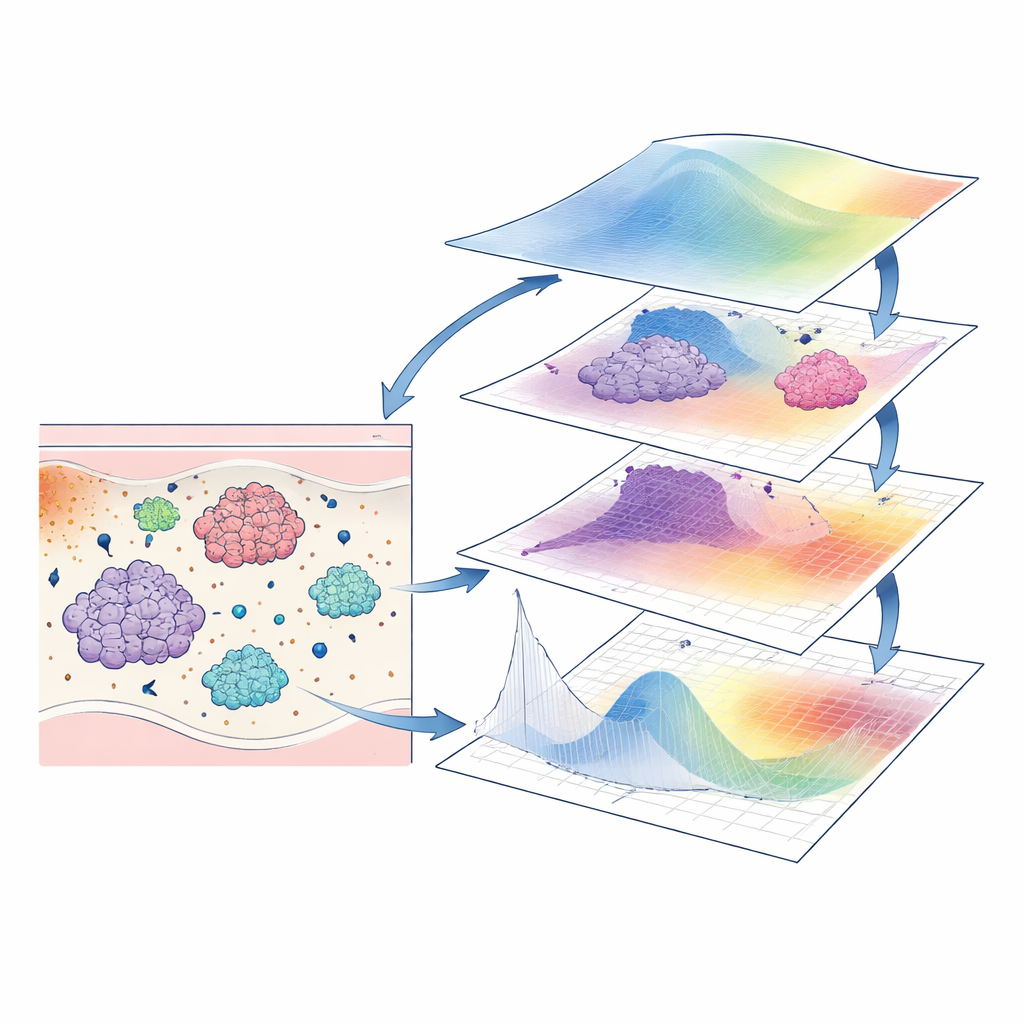
A digital playground for tumors and treatments
The authors develop a virtual laboratory in which three main players evolve together over space and time: cancer cells, immune cells that attack the tumor, and chemotherapy drugs that poison cancer cells. Instead of assuming that everything is well mixed, like ingredients in a stirred pot, the model allows these components to spread, cluster, and interact unevenly across a patch of tissue. Tumor cells grow but are limited by crowding; immune cells are constantly supplied, multiply when they encounter tumor, and eventually die; drugs diffuse through tissue, break down, and can be delivered in different patterns. This framework turns biological intuition into equations that can be simulated and tested under many scenarios that would be difficult or unsafe to explore directly in patients.
Sharper numerical tools for a complex problem
Simulating such a detailed system is not trivial. Many standard numerical methods require extremely fine grids and long computing times to track steep fronts and sensitive interactions, especially when diffusion and reaction terms behave in a strongly nonlinear way. To overcome this, the authors use a technique called a Legendre spectral collocation method, which represents spatial variations using smooth basis functions rather than simple grid values. For smooth patterns, this approach converges extremely quickly, meaning it can capture the key behavior of the tumor-immune-drug system with relatively few points and high precision. Careful convergence tests show that errors fall off almost exponentially as the spatial resolution increases, confirming that observed patterns are genuine properties of the model rather than numerical artifacts.
When tumors vanish, persist, or return
With their model in place, the researchers explore a spectrum of treatment scenarios, from immune-based therapies alone to combined chemo–immunotherapy, time-limited chemotherapy courses, and heterogeneous brain tumors such as glioblastoma. They derive conditions under which the system settles into a tumor-free state versus a chronic, persistent tumor. A key quantity is a threshold number that measures whether a single tumor cell, in the presence of immune cells and drug, generates more than one successor on average. If this value is below one, the tumor eventually disappears; above one, it can invade and survive. Simulations show that strong immune killing and recruitment can clear tumors even without chemotherapy, while weaker immune activity allows cancer to escape control. Adding chemotherapy can dramatically enhance suppression, but only if the drug is potent enough and reaches the tumor effectively. 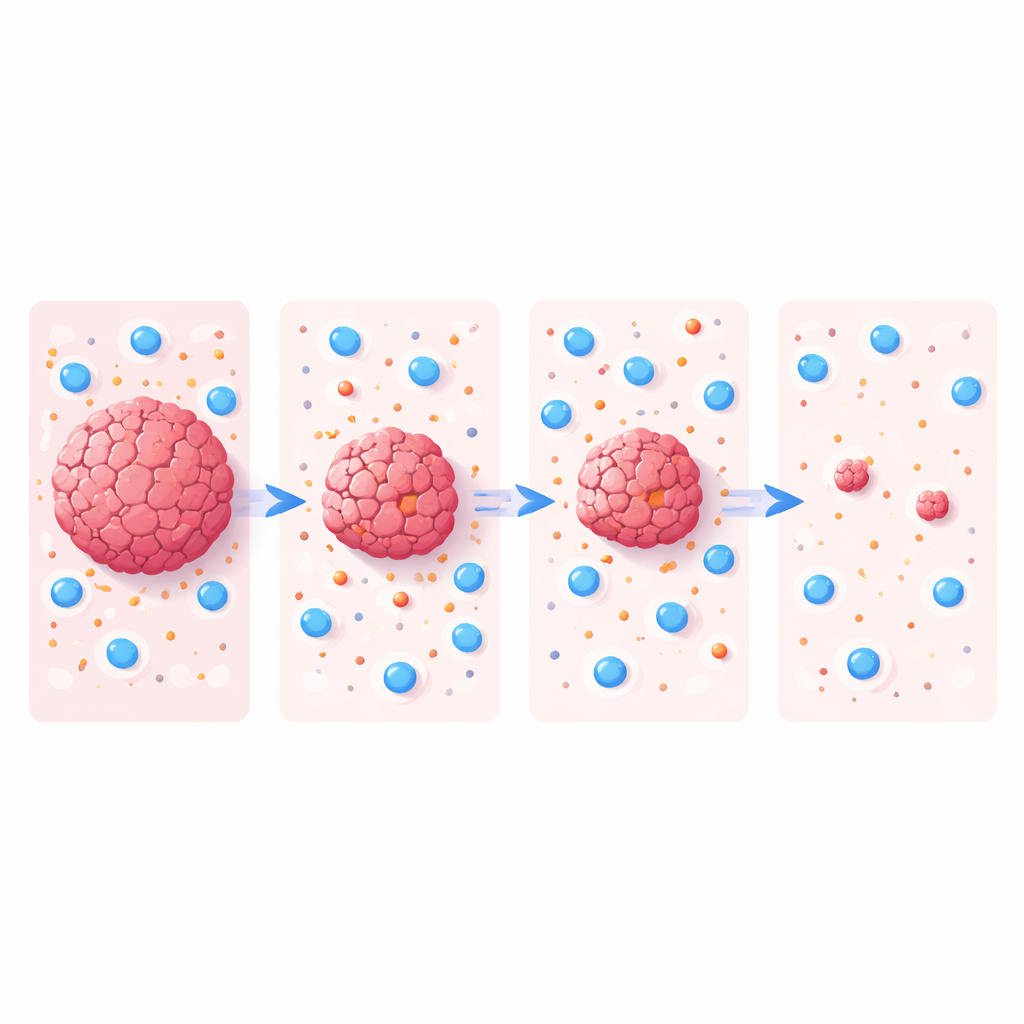
The role of space: hot spots, cold spots, and drug deserts
A particularly important insight is the role of spatial unevenness. The model reveals that patches with poor drug penetration or limited immune access can act as sanctuaries where cancer cells survive and later reseed the tumor. In examples mimicking glioblastoma, regions with lower drug effectiveness or slower cell motion lead to stubborn residual pockets of disease, even when average measures suggest good control. Conversely, when treatment intensity and spatial coverage are sufficiently high, tumors are wiped out across the entire domain with no rebound. Sensitivity analysis further shows that tumor growth rate, immune efficiency, and chemotherapy potency are the most influential levers for shifting outcomes, underscoring the importance of early, sufficiently aggressive, and well-distributed therapy.
What this means for future personalized treatment
Overall, the study argues that carefully constructed mathematical models can do more than produce pretty curves: they can clarify why some treatment plans fail, identify parameters that most deserve measurement or boosting, and guide the design of more personalized strategies. By tying together tumor growth, immune response, and chemotherapy in a spatially detailed way, this framework helps explain when a tumor will be eradicated, when it is likely to relapse after drug withdrawal, and how improving immune strength or drug distribution might change that fate. While still idealized and awaiting calibration to individual patients, such models point toward a future in which oncologists can test candidate therapy schedules on a computer first and use the resulting “maps” to better plan real-world cancer care.
Citation: Shi, H., Khan, S.U., Khan, F.U. et al. Computational analysis of a spatiotemporal model of cancer-immune-chemotherapy dynamics with nonlinear diffusive interactions using spectral technique. Sci Rep 16, 11294 (2026). https://doi.org/10.1038/s41598-026-39289-7
Keywords: cancer modeling, tumor-immune dynamics, chemotherapy, mathematical oncology, spatial diffusion