Clear Sky Science · en
Prediction of heat stress response in dairy cows using milk mid-infrared spectra
Why summer heat matters for dairy cows
As heat waves become more frequent with climate change, dairy cows are struggling to stay cool. High temperatures can make them uncomfortable, reduce how much milk they produce, and affect farmers’ livelihoods. Yet tracking which individual cows suffer most from heat is surprisingly difficult and usually requires extra sensors or environmental measurements. This study explores a clever shortcut: using the chemistry of milk itself, measured during routine testing, to reveal how strongly each cow responds to heat.
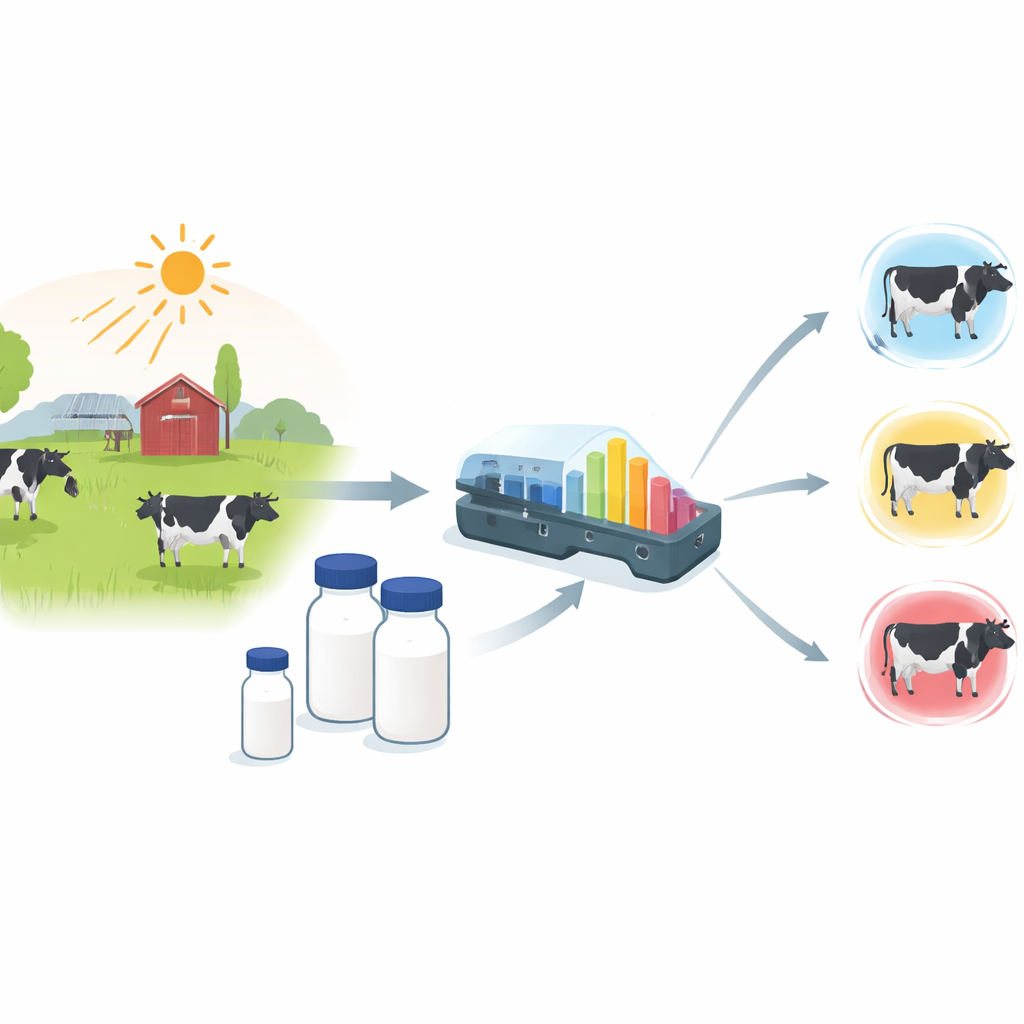
Reading the story of heat from a glass of milk
In many dairy regions, milk from each cow is already checked several times a year using mid-infrared light, a technique that reveals its detailed chemical makeup. The authors reasoned that if heat stress changes milk composition, those changes should leave a fingerprint in these mid-infrared spectra. Instead of installing new barn sensors or taking rectal temperatures, one could use existing milk records to estimate how hard heat is hitting each cow. That would make heat stress monitoring cheaper, easier to scale, and independent of weather station data, which often miss how hot it really gets inside barns.
Linking warm udders and milk changes
The researchers collected data from 399 Holstein cows on five Belgian farms during summer heat waves and during cooler autumn periods. While the cows were milked, they used an infrared camera to measure the surface temperature of each udder — a non-invasive stand-in for body temperature. At the same time, they analyzed milk yield and composition, including fat, protein, and magnesium levels. By comparing heat-wave records with thousands of historical milk tests from the same farms, they calculated how far each cow’s milk traits had drifted from what would be expected under normal, comfortable conditions.
Turning complex data into a heat stress score
From these measurements the team built two kinds of prediction models based solely on the milk spectra. The first model estimated udder surface temperature, essentially asking, “How hot is this cow likely to be?” It reproduced measured temperatures with a typical error of about two-thirds of a degree Celsius. The second model sorted milk samples into three groups: clearly affected by heat, clearly not affected, or in an intermediate “uncertain” zone. Although not perfect, it correctly classified cows in about six out of ten cases and rarely confused strongly affected cows with clearly unaffected ones. The researchers then combined both approaches into a single three-level heat stress response score and applied it to over one million routine milk samples collected from 2020 to 2022.
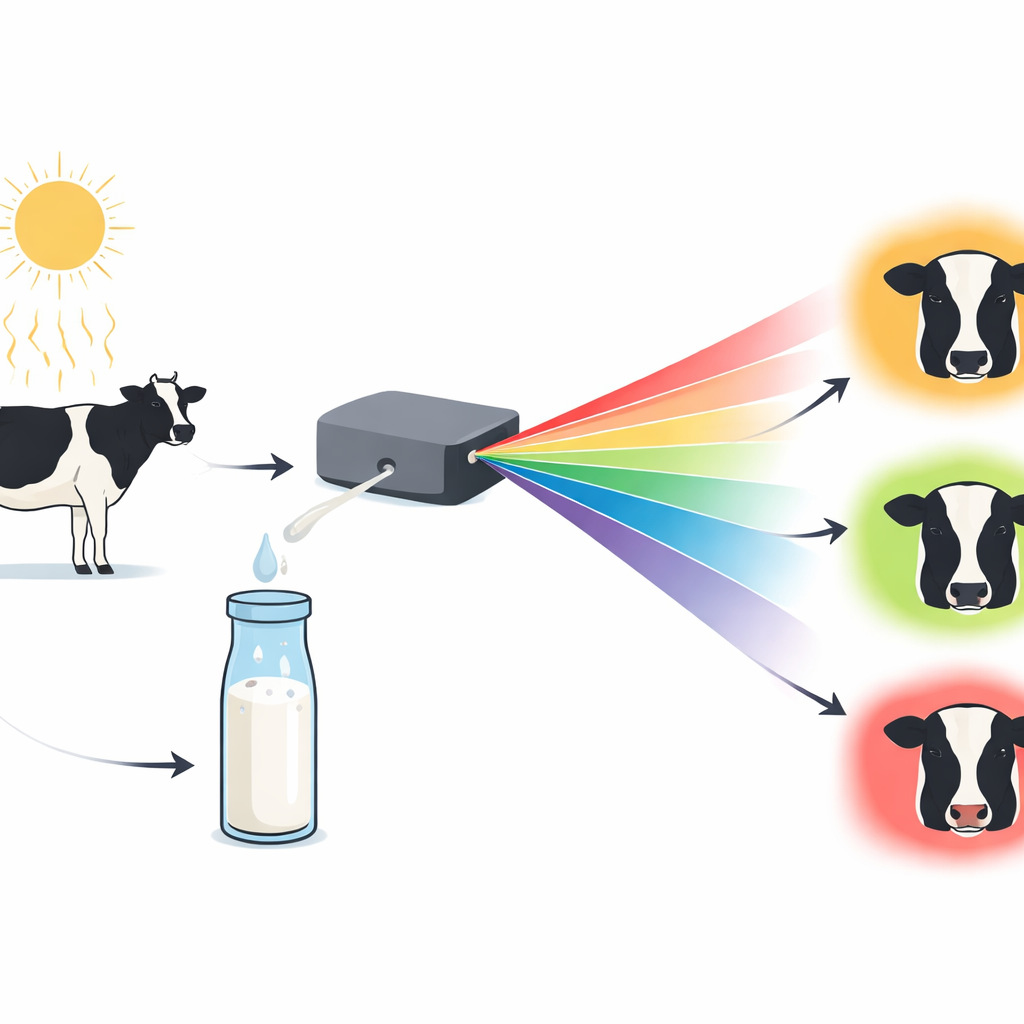
What large-scale patterns reveal
When the combined score was plotted against a standard heat index that mixes temperature and humidity, a clear pattern emerged. Cows almost never showed signs of heat stress at low index values, but responses increased once average conditions reached levels typically associated with discomfort. The model highlighted well-known risk factors: cows in early lactation, those producing the most milk, and older animals tended to have higher predicted heat stress scores. It also exposed big differences among farms exposed to similar weather, suggesting that local housing, shade, and management practices — as well as genetics — strongly shape how cows cope with hot spells.
What this means for farmers and breeding
The study shows that a single milk test can carry enough information to flag cows that struggle in the heat, without extra equipment or added cost. While the prediction still needs formal validation and refinement, it already behaves in line with biological expectations and previous research. In practical terms, this approach could help farmers identify vulnerable animals, fine-tune cooling strategies in barns, and support breeding programs that favor more heat-tolerant cows — all by making smarter use of data they are already collecting.
Citation: Lemal, P., Grelet, C., Dehareng, F. et al. Prediction of heat stress response in dairy cows using milk mid-infrared spectra. Sci Rep 16, 14258 (2026). https://doi.org/10.1038/s41598-026-39287-9
Keywords: heat stress, dairy cows, milk infrared analysis, cow welfare, climate change and livestock