Clear Sky Science · en
Dynamic background motion object semantic segmentation algorithm based on generative adversarial network and transformer collaboration
Seeing Clearly in a Moving World
From self-driving cars to smart security cameras, machines increasingly need to understand what is happening in busy, fast-changing scenes. Yet for a computer, telling a moving person apart from shimmering headlights, swaying trees, or motion blur is far from easy. This study presents a new way for artificial intelligence to pick out moving objects in complex video, even when the background itself is in motion, the light is poor, or the image is blurred.
Why Busy Scenes Confuse Machines
Our world is rarely still. Cars pass under flickering streetlights, crowds weave through each other, and rain or shadows constantly reshape what a camera sees. Traditional computer-vision systems were designed for calmer views, where the background does not change much. In hectic scenes, they often confuse moving objects with moving background patterns, or lose track of people and vehicles when light changes suddenly or when the camera itself is moving. These weaknesses limit the safety of autonomous driving and the reliability of intelligent surveillance in the very situations where accuracy matters most.
Two Powerful Ideas Working Together
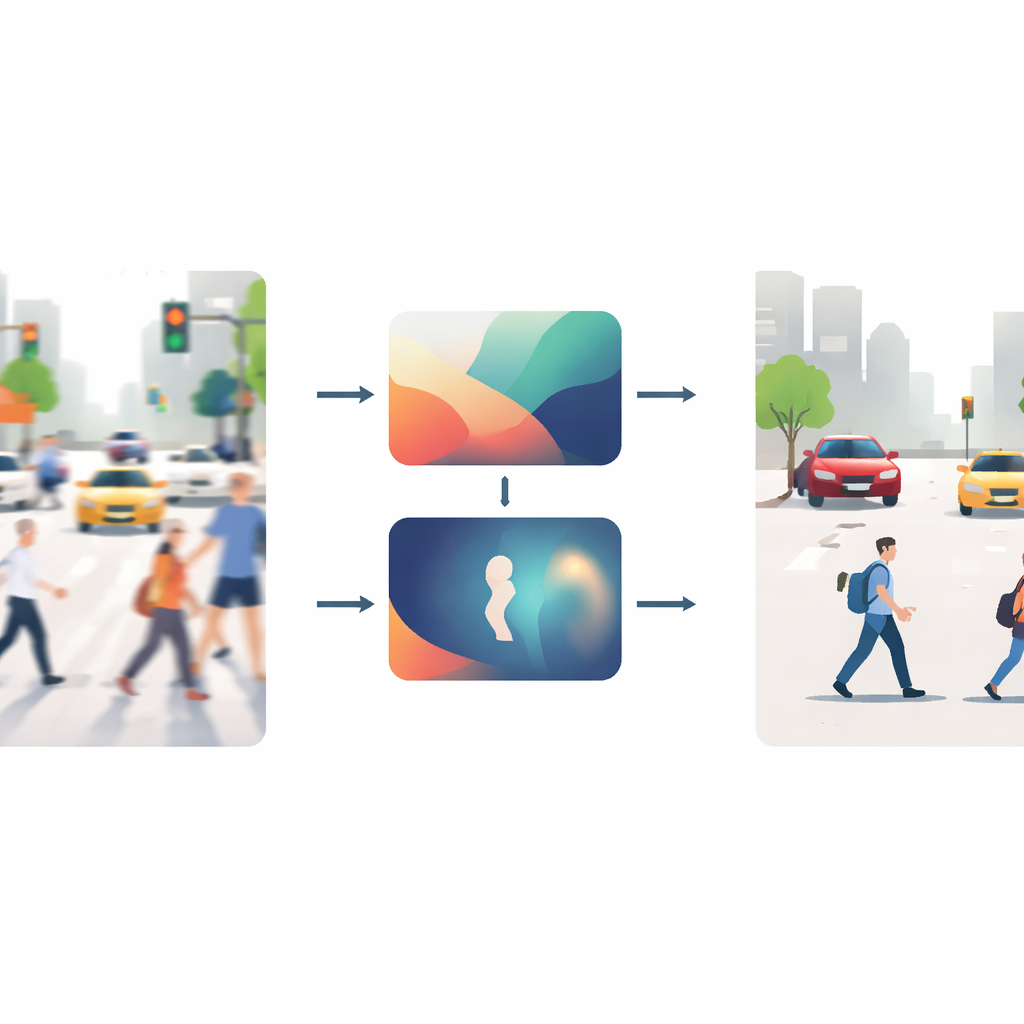
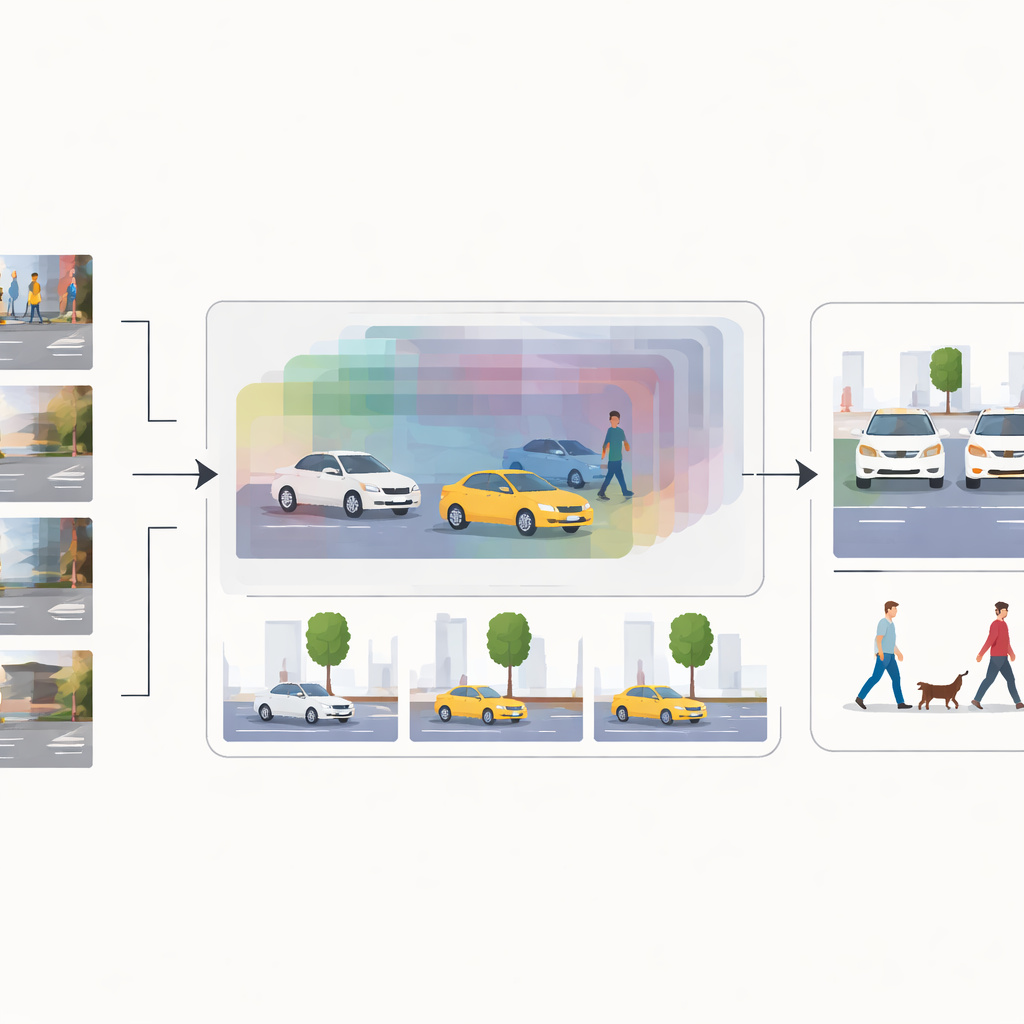
To overcome these problems, the authors combine two influential AI ideas into a single, tightly connected system: one that specializes in creating realistic images, and one that excels at understanding long-range relationships in data. The first, a generator–discriminator pair, learns to synthesize many versions of the same scene with different lighting, motion blur, and background motion. This effectively builds a rich training ground where the model repeatedly practices dealing with difficult visual conditions. The second, a transformer-based module, views the entire image at once and uses an internal attention mechanism to decide which regions are most important, allowing it to link distant parts of the scene and better distinguish foreground objects from a restless background.
Balancing Background Noise and Object Detail
A key innovation is how the system decides, for each region of an image, how much to trust the background modeling versus the object-focused understanding. Instead of simply stacking one module after the other, the authors design a “gated” fusion step that mixes three sources of information: the simulated dynamic background, basic visual cues from standard image filters, and the high-level semantic map produced by the transformer. A learned gate smoothly shifts emphasis toward the background model where distractions are strongest, and toward the object-focused features near the edges of cars, people, or other targets. Additional rules encourage the generated backgrounds to stay semantically consistent with real ones, so that training data is not only visually plausible but also meaningful for the task.
Following Motion Over Time
Real video is not just a collection of separate frames; motion carries crucial clues. To capture this, the system includes a temporal attention module that brings in motion information derived from optical flow, a method for estimating how pixels move from one frame to the next. This module helps the model follow objects as they move, become partially hidden, or reappear, keeping their outlines stable across many frames. The authors test their approach both on carefully controlled virtual scenes—where lighting, motion speed, and background clutter can be tuned—and on the well-known KITTI driving dataset, which contains challenging real-world street footage.
What the Results Mean in Practice
The combined system delivers crisper and more reliable separation of moving objects from their surroundings than several widely used methods. It achieves higher average overlap between its predicted object regions and the true regions, stays more stable across a variety of lighting and motion conditions, and fluctuates less over time. Removing any major component—image generator, transformer, or fusion and temporal modules—noticeably weakens performance, underscoring that the gains come from their cooperation rather than any single trick. Although this richer design requires more computation, it already runs fast enough for many real-time uses with modern graphics hardware. In practical terms, the work shows that teaching machines to imagine challenging scenes and to pay selective, time-aware attention allows them to “see” more like we do, improving the safety and reliability of systems that must interpret a constantly moving world.
Citation: Li, Y., Luo, Z., Chen, T. et al. Dynamic background motion object semantic segmentation algorithm based on generative adversarial network and transformer collaboration. Sci Rep 16, 12626 (2026). https://doi.org/10.1038/s41598-026-39249-1
Keywords: dynamic scene understanding, moving object detection, autonomous driving vision, video semantic segmentation, computer vision robustness