Clear Sky Science · en
Guidance and absorption of internal energy in Vivaldi antennas using multiple slots, full-band dividers, metamaterials, and distributed resistors
Why taming antenna energy matters
Wireless devices—from 5G base stations to imaging radars—depend on antennas that can send and receive focused signals over a wide range of frequencies without wasting precious energy. Yet in many advanced planar antennas, a surprising amount of the energy fed into the structure does not become useful radiation. Instead, it sloshes around inside as stray electromagnetic energy, quietly degrading performance. This paper shows how to redesign a popular antenna type so that more of the energy goes exactly where we want it, and less is lost or reflected, resulting in stronger, cleaner, and more efficient wireless beams.
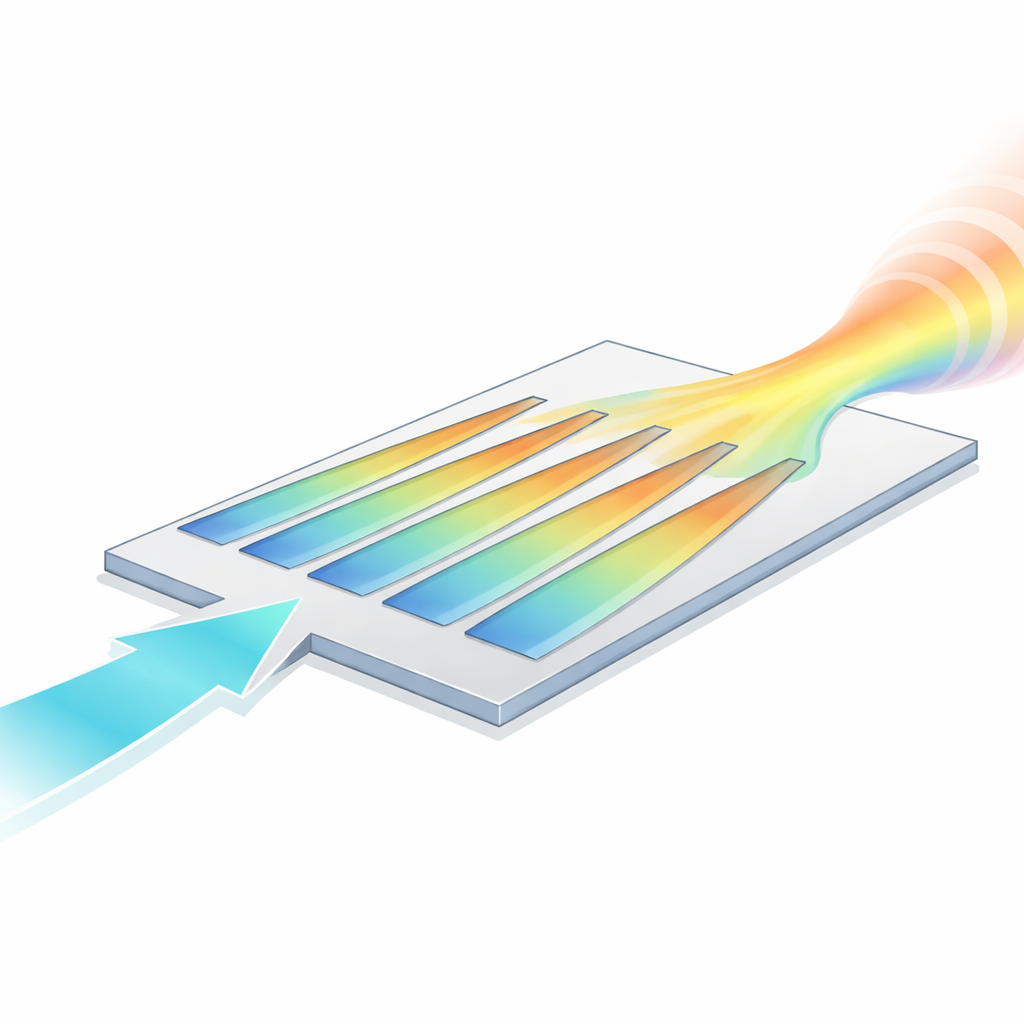
Shaping a smarter antenna board
The work focuses on a traveling-wave antenna known as a Vivaldi antenna, which is attractive because it can operate over a very wide band of frequencies and can be built as a flat circuit board. The authors first analyze a basic design that uses two tapered slots, then extend it to a four-slot version. Arranging multiple slots increases the effective opening through which the antenna radiates, much like widening a flashlight reflector to produce a tighter beam. Doubling the number of slots roughly doubles the power density in the main direction, boosting the gain by about 3 decibels. However, measurements also reveal strong ripples in gain across frequency: at some frequencies the antenna radiates very well, while at others destructive interactions inside the structure reduce performance.
Seeing hidden energy inside the antenna
To understand these ripples, the team turns to detailed maps of the near field—the electromagnetic activity very close to the metal shapes. By tracking how energy clusters travel through the structure over time, they distinguish between useful flows that head straight toward the opening and unwanted flows that take detours, bounce back toward the feed ports, or arrive late. They call these latter contributions residual energy. Even though this residual energy is invisible in normal far-field measurements, it shows up clearly in the near-field maps as bright regions along certain edges and gaps. These late or misdirected waves interfere with the main radiation, causing the observed gain ripples and extra reflections.
Guiding waves with engineered materials
Once the dominant paths are known, the authors reshape how energy moves by adding small patterned metal inclusions—an engineered “metamaterial”—inside each tapered slot. These tiny repeated elements slow down the waves more in the center of each slot than near the edges, helping the front of the wave flatten out as it reaches the opening. A flatter wavefront means that contributions from different parts of the aperture arrive in phase and reinforce each other, increasing directivity. Simulations and measurements show that this metamaterial treatment raises the antenna gain by about 1 decibel over a wide band and slightly reduces reflections, indicating that more of the input power is converted into forward radiation.

Soaking up leftover energy
Flattening the main wavefront is not enough; significant residual energy still circulates along side wings and isolation gaps. To deal with this, the authors deliberately carve zigzag slots into the outer wings and use existing gaps between central wings as preferred paths for stray energy. They then place dozens of tiny resistors along these paths. The zigzag shape lengthens the route and enhances voltage differences, which attract and funnel residual energy into the resistors, where it is harmlessly converted to heat. Using circuit models based on many-port scattering data, the team mathematically optimizes each resistor value so that, across 1.6 to 20 gigahertz, reflections at the input ports are minimized and absorption is maximized. With the optimized resistor network and a small conductive loop to close certain circuits at low frequency, the antenna’s gain curve becomes smooth, peak gain rises to about 20 decibels for a single device and around 25 decibels for a four-by-four array, and the repeated spurious pulses in time-domain radiation nearly disappear.
Feeding arrays for real-world systems
To use these antennas in practice, many identical elements must be driven in unison. The authors therefore design new power dividers built from simple T-shaped line junctions that split one input into four, and then combine them hierarchically to feed sixteen elements. These dividers keep the same impedance at all ports and maintain nearly equal phase and amplitude across the wide operating band, so the array behaves like one large, well-focused radiator. Measurements on a fabricated prototype closely match simulations over much of the band, confirming that the combination of multi-slot geometry, metamaterials, and tailored resistive paths works in real hardware.
What this means for future antennas
In everyday terms, this research shows how to turn a leaky, uneven flashlight beam into a bright, steady spotlight by carefully steering and absorbing the light that would otherwise bounce around inside the housing. By classifying internal energy into helpful and harmful flows, then using patterned materials and tiny resistors to guide and dissipate the latter, the authors provide a recipe for pushing wideband antennas closer to their theoretical limits. The approach is not limited to Vivaldi designs; it offers a general way to diagnose and fix hidden energy waste in many types of traveling-wave antennas used in modern communication, sensing, and radar systems.
Citation: Hoang, H., Nguyen, MH. & Pham-Xuan, V. Guidance and absorption of internal energy in Vivaldi antennas using multiple slots, full-band dividers, metamaterials, and distributed resistors. Sci Rep 16, 10112 (2026). https://doi.org/10.1038/s41598-026-39126-x
Keywords: Vivaldi antenna, wideband antennas, metamaterials, electromagnetic energy, antenna arrays