Clear Sky Science · en
Finite element analysis of a constructional column on the out-of-plane performance of the damaged steel frame-infilled wall
Why these walls matter in earthquakes
When an earthquake strikes, the brick or block walls that fill the gaps inside building frames often take the first hit. These “infill” walls are usually treated as non‑structural partitions, yet in reality they quietly help keep buildings standing. This study explores a new, easier way to build the small vertical columns embedded in such walls, and asks a crucial question: can this simplified construction still protect the wall—and the people inside—when shaking from one direction makes the wall fail out of the plane, like a book falling off a shelf?
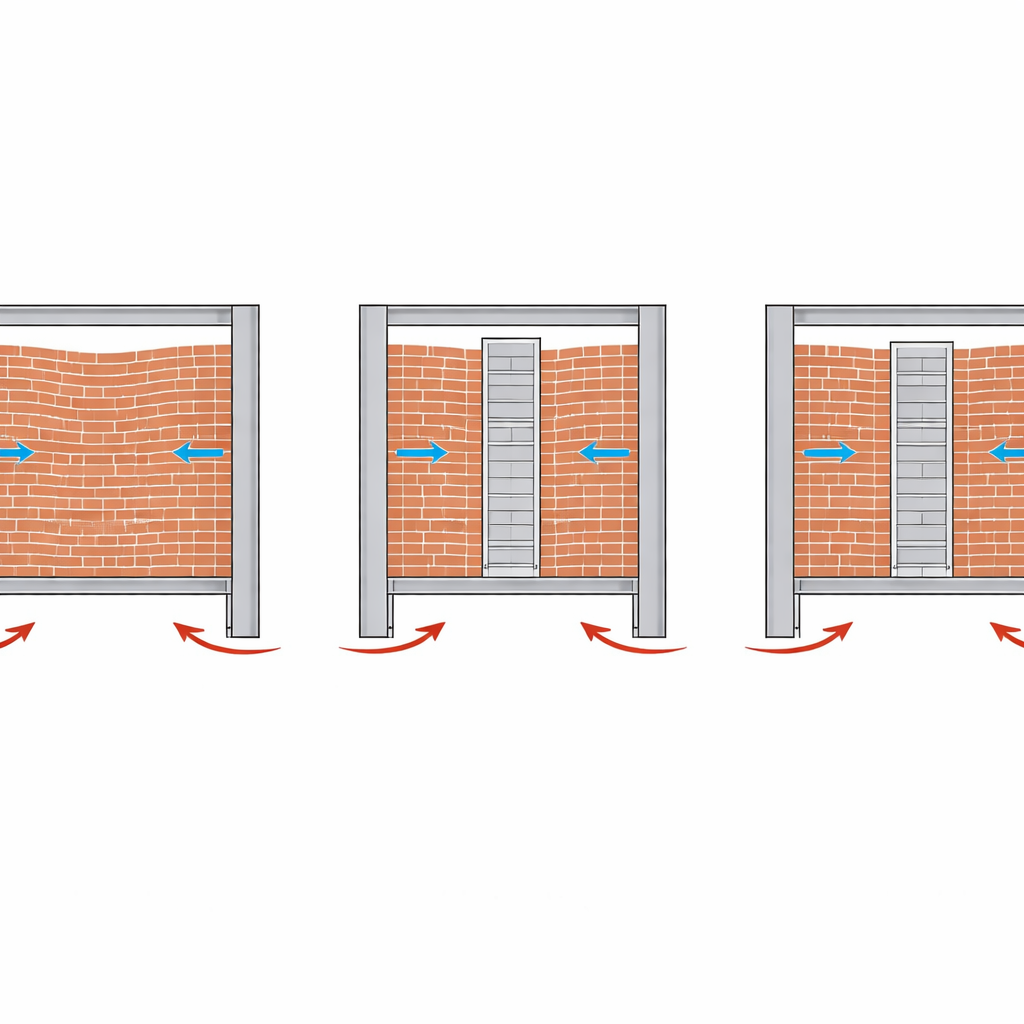
How ordinary walls behave when the ground moves
In many modern buildings, a skeleton of steel or concrete frames is filled with masonry walls. During an earthquake, these walls interact with the frame in complex ways. They can stiffen the whole structure and absorb energy, but they can also crack and fail. One critical weakness is out‑of‑plane failure, where the wall bends and bulges sideways and can collapse outward. Past observations after earthquakes have shown that adding narrow vertical “constructional columns” inside the wall can greatly improve its stability. However, the usual method—casting these columns in place with concrete—requires several days of work, careful formwork and vibration, and often suffers from quality problems.
A simpler column idea inside the wall
To address these practical hurdles, the authors study a fabricated constructional column that is built together with the wall in a single, streamlined step. Instead of assembling formwork and then pouring and vibrating concrete separately, builders insert precast blocks and reinforcement as they lay the bricks, then fill gaps with grout. This approach shortens the construction period for one wall from three days to one, and cuts direct cost by about 30 percent. Earlier tests showed that these fabricated columns are more flexible than traditional cast‑in‑place ones, which fits the desirable design idea of a strong frame and slightly weaker wall: the main frame stays safe while damage concentrates in replaceable infill.
Virtual shaking tests with detailed computer models
Using previous full‑scale experiments as a reference, the team built three high‑fidelity computer models of a single‑story steel frame with a brick infill wall: one with no internal column, one with a conventional cast‑in‑place constructional column, and one with the new fabricated version. They carefully modeled the bricks, mortar, steel frame, reinforcement bars, and contact surfaces, then simulated cyclic in‑plane shaking (side‑to‑side drift) followed by out‑of‑plane loading that pushes the wall perpendicular to its surface. These simulations reproduced key features seen in lab tests, including how diagonal cracks form, how parts of the wall crush or separate, and how the frame and wall share loads, giving confidence that the models capture real behavior.
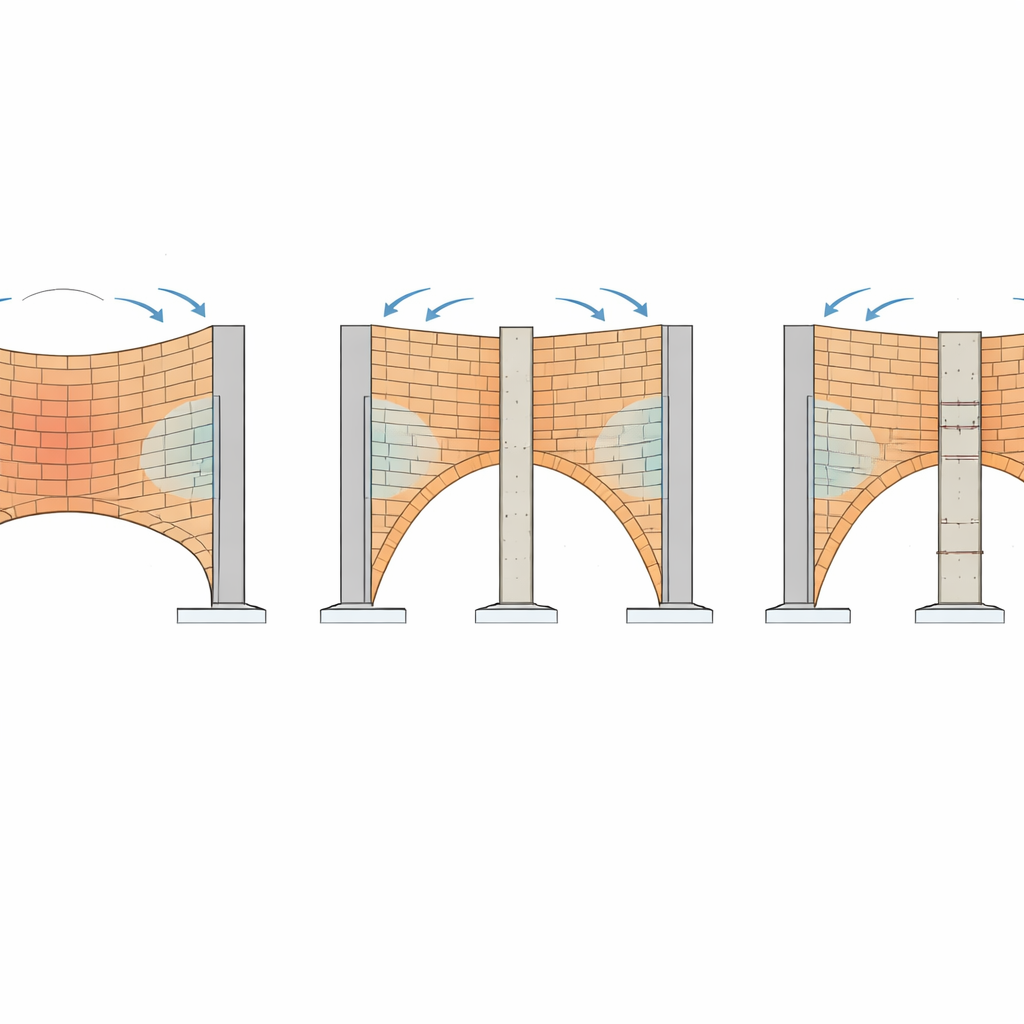
What happens when walls are pushed out of plane
The results show that constructional columns substantially change how the wall bends and cracks under out‑of‑plane loading. In the wall without a column, the middle region is pushed outward strongly, and cracking spreads in an X‑shaped pattern, forming a single arch between the side columns. When a cast‑in‑place column is present, the wall effectively becomes two shorter panels, each forming its own arch. This reduces the sideways bulging in the center and shifts cracks toward the column edges. The fabricated column produces similar two‑arch behavior, but with damage concentrated more at the joints between its precast blocks, where mortar is more vulnerable. Overall, both types of column limit the maximum out‑of‑plane displacement in the wall’s central region.
How much strength is gained or lost
Numbers from the simulations highlight the trade‑offs. Compared with the wall without any internal column, the cast‑in‑place column more than doubles the out‑of‑plane load capacity, while the fabricated column nearly doubles it. Both also make the wall more ductile, allowing it to deform further before losing strength, and they reduce how much in‑plane damage weakens the out‑of‑plane performance. However, the very stiff cast‑in‑place column also attracts larger forces during in‑plane shaking, which can lead to greater localized damage when the wall is later pushed out of plane. The more flexible fabricated column has a smaller strengthening effect in pure numbers, but it better limits out‑of‑plane displacement and damage after the wall has already cracked in plane.
What this means for safer, faster construction
For non‑specialists, the key message is straightforward: adding slim vertical columns inside brick infill walls makes them far less likely to bulge and fall out of a frame during or after an earthquake, and a cleverly fabricated version can achieve much of this protection with simpler, cheaper construction. The cast‑in‑place column still provides the greatest raw strength, but the new fabricated column offers a promising balance between safety, ductility, construction speed, and cost. Because this study focuses on single‑story frames and one wall type, more work is needed before applying the findings to tall buildings or other masonry materials. Even so, the research points toward practical, buildable details that could help ordinary walls quietly perform life‑saving work when the ground starts to shake.
Citation: Wang, Z., Luo, H., Lin, H. et al. Finite element analysis of a constructional column on the out-of-plane performance of the damaged steel frame-infilled wall. Sci Rep 16, 11177 (2026). https://doi.org/10.1038/s41598-026-39054-w
Keywords: masonry infill walls, earthquake engineering, constructional columns, finite element analysis, out-of-plane behavior