Clear Sky Science · en
Grouting uplift for structural rectification of a high-rise building
Why straightening leaning towers matters
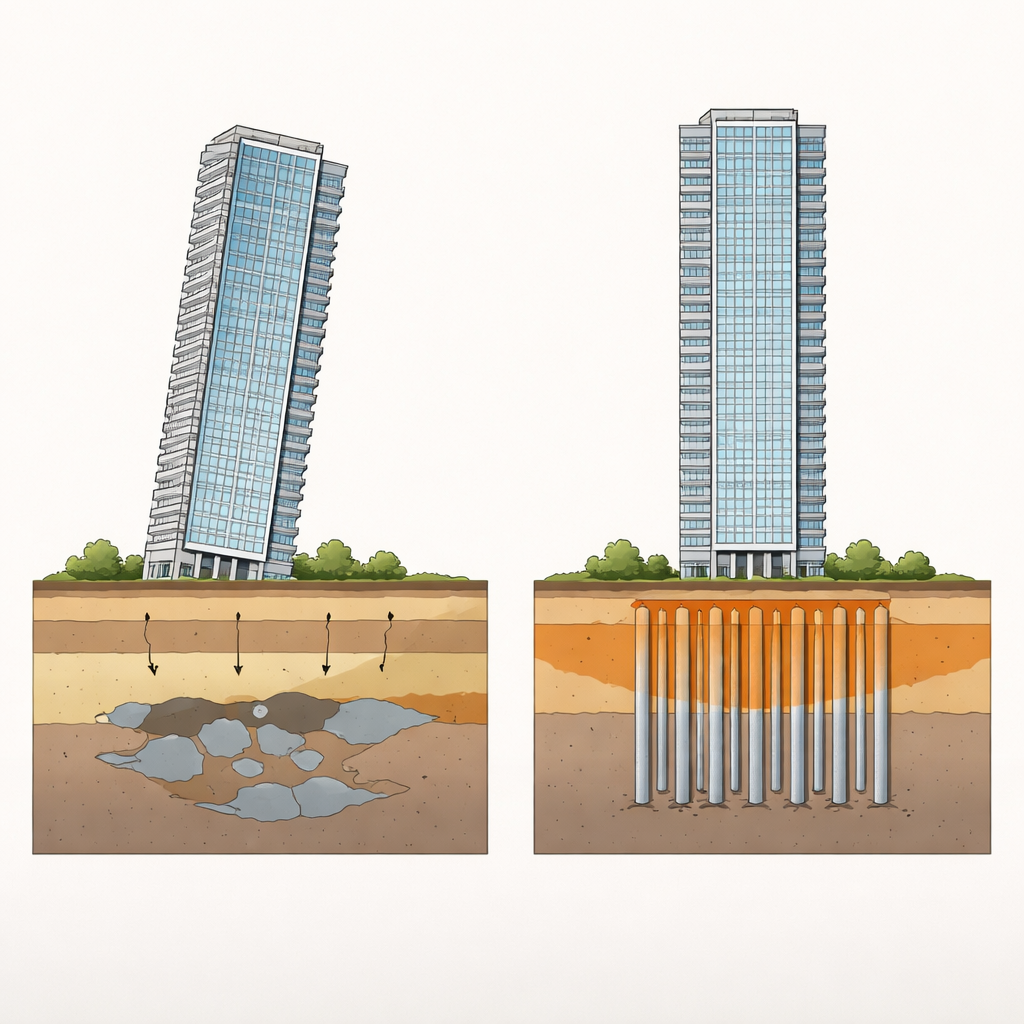
Modern cities are packed with tall buildings squeezed onto limited land, and many of those sites sit on soft or uneven ground. When the soil below a high‑rise settles more in one area than another, the entire structure can slowly lean, threatening safety and comfort for the people inside. This paper follows the story of a 26‑story building in Mengshan County, Guangxi, China, that had begun to tilt alarmingly—and explains how engineers used a carefully planned underground “injection and lift” method to gently bring it back toward plumb without tearing it down.
Hidden trouble under a city tower
After the building was topped out, engineers noticed growing cracks around the basement and signs that the whole structure was drifting southeast. Precise surveys showed that parts of the foundation had sunk more than 20 centimeters, and the tilt of the building was well above comfort and code limits. A detailed geological investigation revealed why. Beneath the raft foundation lay a loose cobble layer with many voids and a deeper rock layer riddled with natural cavities. These “empty pockets” in the ground reduced the ability of the soil and rock to carry the building’s weight, causing some sections to sag more than others and pulling the basement walls and slab into tension.
Using virtual models to see underground
Because engineers cannot see directly into the ground, the team built a three‑dimensional computer model of the building and surrounding soil. In this virtual version, they reproduced the layers found on site and inserted cavities where drilling had discovered them. They then let the simulated building “settle” under gravity to see how it would behave. The pattern of sinking in the model matched real‑world measurements closely, confirming that weak, porous layers and underground voids were the main culprits. When the researchers reran the model without cavities, the settlement became much more uniform and the tilt dropped sharply, underscoring how important these hidden spaces were to the problem.
Injecting strength before lifting
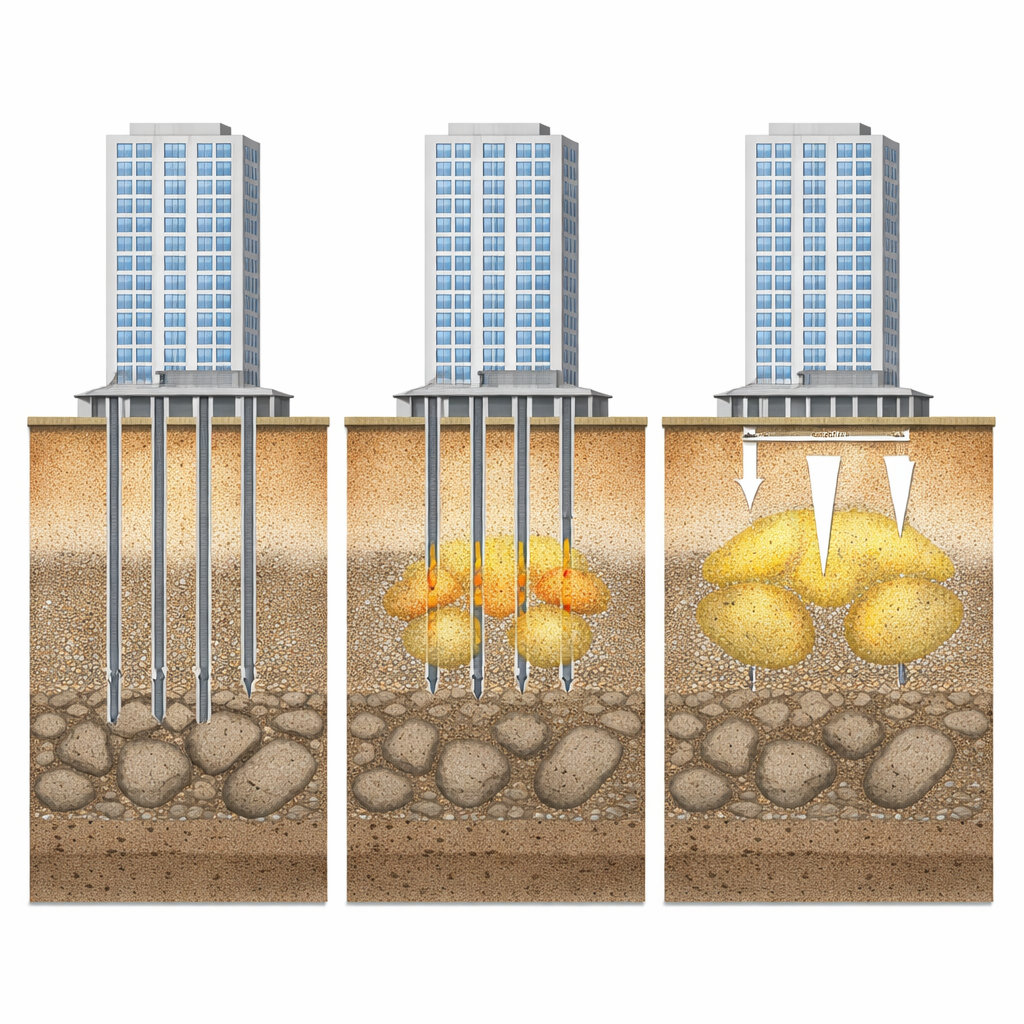
Simply pumping material under one side of a building and pushing it up carries serious risks: lifting can be uneven, new cracks can form, and the structure may lean again as injected material shrinks or redistributes. To avoid this, the researchers designed a two‑stage approach. First came reinforcement. They drilled a grid of holes around and under the building, targeting both shallow cobbles and deeper weak rock. Into these holes they injected a specially formulated grout made from aluminum and iron industrial by‑products blended with cement. In tests, this mix hardened quickly, spread only within a controlled radius, reached high strength, and shrank very little, so it could fill cavities, bind loose particles, and create stiff “columns” in the soil without later pulling back from the surrounding ground.
Gentle, closely watched lifting
Only after the ground was strengthened did the team use grouting to actually lift the structure. Working mainly on the more heavily settled east and south sides, they injected the grout in stages from the bottom of each hole upward, using low pressures and very small daily lift limits. Ten sets of equipment worked in a coordinated pattern, moving from zones with the greatest settlement toward more stable areas. Throughout the 45‑day operation, an automatic monitoring system tracked minute changes in building height and tilt at dozens of points, allowing crews to adjust injection rates and pressures on the fly. Computer simulations of the lifting process, which represented grout as an expanding volume in the soil, helped confirm that planned pressures would be strong enough to raise the building but not so high as to damage the structure.
A once‑leaning tower brought back within bounds
When the work was complete, measurements showed that the foundation’s maximum tilt had dropped from about 6 parts per thousand to just 0.3 parts per thousand—well within accepted safety and comfort limits. The difference in settlement across the building shrank dramatically, and stresses in the basement walls and slab fell below the tensile strength of the concrete, reducing the risk of new cracking. By combining a tailored grout, a “strengthen first, lift later” strategy, careful hole placement, low‑pressure staged injection, and real‑time monitoring, the team demonstrated a practical way to rescue high‑rise buildings that are already standing on problematic ground. For city dwellers, this means that even when the soil beneath a tower quietly fails, engineering methods now exist to restore stability without closing or demolishing the building.
Citation: Cui, X. Grouting uplift for structural rectification of a high-rise building. Sci Rep 16, 10462 (2026). https://doi.org/10.1038/s41598-026-38875-z
Keywords: building settlement, ground improvement, foundation grouting, high-rise safety, structural rectification