Clear Sky Science · en
Identification of dynamic driving styles based on behavioral primitives
Why your driving habits matter
Anyone who has ridden with different drivers knows that some people glide smoothly through traffic while others stop, start, and dart between lanes. These patterns are more than quirks; they affect comfort, safety, and how future assisted and self-driving cars should behave around us. This study looks closely at how everyday steering, braking, and accelerating can be broken into tiny pieces to reveal whether a driver is being cautious, average, or aggressive at any given moment.
Breaking trips into tiny building blocks
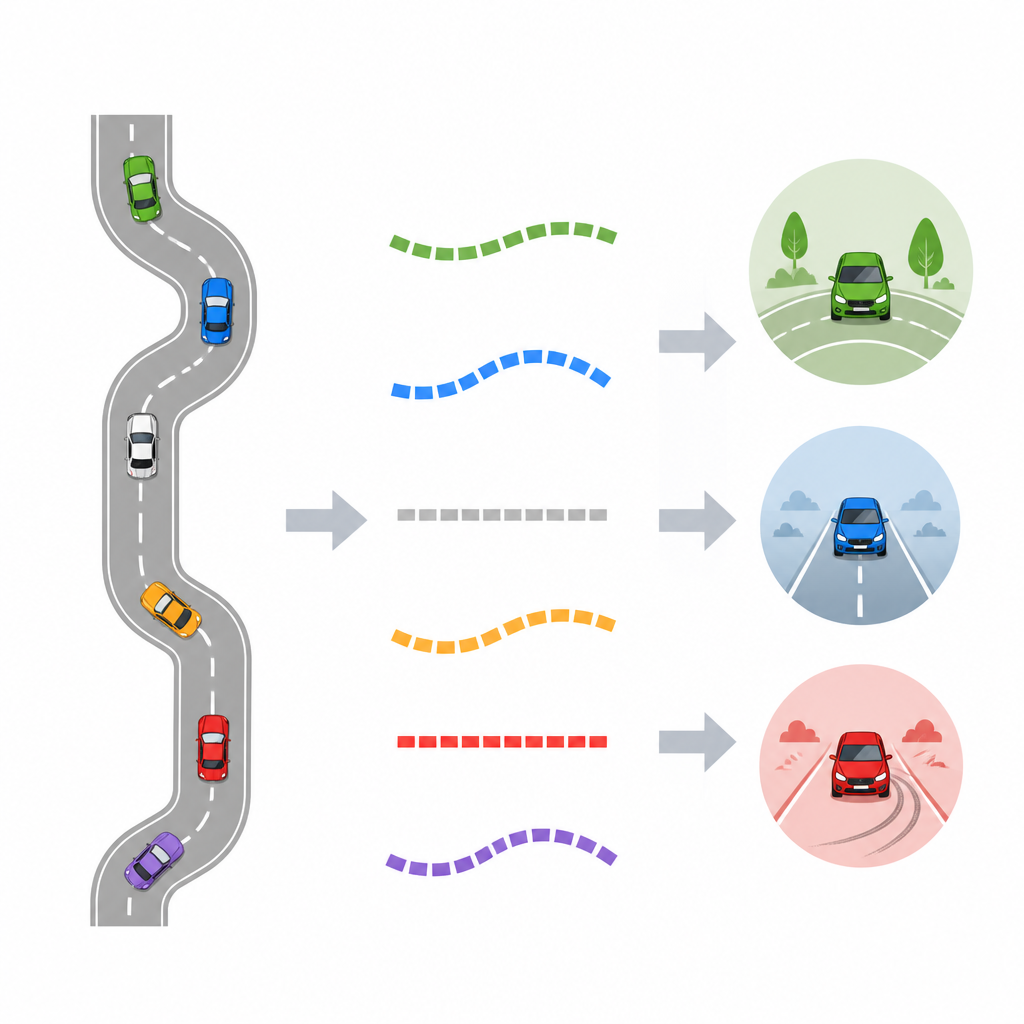
The researchers start from the idea that a drive is not one long, uniform behavior. Instead, it is made up of short segments, or “primitives,” such as going straight at a steady speed, slowing down sharply, or turning while speeding up. Using a driving simulator, they collected about five hours of data from 17 drivers traveling the same route with gentle traffic and a few scripted surprises. From the continuous stream of speed, acceleration, and steering information, they carved out 2,763 small segments, each representing a brief, physically meaningful pattern of motion.
Finding common patterns in the chaos
To organize these many segments, the team used unsupervised data methods that do not rely on human labels or questionnaires. First, they separated movements across the road from movements along the road, then applied a two-step process to locate where one pattern ended and another began. Next, they grouped the resulting segments into five main primitive types with distinct meanings: for example, going straight at medium speed with gentle changes, turning left at medium speed, crawling straight at low speed while gently slowing, going straight fast while braking hard, and turning right while speeding up quickly. Even though individual segments varied in length and exact values, those in the same group shared similar shapes over time.
Turning behavior into risk levels
Once the primitive types were set, the researchers asked how risky each one tended to be. They summarized each group using basic statistics like average speed, how sharply the car turned, and how much these values fluctuated. From these eight simple features, they computed a “risk index” for each primitive type. They then studied how drivers moved from one primitive to another, for instance from slow straight driving into hard braking, and how often each jump occurred. Transitions that combined a big jump in risk, a risky next segment, and a rarely used jump were treated as especially risky. In this way, both what the driver was doing and how they got there contributed to an overall moment-by-moment safety picture.

Scoring cautious, normal, and aggressive moments
To rate driving style for every segment in time, the study built a simple scoring formula that blends three ingredients: the risk of the current primitive, the risk of the transition that led into it, and the risk of the transition that follows it. Objective statistics determined how much weight each ingredient should carry. The result was a style score for every moment, on a scale where higher values meant more aggressive behavior. A swarm-inspired search method then automatically chose two cut points on this scale, splitting the data into cautious, normal, and aggressive styles so that each group was as distinct as possible.
What the patterns reveal about real drivers
Applying this framework to the 17 drivers showed that most of their time was spent in the normal range, with fewer cautious moments and the fewest aggressive ones. Many drivers were cautious when starting and ending the route, becoming more assertive mid-trip once they were comfortable. Some drivers, who often used high-risk primitive types and risky transitions, finished the route much faster and were labeled aggressive over the long term. Others relied heavily on low-risk patterns and had longer travel times, matching an overall cautious style. Even though road events could briefly push anyone toward more forceful actions, each person’s underlying style remained fairly stable when viewed across an entire drive.
Why this matters for future cars
By slicing driving into small, meaningful units and watching how they change over time, this study shows a way to track driving style as it unfolds second by second, instead of relying on broad, fixed labels. For a layperson, this means that cars and driver-assistance systems could one day respond not just to where a vehicle is on the road, but also to how its driver tends to behave and how that behavior is changing in the moment. Such awareness could make shared roads safer and help automated vehicles blend more naturally with human drivers.
Citation: Zheng, X., Kang, W., Ren, Y. et al. Identification of dynamic driving styles based on behavioral primitives. Sci Rep 16, 15144 (2026). https://doi.org/10.1038/s41598-026-38787-y
Keywords: driving style, driver behavior, traffic safety, autonomous vehicles, risk assessment