Clear Sky Science · en
Nonlinear dynamics of reverse osmosis high pressure high speed centrifugal pumps
Keeping Clean Water Flowing
Reverse osmosis desalination plants rely on powerful pumps to push seawater through membranes and turn it into drinkable water. If these pumps vibrate too much or their internal bearings fail, the whole system can shut down, driving up costs and risking water shortages. This paper explores how a compact, high-speed, high-pressure pump behaves dynamically on the inside, and shows how subtle design choices in its internal supports can mean the difference between smooth, reliable operation and chaotic motion that can damage the machine.
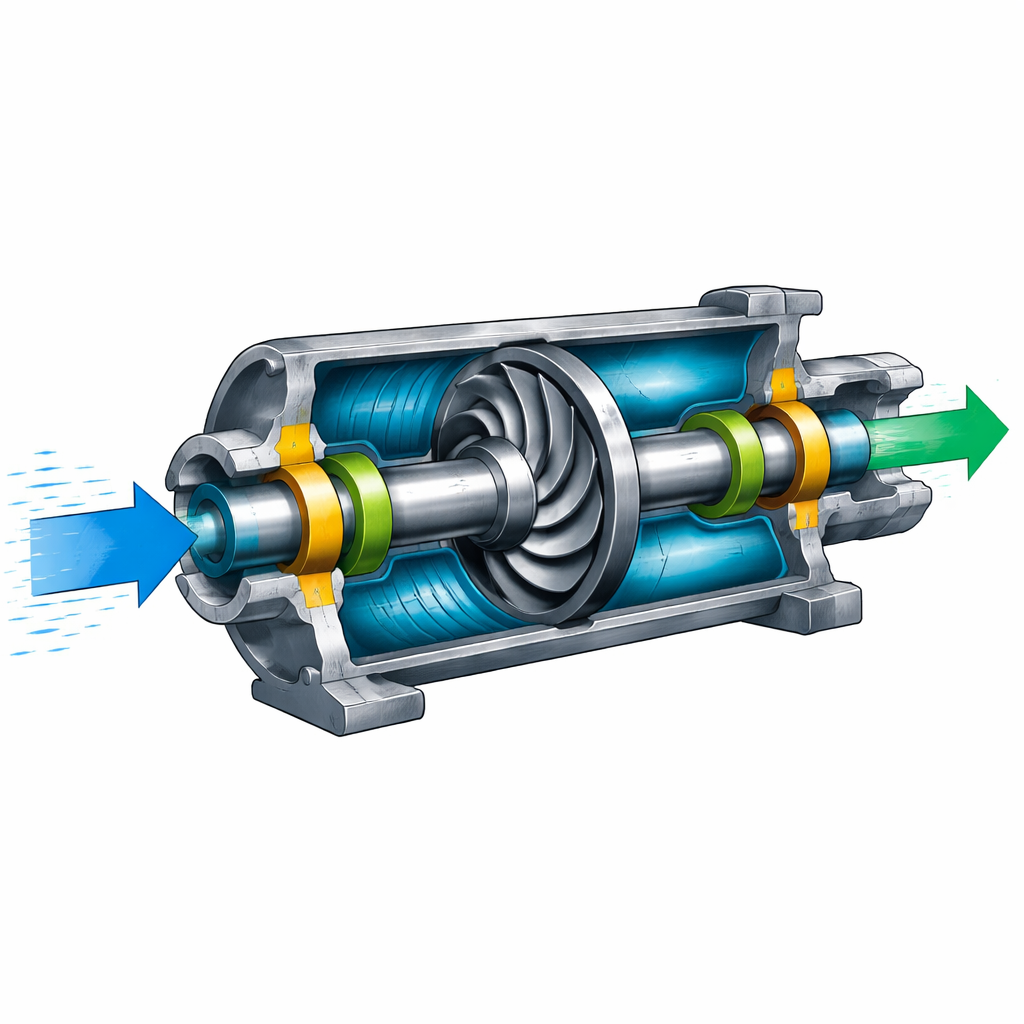
How a Special Pump Fits Inside a Desalination Plant
The study focuses on a single-stage centrifugal pump designed for reverse osmosis, where seawater is both the fluid being pressurized and the lubricant inside the pump. Unlike many industrial pumps, this design has no external bearing box. Instead, the spinning shaft and impeller are supported entirely by internal journal bearings (which carry sideways loads) and thrust bearings (which carry end loads). Using water instead of oil avoids the risk of contaminating delicate membranes, but it also leaves less margin for error: the thin films of water that keep metal parts from touching must be carefully controlled.
Peering Inside the Moving Parts
To understand how this pump behaves at operating speed, the authors build a mathematical model of the rotor–bearing system. They treat the shaft and impeller as a rigid body that can move in three directions and tilt in two, while the supporting bearings are modeled in more detail. For the bearings, they calculate how pressurized water forms a supporting film around the shaft and across the thrust pads, using a classic lubrication equation solved on a fine grid. In parallel, they use computational fluid dynamics to simulate how seawater flows through the impeller and casing, and to estimate the fluctuating hydraulic forces that push on the rotor during operation. These forces are then fed into the dynamic model to see how the rotor actually moves over time.
What Happens When Design Knobs Are Turned
With this digital test bench in place, the team explores how different bearing and pump design choices affect performance. They first examine a configuration with only two journal bearings and find that the left bearing often runs dangerously close to contact, with an extremely thin water film and irregular, almost chaotic motion. Adding a central journal bearing, which also acts like a rear wear ring, redistributes the loads and improves conditions in the left bearing. The authors vary features such as the width of the bearings, the presence and size of a groove that feeds water into the left bearing, the diameter of the left journal, and details of the thrust bearing geometry. In many cases, increasing a parameter initially improves the water film thickness and stability, but pushing it too far causes a sudden jump to more complex, unstable motion.
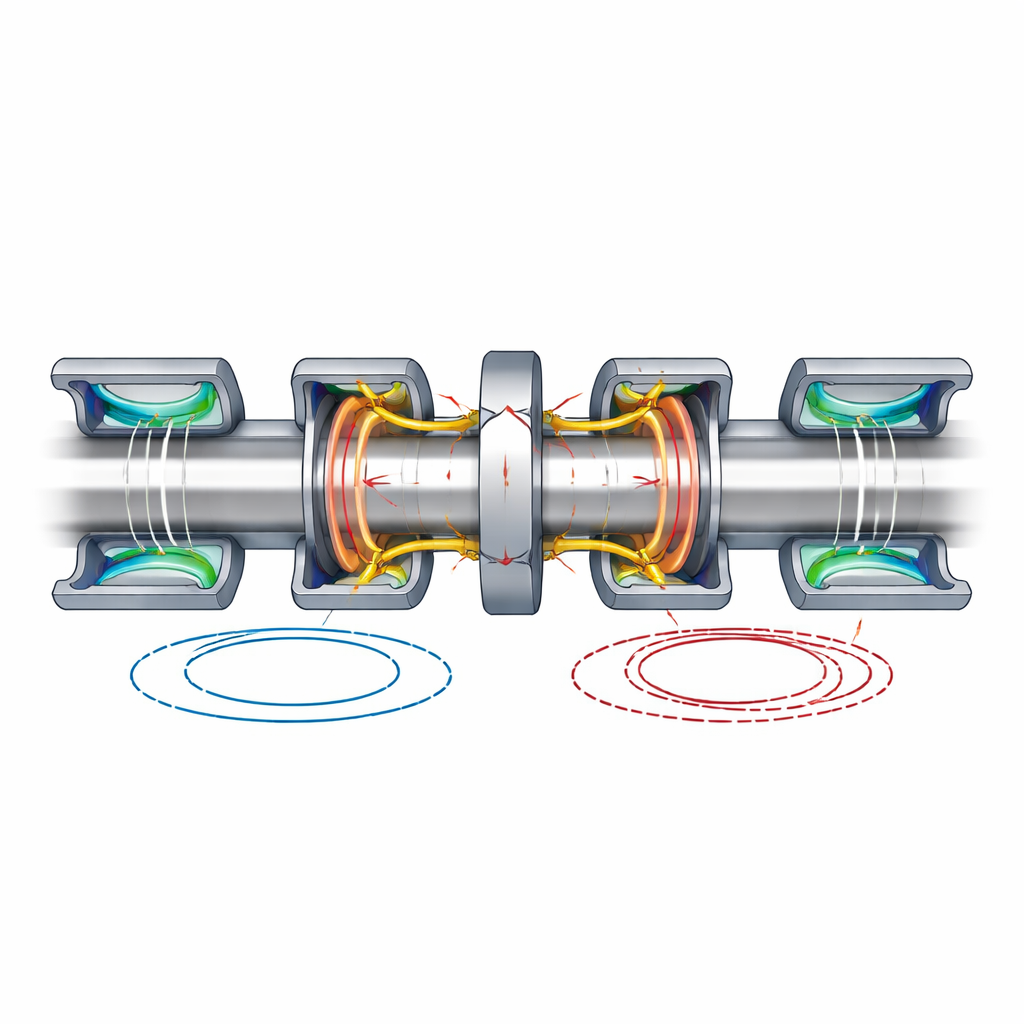
Why Pressure and Balance Matter So Much
The study highlights the crucial role of boundary conditions—essentially, the pressures at the edges of the bearings, which can be controlled with auxiliary plumbing lines. At modest supply pressures the left bearing has a healthy water film, but as the external pressure is raised further the internal pressure pattern changes and the bearing’s load-carrying capacity actually drops. The minimum film thickness shrinks and the rotor motion can become chaotic. The authors also investigate the effects of unavoidable rotor unbalance, which grows over time as parts wear. Depending on the phase of this unbalance relative to the hydraulic forces, the same increase in unbalance can either mildly thicken the water film or drive it toward unsafe thinning and large whirling motions.
Design Lessons for Safer, Smaller Pumps
For readers outside engineering, the bottom line is that a compact desalination pump can be made both powerful and reliable—but only if its internal supports are tuned with great care. The work shows that the detailed shape and pressure environment of the bearings strongly control whether the spinning shaft settles into a small, steady orbit or slips into erratic motion that risks metal-to-metal contact. While the direct coupling between thrust and journal bearings is modest in this particular rigid-rotor design, the overall rotor–bearing system can tip from orderly to chaotic behavior when design parameters are pushed beyond certain thresholds. By mapping out these boundaries in advance, the study offers practical guidelines for building smaller, more efficient high-pressure pumps that keep clean water flowing without unexpected breakdowns.
Citation: Sayed, H., El-Sayed, T.A. & Friswell, M.I. Nonlinear dynamics of reverse osmosis high pressure high speed centrifugal pumps. Sci Rep 16, 12043 (2026). https://doi.org/10.1038/s41598-026-38772-5
Keywords: reverse osmosis pumps, rotor dynamics, water lubricated bearings, centrifugal pump stability, hydrodynamic lubrication