Clear Sky Science · en
Mechanical performance simulation and application of assembled self-centring shear lead damper
Keeping the Power On When the Ground Shakes
High-voltage substations are the hidden backbone of modern life, quietly routing electricity so our lights, hospitals, and data centers keep running. Yet many of the tall, porcelain-clad devices inside these yards are surprisingly fragile in earthquakes. This paper introduces a new kind of mechanical "shock absorber"—an Assembled Self-Centring Shear Lead Damper (ASSLD)—designed to help such equipment ride out strong shaking, dissipate dangerous energy, and then straighten itself back up so power can be restored quickly.
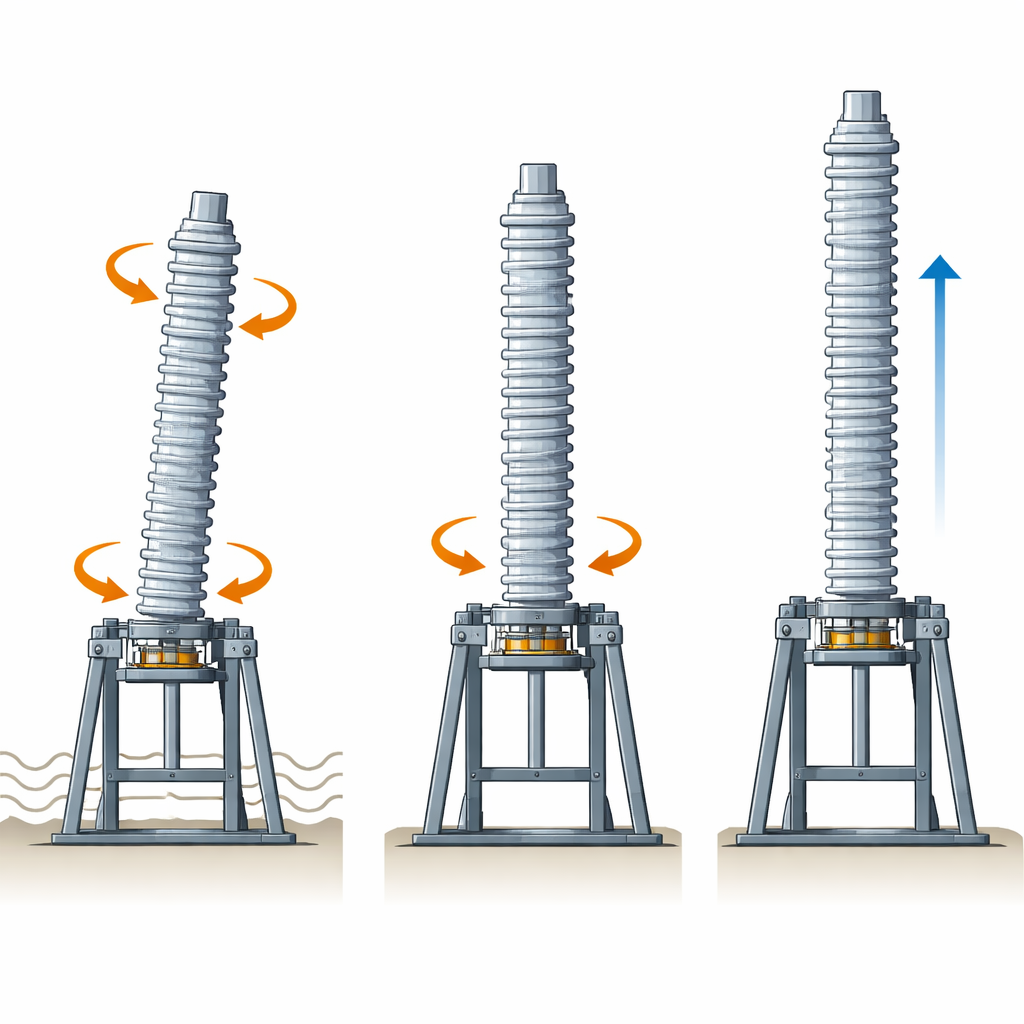
Why Tall Electrical Towers Are at Risk
In substations, equipment like porcelain surge arresters and transformers often stand several meters high on slender supports. Their porcelain shells are strong in normal service but crack easily when shaken side-to-side. Existing protective measures—such as rubber bearings, wire-rope dampers, and tuned mass weights—can cut forces, but they have drawbacks. Some increase the sway at the top so much that connecting wires are overstretched; others rely on complex hydraulic parts or heavy masses that are hard to retrofit. A widely used solution, the shear lead damper, can absorb a lot of energy but tends to leave the equipment leaning after a big quake because it lacks a built-in “self-righting” ability.
A New Damper That Springs Back to Center
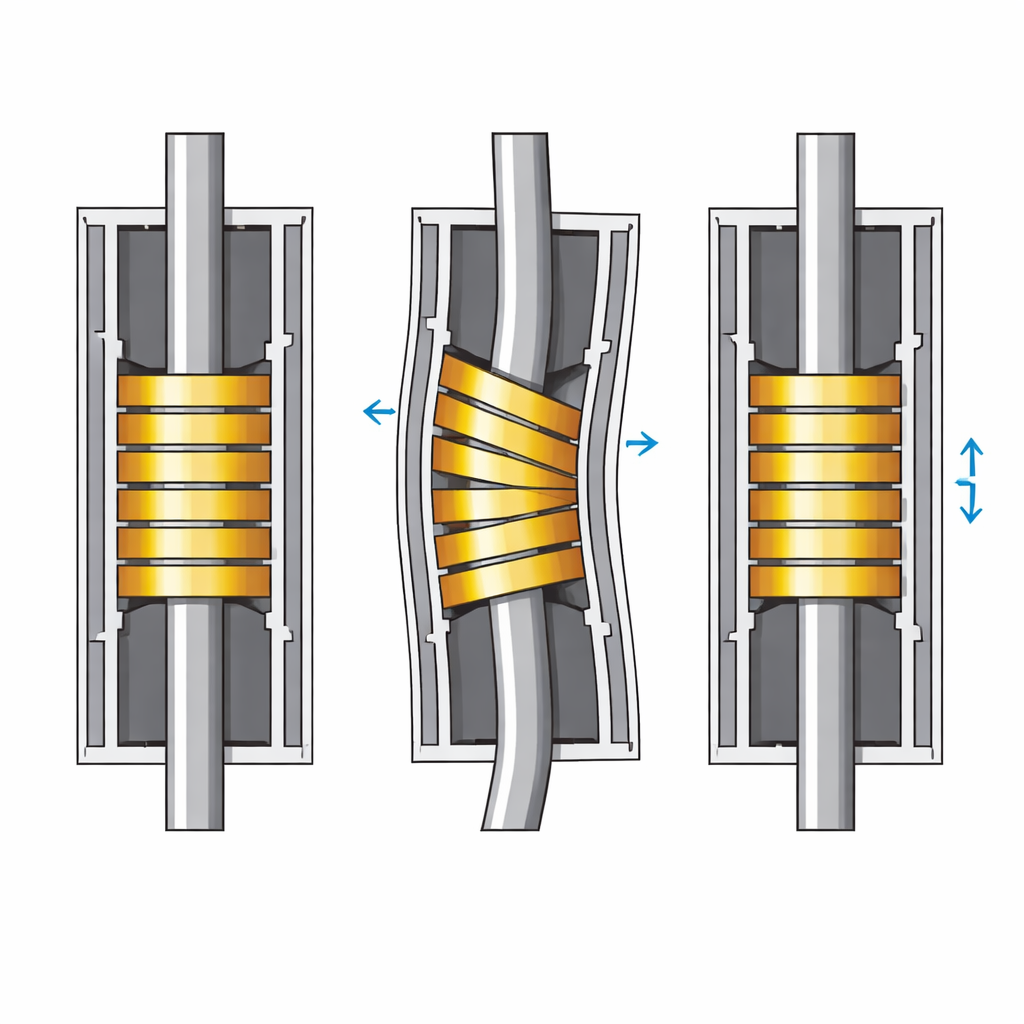
The ASSLD is designed to solve this trade-off between energy absorption and self-centring. Inside a steel casing, soft metal rings made of lead are stacked around a central rod. During shaking, the equipment moves relative to its support frame, putting the device in tension or compression. The motion shears the lead rings, turning seismic energy into harmless heat, while the central rod—made from a superelastic shape memory alloy (SMA)—stretches like a powerful spring and then pulls the system back to its original position when the motion subsides. Multiple concentric rings share the load and can be factory-made with precision, avoiding messy on-site casting of lead and improving long-term reliability.
Putting the Materials and Mechanism to the Test
The researchers first characterized the SMA bars that form the self-centring core. In lab tests with controlled back-and-forth stretching and compression, these bars showed the distinctive “flag-shaped” response of superelastic materials: they can undergo several percent strain, dissipate moderate amounts of energy, and still recover most of their original length. Even though their energy dissipation alone is modest, their ability to spring back—with recovery rates often above 80%—makes them ideal partners for lead rings, which are excellent at absorbing energy but poor at snapping back. Separate tests on assembled lead-ring dampers quantified how ring length and configuration affect force, stiffness, and stability of energy dissipation, guiding the final ASSLD geometry.
From Bench Experiments to Computer Models
The full ASSLD device was then built and cycled on a powerful testing machine, revealing how it behaves under growing displacements. The combined system displayed both strong energy dissipation and partial self-centring, with equivalent damping roughly doubling compared with SMA bars alone and residual displacements much smaller than those of pure lead dampers. To predict performance under many scenarios, the authors developed detailed computer models using the ABAQUS finite element platform. They improved existing SMA models by embedding special elastic “filaments” to better capture asymmetry between tension and compression, as well as the material’s ability to reset after cycles of loading. Although the model still idealizes certain low-stress effects, it matched experiments within engineering accuracy for the moderate and large deformations typical of earthquakes.
Protecting a Real-World Surge Arrester
To see what the new damper could do in practice, the team simulated a 500 kV surge arrester—a tall porcelain column topped with metal fittings—mounted on a steel frame, both with and without ASSLD units installed around its base. They subjected the virtual structure to nine earthquake records, including standardized design motions and historic events like the El Centro and Landers earthquakes. With ASSLDs in place, stresses in the porcelain dropped substantially and peak accelerations at the top of the equipment were cut by about 13% to 38%, improving safety margins that would otherwise be inadequate under stronger shaking. In most cases, sideways displacement at the top also decreased by around 11%, though for a few narrow-band artificial motions the extra flexibility slightly increased sway, highlighting that no damper is universally beneficial under every possible ground motion shape.
What This Means for Future Power Grids
For a non-specialist, the key outcome is that the ASSLD behaves like a smart shock absorber for critical grid hardware: it absorbs large amounts of earthquake energy while doing its best to pull equipment back to plumb once the shaking stops. Compared with traditional devices, it offers up to about 45% more energy dissipation and significantly better recentring, which can reduce damage, shorten inspection times, and speed post-quake recovery. While the exact performance depends on temperature and the frequency content of local earthquakes, this work shows a clear path toward more resilient substations that can better keep the lights on when the earth moves.
Citation: Liu, H., Chen, Q., Gao, Y. et al. Mechanical performance simulation and application of assembled self-centring shear lead damper. Sci Rep 16, 12683 (2026). https://doi.org/10.1038/s41598-026-38631-3
Keywords: seismic isolation, shape memory alloy damper, power substation safety, surge arrester protection, energy dissipation device