Clear Sky Science · en
Non-destructive assessment of lime and nano-alumina oxide stabilized clay for new material development
Stronger ground for everyday structures
Many roads, houses, and pipelines are built on clay soils that swell when wet and shrink when dry, leading to cracks, bumps, and uneven settling. This study explores a new way to turn such troublesome clay into a stronger, more reliable base material by blending in common lime and tiny nano-sized particles of aluminum oxide. The researchers also test whether sound waves can be used to check the strength of the improved soil without digging it up, pointing toward faster, cheaper quality control on real projects. 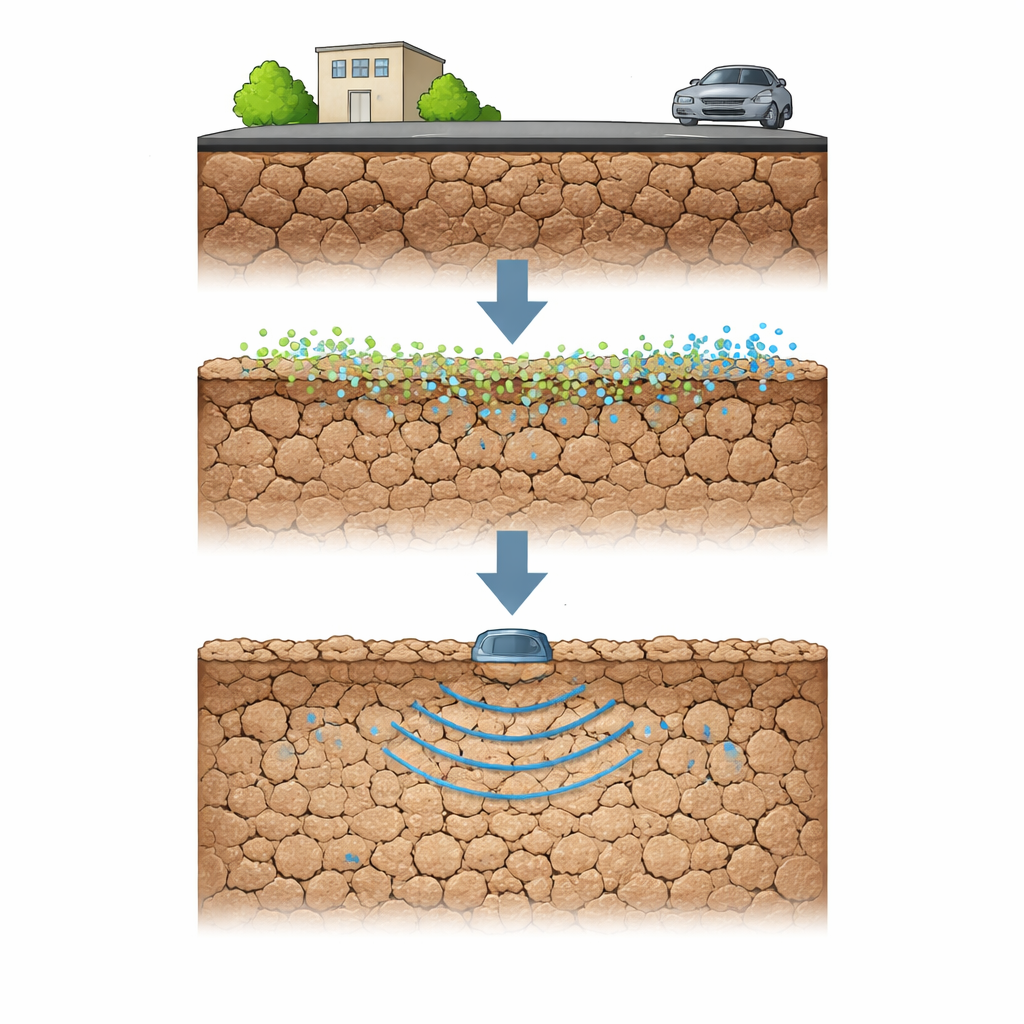
Why problem soils need a smart fix
Expansive clays are notorious for causing differential settlement—where parts of a structure sink or heave more than others. Traditional soil stabilization often relies on large amounts of lime or cement to stiffen the ground, but these binders are energy-intensive to produce and add to carbon emissions. The authors investigate whether adding a very small dose of nano-scale aluminum oxide to lime-treated clay can both boost performance and reduce the amount of lime needed. Because nanomaterials have extremely high surface area, they can promote bonding at the microscopic level, potentially transforming weak, crack-prone clay into a dense, rock-like mass using relatively little additive.
How the test soil was made and examined
The team worked with a highly plastic clay classified as a problem soil for construction. They mixed in different amounts of lime and nano-alumina, carefully controlled the water content, and compacted the material to simulate real building conditions. Samples were cured for one week, four weeks, and three months to watch how strength developed over time. A suite of tests was run: traditional crushing and splitting tests to measure how much stress the soil could withstand; an ultrasonic pulse velocity test that sends a sound wave through the sample and times how fast it travels; and microscopic and mineral tests that reveal how the internal structure and minerals change as reactions proceed.
Finding the sweet spot in the recipe
The results showed that there is a clear “just right” combination of additives. Adding lime alone first increased, then eventually reduced strength as too much lime made the structure more open and less dense. The best lime level was about 9 percent by dry soil weight. When nano-alumina was introduced on top of this, strength rose sharply up to about 1.2 percent nano content (measured relative to the lime), then declined if more was added because the tiny particles began to clump rather than spread evenly. With 9 percent lime plus 1.2 percent nano-alumina, the clay’s compressive strength grew by about 42 percent and its tensile strength by about 26 percent after just seven days. Over 90 days, both strength and sound-wave speed continued to rise, showing that slow-forming reaction products kept knitting the soil grains together.
What happens inside the soil
Microscope images and X-ray analyses revealed why this optimized mix worked so well. Without nanoparticles, the lime-treated clay still contained many voids and fragile crystals of calcium hydroxide, which do not bond soil grains very effectively. With 1.2 percent nano-alumina, the structure became far denser: tiny particles filled gaps, and more of the lime reacted with the clay minerals to form gel-like products that wrapped around and bridged grains. These amorphous, glue-like phases created a continuous network, greatly reducing weak spots. At higher nano contents, however, agglomeration led to uneven regions where reactions were less efficient, mirroring the drop in measured strength and wave speed.
Listening to soil strength
A key outcome of the study is the strong link found between ultrasonic pulse velocity and the mechanical strength of the stabilized clay. As the soil became denser and better bonded, sound waves crossed it much faster. By fitting the data, the researchers derived exponential equations that relate wave speed to both compressive and tensile strength with good statistical accuracy. This means that on a construction site, engineers could potentially monitor the health and uniformity of stabilized soil layers simply by placing sensors on the surface and measuring how fast sound pulses travel, greatly reducing the need for destructive coring and laboratory testing. 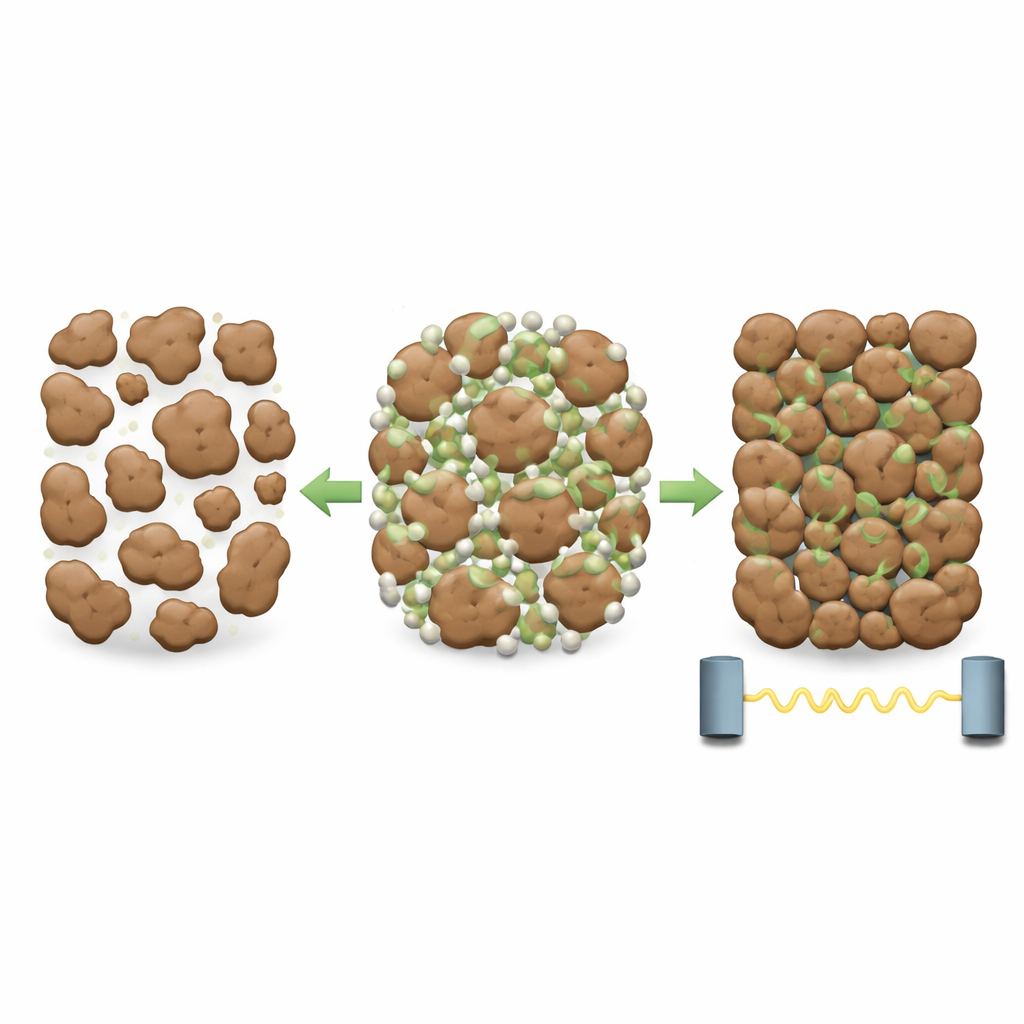
What this means for real-world building
In everyday terms, the study shows that a carefully tuned blend of lime and a tiny amount of nano-alumina can turn difficult clay into a stronger, more uniform, and more stable foundation material, while also enabling a “listen instead of dig” approach to quality control. The authors recommend a mix of about 9 percent lime and 1.2 percent nano-alumina, cured for at least 28 days, as a practical starting point. Because the nanomaterial allows engineers to use less lime for the same or better performance, this method offers both engineering benefits and environmental savings, pointing toward more durable roads and structures built on challenging ground with a smaller carbon footprint.
Citation: Fahimi, R., Soleimani Kutanaei, S., Seyedkazemi, A. et al. Non-destructive assessment of lime and nano-alumina oxide stabilized clay for new material development. Sci Rep 16, 10187 (2026). https://doi.org/10.1038/s41598-026-38443-5
Keywords: soil stabilization, expansive clay, nanomaterials, lime treatment, ultrasonic testing