Clear Sky Science · en
Characteristics of the gut mycobiome in patients with membranous nephropathy
Why tiny gut fungi might matter to kidney health
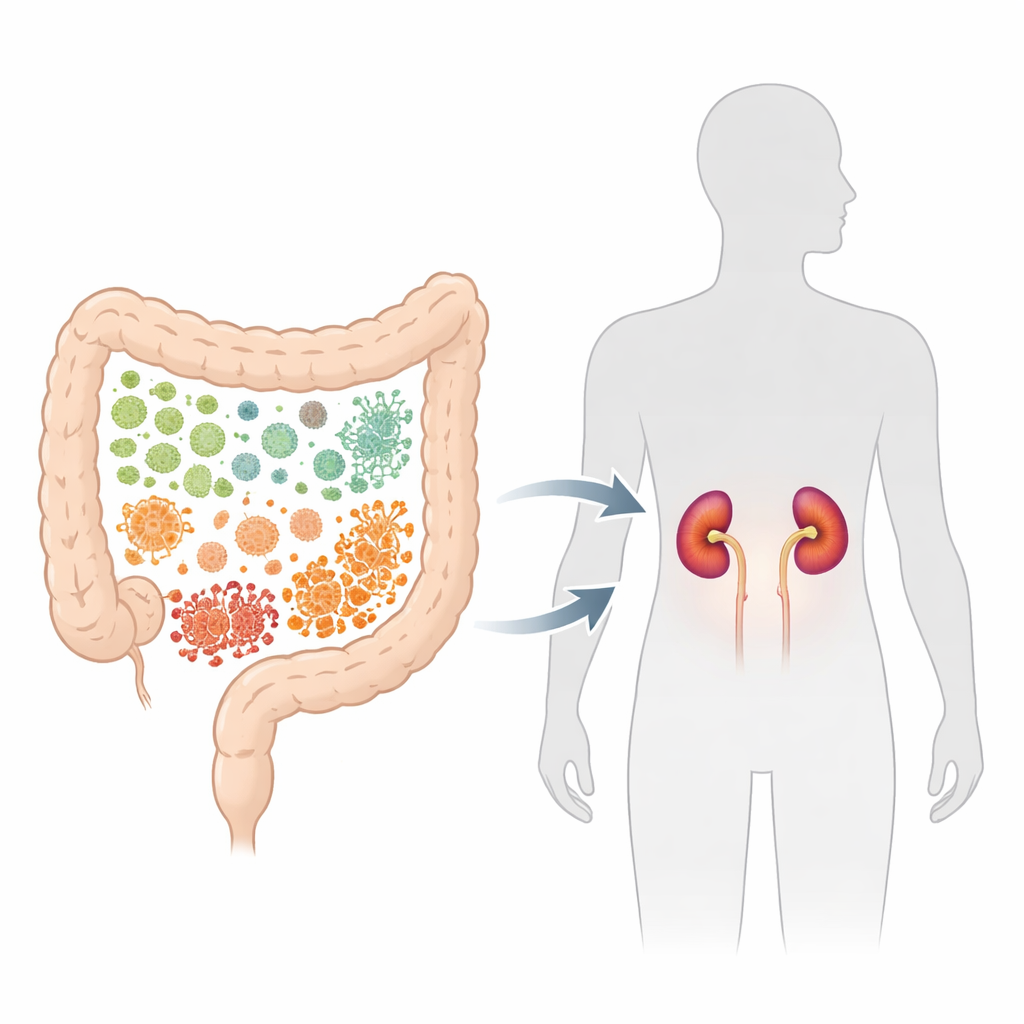
Membranous nephropathy is a leading cause of heavy protein loss in the urine and kidney damage in adults, yet doctors still rely on invasive kidney biopsies to diagnose it. This study looks in an unexpected place for answers: the microscopic fungi that live in our intestines. By examining patterns of these gut fungi, the researchers asked whether they could better understand the disease and even tell patients with membranous nephropathy apart from healthy people using only a stool sample.
Looking at stool instead of kidney tissue
The team collected fecal samples from 120 patients with biopsy-proven membranous nephropathy and 34 healthy volunteers at a large hospital in China. Some patients had never been treated, while others were at different stages of response to therapy. Rather than focusing on bacteria, the researchers targeted fungal genetic material using a method called ITS sequencing, which identifies different fungal types in a sample. They then compared how many kinds of fungi were present, how evenly they were distributed, and which groups were most common in patients versus healthy controls.
Gut fungi shift in people with kidney disease
The analysis revealed that people with untreated membranous nephropathy had less diverse gut fungi than healthy individuals. In other words, they hosted fewer distinct fungal types. The overall fungal community also looked different: one major group of fungi (Ascomycota) was more abundant in patients, while another (Basidiomycota) was relatively depleted. At finer resolution, some fungi, such as the common yeast Saccharomyces cerevisiae and Hydnobolites roseus, were more plentiful in patients, whereas others, including Candida albicans and several lesser-known environmental fungi, were reduced. These consistent shifts suggest that the disease is linked to a broad disturbance in the fungal part of the gut ecosystem.
Fungal fingerprints as a noninvasive signal
To test whether these changes could help identify patients without touching the kidney, the researchers built computer models that learned from fungal patterns. Using data from 34 untreated patients and 34 healthy controls, a machine-learning approach called random forest selected just six specific fungal signals, or "operational taxonomic units," that best distinguished the two groups. When these six markers were combined into a single score, the model correctly separated patients from controls in nearly all cases, with a very high area under the curve, meaning strong diagnostic performance. A second type of model, based on support vector machines, confirmed that the same six fungal markers could accurately classify new, unseen samples.

What happens as treatment and illness change
The study also examined treated patients whose disease was not improving, partially improving, or in complete remission. Fungal richness varied across these groups, and even patients whose kidney disease had fully quieted did not return to the same fungal patterns seen in healthy people. Their gut fungi remained less diverse and compositionally distinct, hinting that some changes may persist beyond visible recovery. Importantly, these fungal patterns were similar in treated and untreated patients overall, suggesting they reflect the disease itself more than the medications used. Several fungal groups tracked with clinical measures such as the amount of protein in the urine, linking the gut changes to disease severity.
What this could mean for patients
In plain terms, the study shows that people with membranous nephropathy carry a different and less varied collection of gut fungi than healthy individuals, and that a small set of these fungi can almost always tell the two groups apart from a stool sample alone. While the work does not prove that fungi cause the kidney disease, it raises the possibility that simple, noninvasive tests based on gut fungi could one day help screen for membranous nephropathy, monitor its course, or guide treatment, reducing reliance on kidney biopsies.
Citation: Zhi, Y., Zhou, Y., Wang, M. et al. Characteristics of the gut mycobiome in patients with membranous nephropathy. Sci Rep 16, 9973 (2026). https://doi.org/10.1038/s41598-026-38437-3
Keywords: membranous nephropathy, gut fungi, mycobiome, kidney disease biomarkers, stool-based diagnosis