Clear Sky Science · en
Design of MIMO antenna for 6G applications supported by fractal geometry
Why tiny antennas matter for future wireless
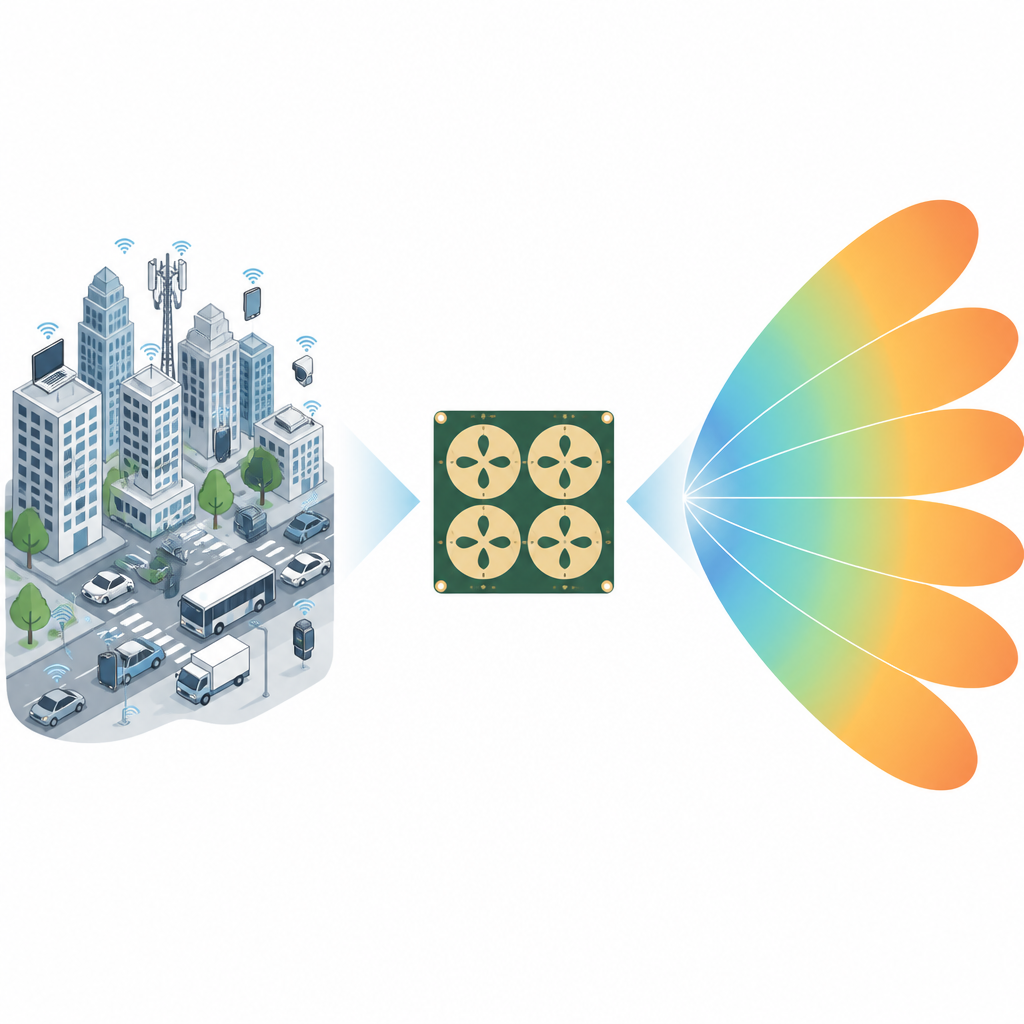
As our phones, cars, and gadgets demand faster and more reliable connections, the next generation of wireless networks will need compact antennas that can squeeze high data rates into limited space without signals getting in each other’s way. This study shows how a small, carefully shaped antenna array can help meet those needs for upcoming 6G and advanced 5G systems, especially in busy mid‑band frequencies used for Wi‑Fi, connected vehicles, and immersive applications.
A new way to pack antennas into small devices
The researchers designed a flat, coin‑sized antenna built on a printed circuit board, aimed at frequencies between about 5 and 12 gigahertz, a key range for current Wi‑Fi and future 6G services. Rather than relying on a single antenna, they created a four‑element Multiple‑Input Multiple‑Output (MIMO) layout, which allows several data streams to be sent and received at once. This boosts speed and reliability, but it also raises a key challenge: when antennas are packed closely together, they tend to interfere with one another. The team’s central question was how to fit four antennas into a very small area while keeping their signals clean and distinct.
Using repeating patterns to shape radio waves
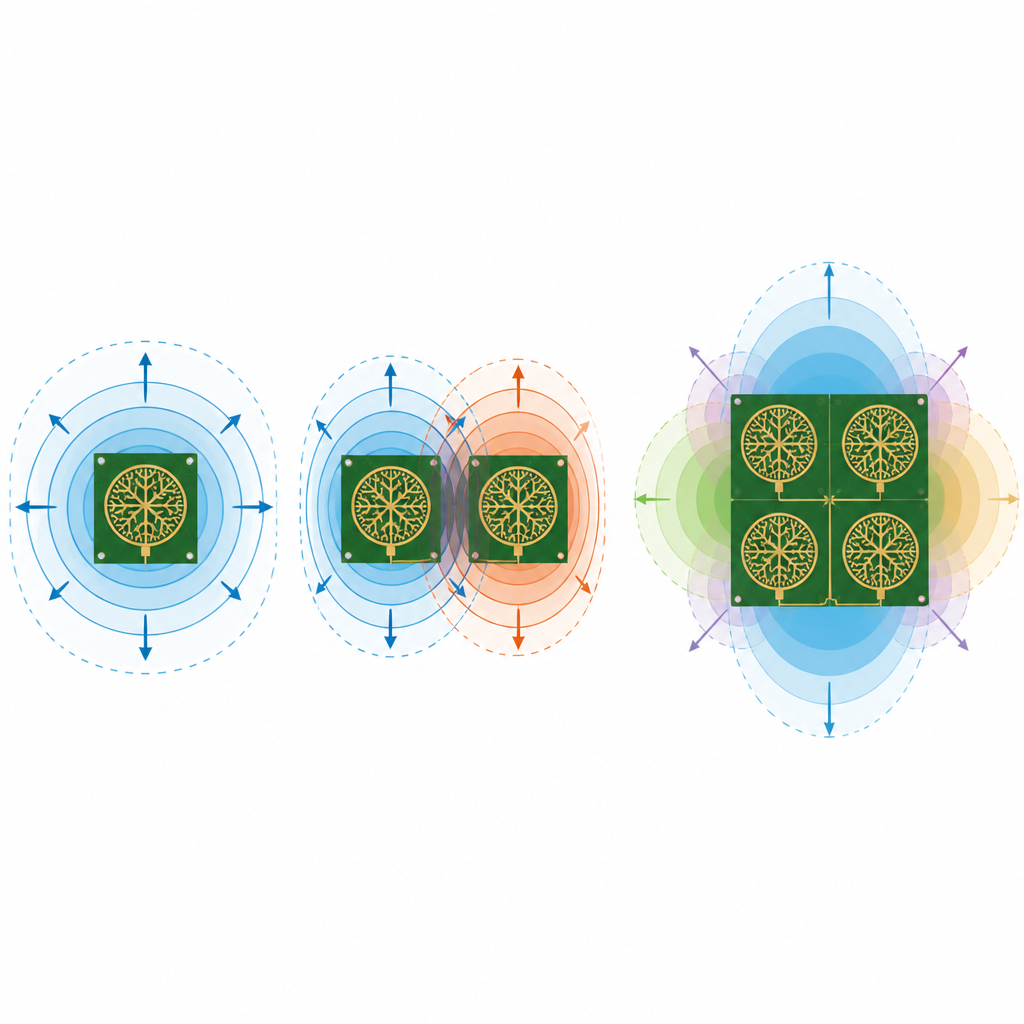
The heart of the design is a special patch of copper patterned with circular shapes that repeat at smaller and smaller scales, a style known as fractal geometry. Starting from a simple circular patch, the authors added rings and smaller circles arranged symmetrically, then carved circular slots from this pattern. Each new level of detail changes how electric currents flow on the surface, which in turn creates several useful resonant frequencies and helps stretch the antenna’s working band. By also trimming the metal ground layer beneath the patch, they were able to widen the usable range so the single element responds smoothly from about 5.25 to 11.3 gigahertz, with modest but steady gain. To better understand and tune this behavior, they built an equivalent circuit model made of inductors, capacitors, and a resistor that mimics the antenna’s multiple resonances as if it were a multi‑stage filter.
From one element to a four‑antenna team
After optimizing the single fractal patch, the team arranged two of them at right angles to form a 1×2 MIMO layout, and then extended this to a 2×2 square of four patches on a board only 33 by 33 millimeters in size. The key performance test is how strongly each antenna “talks” to its neighbors, which is measured through so‑called S‑parameters and related quantities. Across the 5.8 to 11.2 gigahertz band, unwanted coupling between elements stays well below typical design limits, with isolation often better than 24 to 35 decibels. At the same time, the antennas maintain good matching to the feed lines, meaning that most of the energy launched into them is radiated rather than reflected back.
Judging how well the array behaves as a system
The study goes beyond basic measurements to look at how the four‑antenna system would behave in real wireless links. The authors calculate several standard MIMO quality metrics, including how similar the signals received by different elements are, how much signal strength is gained from using multiple paths, and how much data‑carrying capacity is lost to internal imperfections. In all cases, the values remain within widely accepted limits: the antennas show very low correlation, high diversity gain, small channel capacity loss, and low overall reflected power when all ports are active. Tests in an anechoic chamber confirm that the radiation patterns remain stable, with efficiency typically above 90 percent and gain rising from about 2 to nearly 4 decibels across the band.
What this means for everyday wireless devices
In simple terms, this work demonstrates that a compact square of four tiny, fractal‑shaped antennas can cover a wide slice of mid‑band spectrum while keeping their signals cleanly separated. That makes the design a good fit for future 6G equipment and advanced 5G devices that must handle high data rates, such as in extended reality, connected cars, and dense urban networks, without growing in size. While the prototype shows small differences between simulated and measured behavior, mainly due to fabrication details, the overall performance is strong and could be further improved with refined manufacturing and larger arrays.
Citation: Kumar, A., Kumar, R., Keswani, B. et al. Design of MIMO antenna for 6G applications supported by fractal geometry. Sci Rep 16, 15400 (2026). https://doi.org/10.1038/s41598-026-38312-1
Keywords: 6G antenna, MIMO array, fractal geometry, mid-band wireless, wideband antenna