Clear Sky Science · en
Nonlinear stability and vibration of flexible spacecraft solar arrays under thermally induced flutter during the penumbra phase
Why satellite solar panels can start to shake
Modern space telescopes and communication satellites rely on large, lightweight solar panels to generate power. These panels are so thin and flexible that even changes in sunlight can make them vibrate. When a satellite passes through Earth’s shadow, the panels cool and heat rapidly, which can trigger self-sustaining shaking. This study explains how and why that happens, using a detailed model inspired by the Hubble Space Telescope’s solar arrays.
Shifting light and sudden temperature changes
As a satellite orbits Earth, it regularly moves from full sunlight into partial shadow (the penumbra) and then into full darkness. During these transitions, the solar panels experience steep temperature gradients: parts of a panel may cool quickly while others remain hot. The authors model this process with a heat equation that accounts for the finite speed at which temperature waves move through the material, rather than assuming that heat spreads instantly. They focus on a critical speed ratio, when the thermal wave travels at about 95 percent of the speed of light, because their analysis shows that panel vibrations become especially sensitive in this regime. 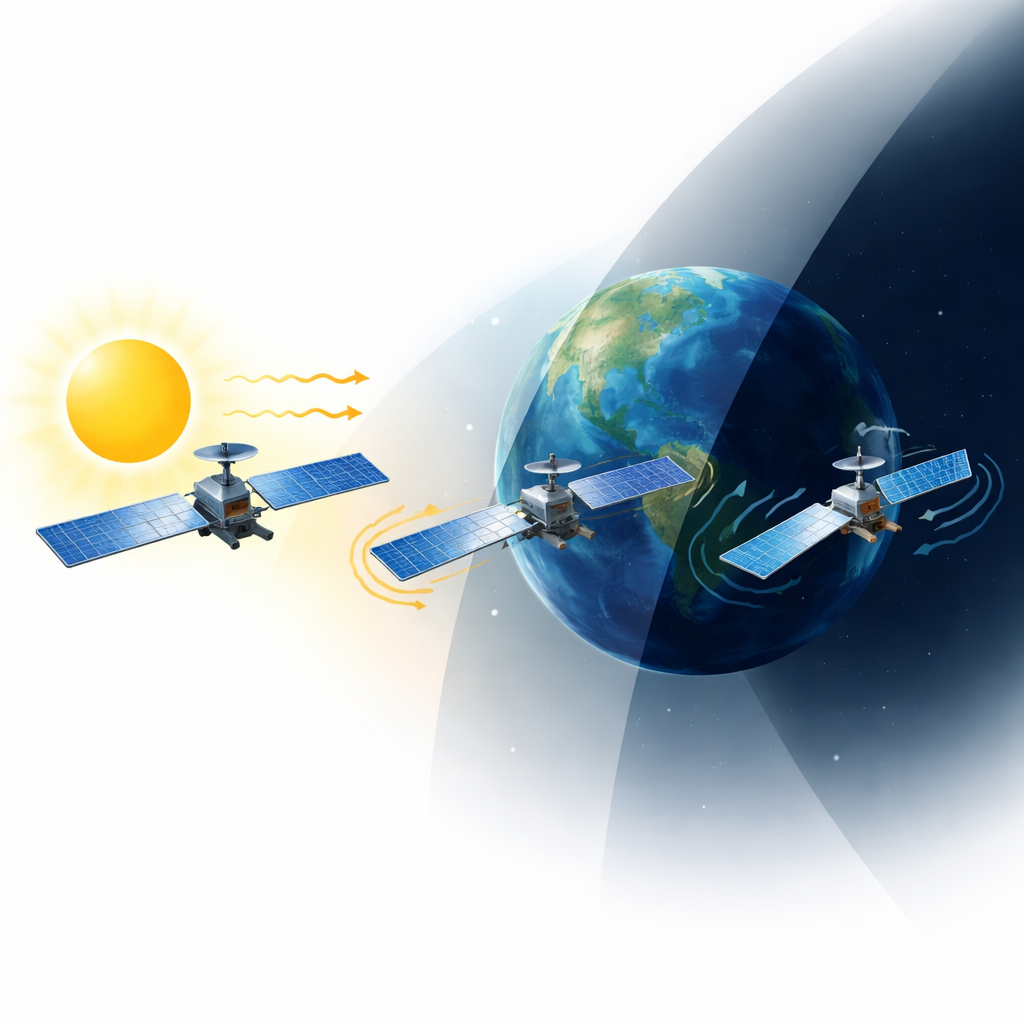
How heat turns into motion
The team builds a nonlinear mechanical model of a satellite with flexible solar arrays attached to a central rigid body. The panels can bend in and out of the orbital plane and twist along their length. Using energy methods, they derive equations that couple these motions to the evolving temperature field. Thermal loads act like time-varying forces and torques: non-uniform heating makes one side of a panel expand more than the other, which bends and twists it. The model also includes “geometric” effects that appear when deformations are no longer small, adding quadratic and cubic terms that can feed energy back into the motion instead of simply damping it out.
Self-sustained oscillations and energy exchange
With these ingredients, the authors explore two key nonlinear behaviors. First, they identify limit cycle oscillations, in which the panels settle into a persistent vibration of fixed amplitude without any ongoing external push. These emerge when structural nonlinearities, such as large bending and twisting, balance the natural damping. Second, they study internal resonance, where different vibration modes exchange energy because their natural frequencies line up in certain ratios. Using a mathematical technique called the Method of Multiple Scales, they show that specific three-to-one relationships between bending and twisting frequencies can arise from thermal effects, even if the structure is not tuned that way in the cold. This means temperature changes alone can create strong mode coupling.
Tracking complex motion with geometric maps
To visualize how the motion evolves as the thermal conditions change, the researchers turn to tools from nonlinear dynamics: phase portraits, Poincaré maps, and bifurcation diagrams. These graphical methods reveal whether the system settles to rest, vibrates periodically, or transitions to more complicated behavior. The simulations show that when the thermal wave speed is below a “flutter” threshold, vibrations tend to die out. Above this threshold, oscillations grow. Near the critical range around 0.95, the system can support several possible long-term states at once, depending on initial disturbances. In some cases, bending and twisting remain synchronized with a single period; in others, the bending motion cycles three times for each twist cycle, or even evolves toward quasi-periodic patterns. 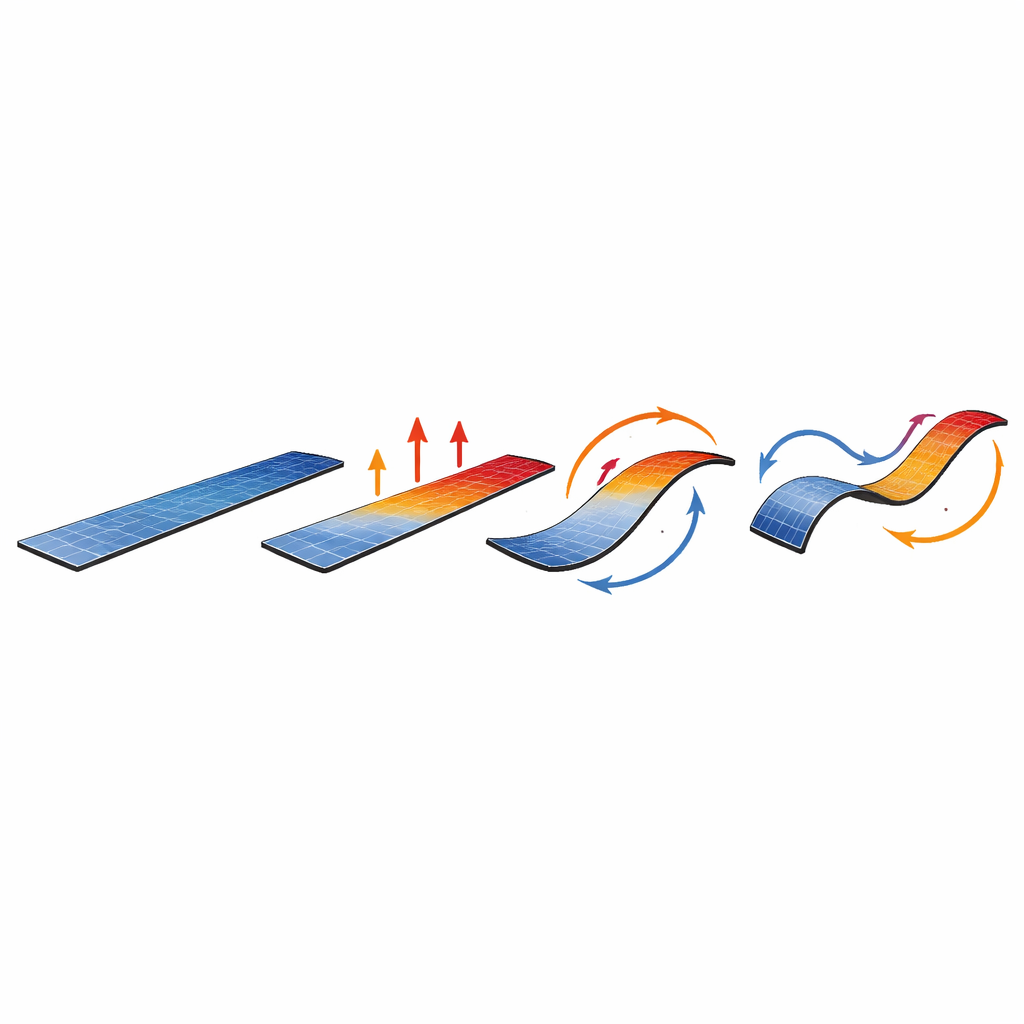
Implications for space telescopes and future designs
The study concludes that structural nonlinearities in flexible solar panels are the main drivers of long-lasting, self-sustained vibrations, while thermal nonlinearities reshape the boundaries between stable and unstable behavior and can amplify these motions during eclipse transitions. Crucially, the analysis shows that such limit cycle oscillations can appear even before reaching the classical flutter speed predicted by simpler models. For builders of precision spacecraft like the Hubble Space Telescope, this means that thermal environments during penumbra crossings must be treated as an active source of dynamic excitation. Designing stiffer panels, adjusting their geometry, or adding smart damping and control strategies could help keep thermally induced shaking within safe limits and preserve pointing accuracy for future missions.
Citation: Motaharifard, O., Daneshjou, K. & Bakhtiari, M. Nonlinear stability and vibration of flexible spacecraft solar arrays under thermally induced flutter during the penumbra phase. Sci Rep 16, 9856 (2026). https://doi.org/10.1038/s41598-026-38274-4
Keywords: spacecraft vibration, flexible solar arrays, thermal flutter, limit cycle oscillations, nonlinear dynamics