Clear Sky Science · en
Interpretable machine learning for optimized dimethyl ether production from bio-methanol
Turning Plant Waste into Clean Fuel
Imagine turning plant-based alcohol into a clean-burning fuel using a chemical reactor that can "learn" how to run itself better over time. This paper explores how combining traditional chemical engineering with modern machine learning can make the production of dimethyl ether—a promising, low-soot fuel made from bio-methanol—more efficient, easier to control, and simpler to understand.
Why This Fuel and This Reactor Matter
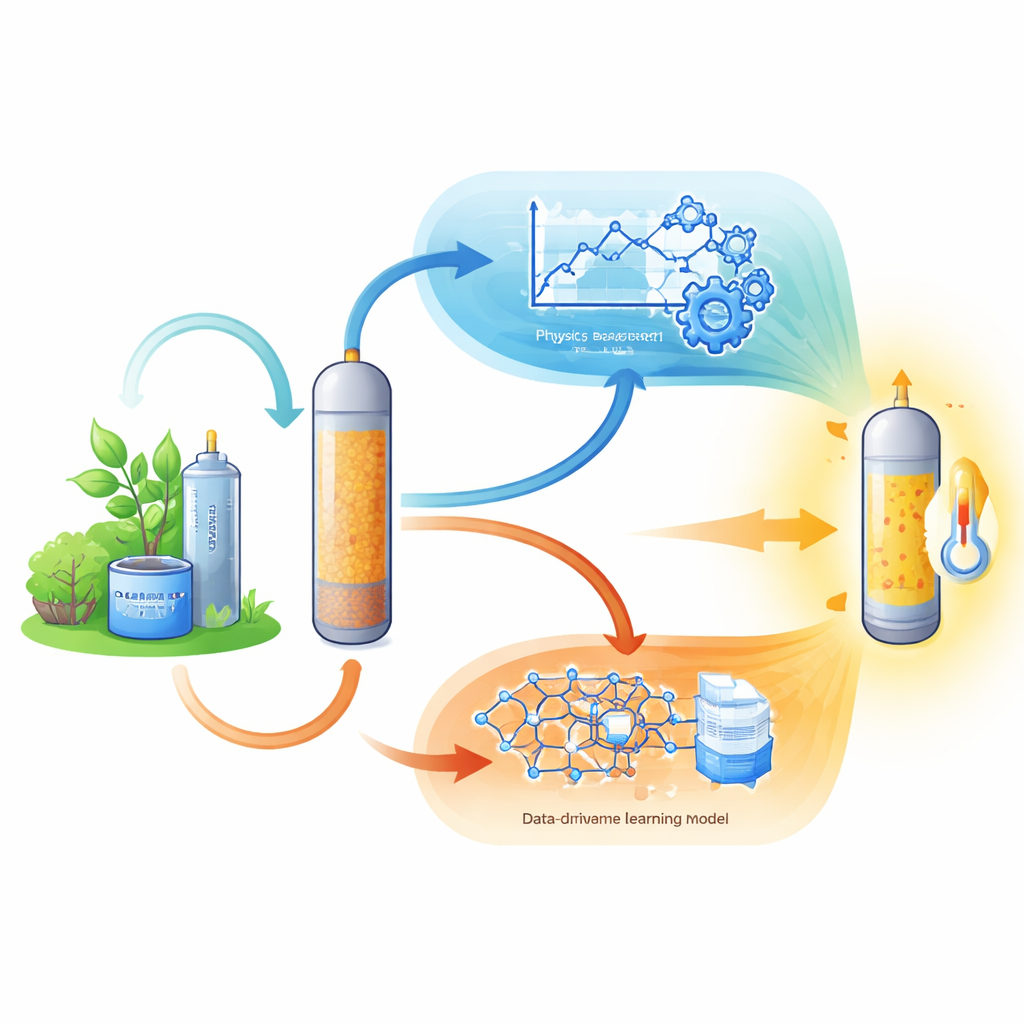
Dimethyl ether (DME) is attracting attention as an alternative to diesel because it burns cleanly and can be made from renewable sources like bio-methanol. At the heart of a DME plant is a packed tube called a fixed-bed reactor, filled with a solid catalyst that helps methanol molecules join and release water and heat. This reaction is highly exothermic, meaning temperature can climb quickly and affect both safety and fuel quality. Designing and operating such reactors has traditionally relied on complex "first-principles" models—systems of equations based on physics and chemistry—that are accurate but slow and difficult to adjust when real-world behavior deviates from theory.
Blending Physics with Data
The authors propose a hybrid approach that blends physically based models with data-driven machine learning. They first build and rigorously validate a detailed reactor model that tracks how temperature, pressure, and the amounts of methanol, DME, and water change along the reactor length. Using this digital twin, they generate 7,000 realistic operating scenarios, deliberately adding noise to imitate experimental uncertainty. On this synthetic but physics-respecting data set, they train several machine learning methods—including K-Nearest Neighbors and two popular tree-based ensemble models—to predict reactor behavior directly from operating conditions like feed rate, inlet temperature, and pressure.
Teaching the Model to Correct and Explain Itself
Rather than replacing physics altogether, the study uses machine learning in two complementary hybrid roles. In a "correction" mode, a specialized neural network that handles sequences learns to polish the predictions of the first-principles model along the reactor length, capturing subtle trends that the equations miss. In an "estimation" mode, machine learning stands in for hard-to-measure kinetic laws by predicting the local reaction rate from observable variables; the rate is then fed back into the physics model. In both cases, the core physical framework is preserved, so the results remain interpretable in familiar engineering terms—conversion, temperature rise, and pressure drop—while gains in accuracy are achieved where the empirical formulas are weakest.
Finding the Sweet Spot of Operation
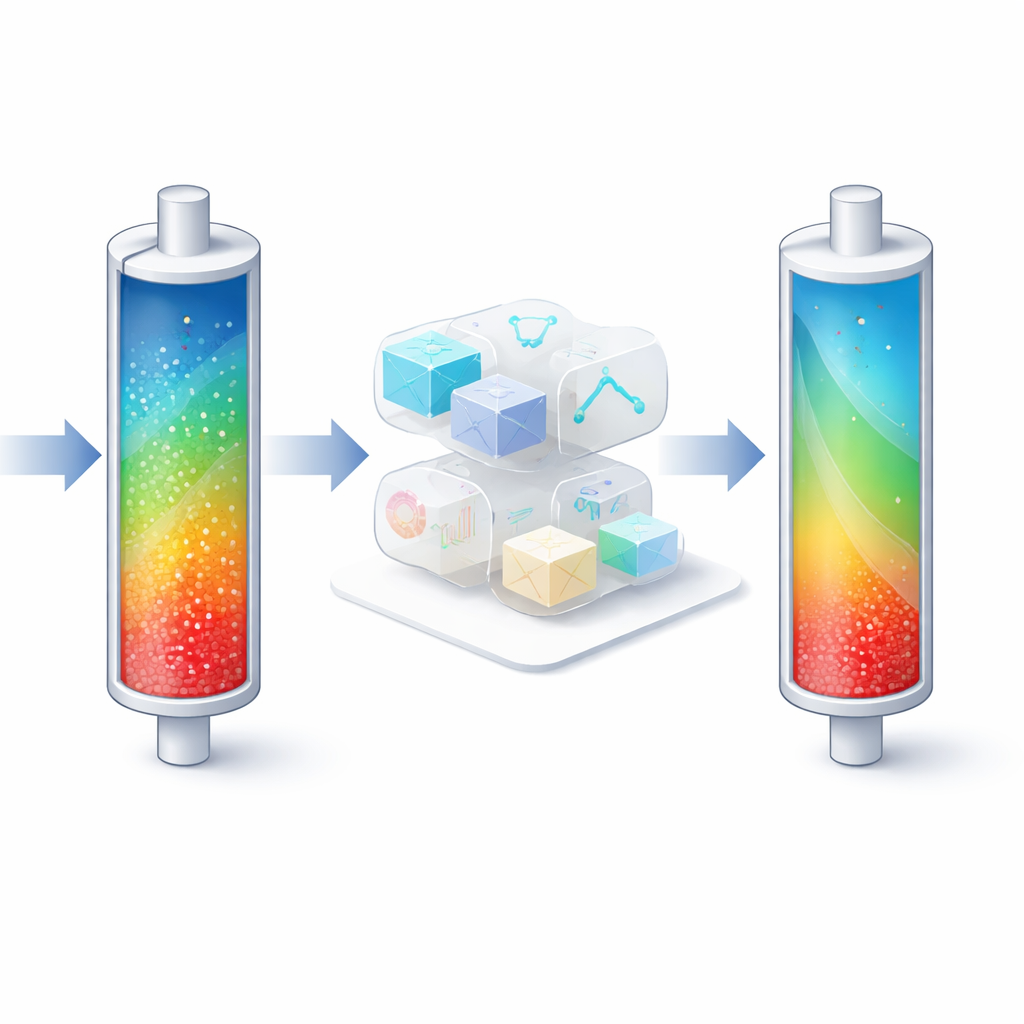
Once a fast and accurate surrogate model is available, it becomes practical to search for the best way to run the reactor. The authors link their most accurate machine learning model to an evolutionary optimization algorithm designed to explore many operating conditions automatically. Their objective is to maximize how much methanol is converted into DME while keeping the temperature increase as low as possible to avoid hot spots and material stress. The optimized conditions identified in this way reach about 84% conversion with a much smaller temperature rise than in the baseline case, and the learned models can evaluate each candidate scenario roughly twenty times faster than the full physics-based simulator.
What This Means for Future Clean Processes
For a non-specialist, the key message is that we no longer have to choose between opaque black-box artificial intelligence and slow, equation-heavy models. By combining them thoughtfully, this work shows that a chemical reactor producing a clean fuel from renewable alcohol can be simulated, understood, and tuned more effectively. The physics-based backbone keeps the model grounded in real-world behavior, while machine learning fills in gaps and speeds up calculations. This hybrid strategy offers a roadmap for designing cleaner, safer, and more efficient chemical processes—not just for DME, but across many technologies needed for a low-carbon future.
Citation: Mokari, M., Rahmani, M. & Atashrouz, S. Interpretable machine learning for optimized dimethyl ether production from bio-methanol. Sci Rep 16, 9889 (2026). https://doi.org/10.1038/s41598-026-38090-w
Keywords: dimethyl ether, hybrid modeling, machine learning, fixed-bed reactor, process optimization