Clear Sky Science · en
Development of detection sensitivity to material properties in school-age children
How Children Learn to See What Things Are Made Of
When you glance at a spoon, a toy, or a glass, you instantly know whether it is shiny metal, dull plastic, or clear glass. This quick judgment helps you guess how heavy it is, whether it might break, or how it will feel to touch. But this skill is not fully formed at birth. This study asks a simple but important question: during the school years, how do children get better at telling what things are made of just by looking?
Looking for the Odd One Out
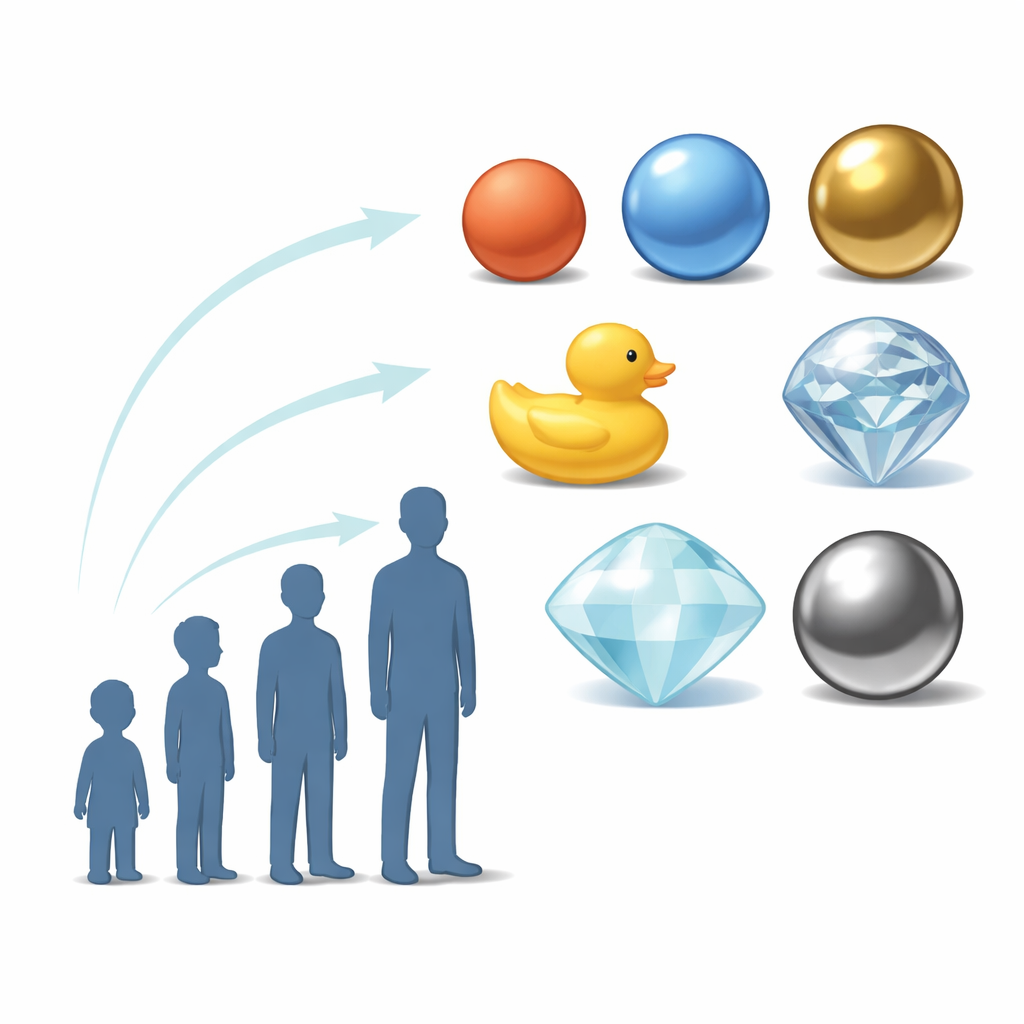
The researchers studied over a hundred children aged 6 to 12, plus a group of young adults. Instead of using real objects, they showed people computer-made pictures of smooth, abstract shapes. These pictures were designed so that only the material look changed while the shape stayed the same. In each trial, four shapes appeared on a touch screen: three were made of one kind of material and one was different. The task was like a visual game of “odd one out” — participants simply had to tap the object that looked unlike the others. By seeing how often they chose correctly under easier or harder conditions, the team could track how sensitive each age group was to subtle differences in surface appearance.
Shiny Versus Dull and Real Shine Versus Fake Paint
One set of tests focused on how shiny an object looked. Sometimes the target was less shiny than the others; sometimes it was more shiny. All age groups could spot differences in shine, but older children and adults were better than younger children when the target was strongly glossy. Interestingly, everyone found it easier to pick out a dull object among shiny ones than the other way around, suggesting that the brain may treat “no shine” as a simple, easy-to-spot signal. Another test asked participants to tell a truly glossy surface from one that only looked shiny because bright spots had been painted on. Here, adults clearly outperformed both younger and older children, showing that separating real reflections from painted patterns is a more demanding skill that keeps developing through the school years.
Gold, Plastic, Silver, and Glass
The team also examined how well children could tell one material “type” from another, even when the differences were subtle. In one task, shapes gradually shifted between looking like gold and looking like yellow plastic. In another, they shifted between mirror-like silver and see-through glass. Because the computer images blended these looks in careful steps, some pairs were obviously different while others were only slightly so. For gold versus plastic, children of all ages did about as well as adults, suggesting that the cues that separate a rich metallic look from a colored plastic one are already well in place by early school age. For silver versus glass, however, younger children were less accurate, especially when the two appearances were very similar. Adults and older children were better at noticing the fine differences between a reflective, mirror-like surface and a clear, see-through one.

Growing Minds and Growing Visual Skills
Putting all the tasks together, the study paints a picture of uneven but understandable growth. Some abilities — such as telling gold from yellow plastic or spotting a dull surface among shiny ones — seem to be mostly in place by late childhood. Other abilities, especially those that require combining several clues at once, like judging whether a shine truly fits the three-dimensional shape of an object, continue to improve through the school years and even into adulthood. The authors suggest that this pattern reflects the complexity of the brain processes involved. Basic material categories and simple shine differences come online early, while more advanced skills that compare highlights, shape, and depth develop slowly and vary a lot from person to person.
Why These Findings Matter
For a layperson, the key message is that seeing “what things are made of” is not a single talent but a collection of visual skills that mature at different speeds. Children can already make many useful material judgments long before their teens, but some fine-grained abilities — like separating real gloss from painted shine or telling a mirror-like surface from glass — keep sharpening with age and experience. Understanding these developmental paths can help teachers, designers of educational media, and even makers of digital content create visuals that match what children are actually able to see and understand at different ages.
Citation: Imura, T., Sawayama, M., Shirai, N. et al. Development of detection sensitivity to material properties in school-age children. Sci Rep 16, 11062 (2026). https://doi.org/10.1038/s41598-026-37801-7
Keywords: material perception, child development, visual perception, glossiness, computer-generated images