Clear Sky Science · en
Predictive temperature control of electric two wheeler hub motor using gradient aware neural regulation with degradation tracking and fault tolerant multi condition torque adaptation
Smarter Electric Scooters for Everyday Streets
Electric scooters are rapidly becoming a common sight in busy cities, but the compact motors hidden inside their wheels can quietly overheat and wear out. This paper explores a new way to make those in‑wheel motors think ahead about heat, protect themselves from damage, and still give riders smooth, strong acceleration. By blending physics, artificial intelligence, and clever safety logic, the authors show how future scooters could be both more fun to ride and more reliable over years of daily use. 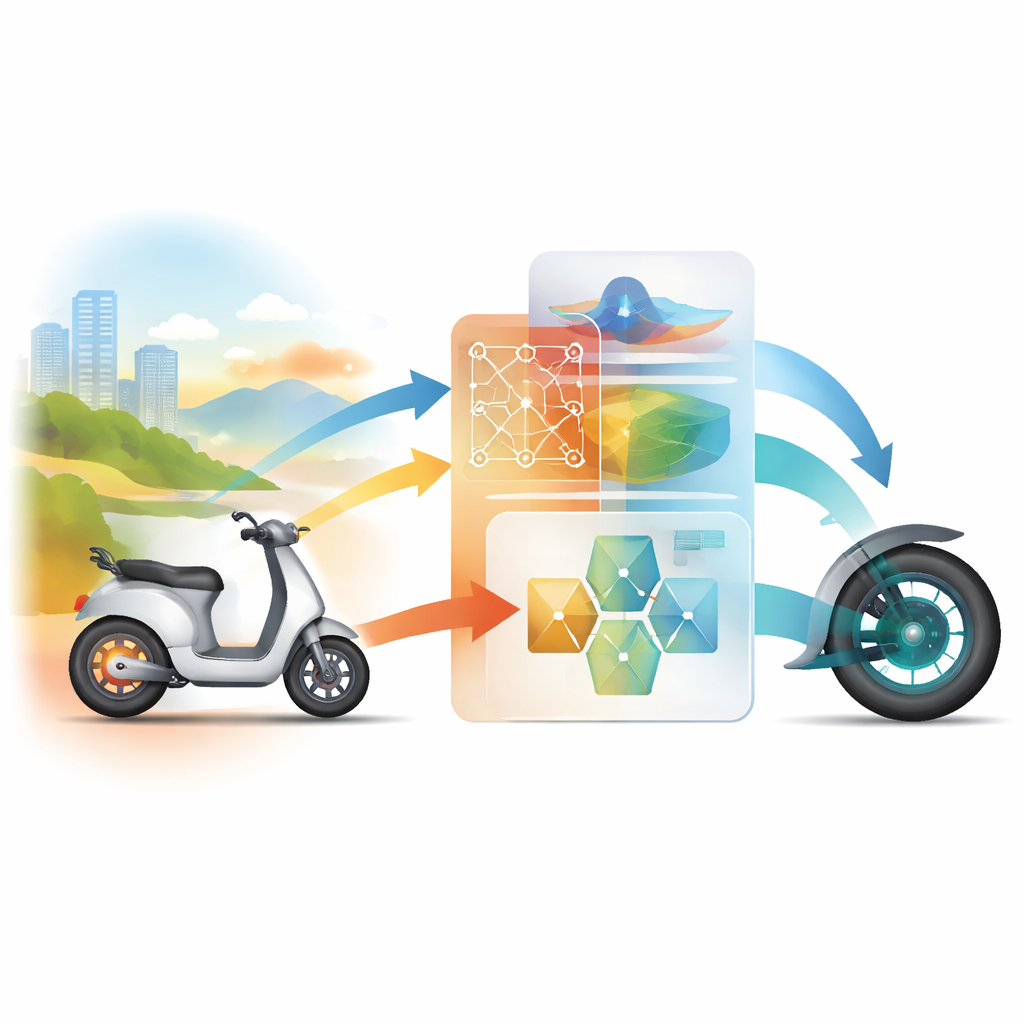
Why Heat Is the Hidden Enemy
In many low‑cost electric two‑wheelers, the motor is built directly into the rear wheel. This saves parts and improves efficiency, but it also traps heat in a tight space with poor airflow, especially in stop‑and‑go traffic, steep climbs, or scorching summers. If temperatures climb too high, copper windings, magnets, and insulation age faster or even fail. Most current scooters guard against this with simple temperature thresholds: once a sensor reports a high reading, the controller abruptly cuts torque. That protects hardware, but it can feel like sudden loss of power, and it often leaves unused “thermal headroom” on cooler days or gentle rides.
A Three‑Layer “Brain” for the Hub Motor
The authors propose a Hybrid Gradient‑Aware Neural Regulation (GANR) system that acts like a three‑layer brain for the hub motor. First, a lightweight neural network estimates and predicts motor temperature using signals the scooter already has—current, voltage, speed, and outside temperature—so it can keep working even if the temperature sensor drifts, gets noisy, or fails outright. Second, the system tracks how much long‑term heat damage the motor has accumulated through a Motor Health Index, a number that gradually falls as the motor lives through thousands of hot cycles. Third, a multi‑condition torque controller uses both the current temperature and this health index, plus ambient weather and ride intensity, to decide how much torque is safe to deliver in the next few seconds. Instead of reacting only after a limit is crossed, it looks at how fast the motor is heating and gently eases torque before trouble arrives.
Watching Health, Heat Margin, and the Road Ahead
Under the hood, the system uses a simplified but well‑tested thermal model to estimate how heat flows from copper windings to the motor shell and then to the air. On top of that, it computes a “thermal margin” and a “time to torque drop”: how far the motor is from a critical temperature and how many seconds remain before derating would be needed if nothing changed. At the same time, the Motor Health Index accumulates damage based on known temperature‑lifetime laws—running a bit hot occasionally is fine, but long spells near the limit clearly reduce remaining life. The controller blends these indicators with battery energy and selected ride mode (eco, normal, or sport) to choose between performance‑oriented, balanced, or protective behavior. In hot climates, it automatically tightens safe limits; in cool weather it safely allows more torque before backing off. 
Handling Faults and Fitting on Cheap Hardware
Because low‑cost scooters use modest microcontrollers, the authors carefully design the neural networks and control logic to run within strict CPU‑cycle and memory budgets. They prune and quantize the networks so that all intelligence fits in tens of kilobytes and executes in well under a millisecond per control cycle. A dedicated fallback state machine monitors sensors and the neural estimator: if a temperature sensor sticks, drifts, or goes out of range, the system automatically switches to an estimator‑driven safe mode with conservative torque caps. If processor load spikes or unexpected glitches occur, it can fall back further to simple lookup‑table control. Throughout, watchdogs and safety checks ensure that any failure leads to graceful torque reduction rather than sudden shutdown or runaway heating.
What the Simulations Reveal for Riders
Using detailed simulations of city and aggressive hill‑climb rides, the authors compare their GANR controller to a standard proportional‑integral scheme. The new approach keeps peak motor temperatures several degrees lower, spends far less time above risky thresholds, and almost eliminates “thermal runaway” scenarios. It also delays the need for torque derating by up to about 14%, improves energy efficiency by roughly 7%, and maintains temperature prediction errors around just 2 °C even when sensors misbehave. Over repeated hard rides—especially in hot weather—the Motor Health Index for the GANR system stays much higher than for a conventional controller, suggesting a longer motor life with fewer surprises for owners.
Safer, Longer‑Lasting Electric Mobility
In simple terms, this work shows how giving an electric scooter a modest dose of predictive intelligence can make it both tougher and nicer to ride. Instead of waiting to get too hot and then suddenly pulling power, the hub motor learns to sense how conditions are changing, how tired it already is, and how much safety margin remains. It then shapes torque smoothly so riders feel consistent performance while the hardware quietly protects itself. Because the whole design is tailored to run on inexpensive embedded chips, it offers a practical path toward smarter, safer, and more durable electric two‑wheelers in crowded, heat‑stressed cities.
Citation: Deshmukh, S., Lokhande, N. & Yeolekar, S. Predictive temperature control of electric two wheeler hub motor using gradient aware neural regulation with degradation tracking and fault tolerant multi condition torque adaptation. Sci Rep 16, 13436 (2026). https://doi.org/10.1038/s41598-026-37505-y
Keywords: electric scooters, motor thermal management, neural network control, predictive torque derating, fault tolerant EV systems