Clear Sky Science · en
Formation tracking control of multiple USVs using ADRC with prescribed performance
Smart Boat Teams on a Tough Sea
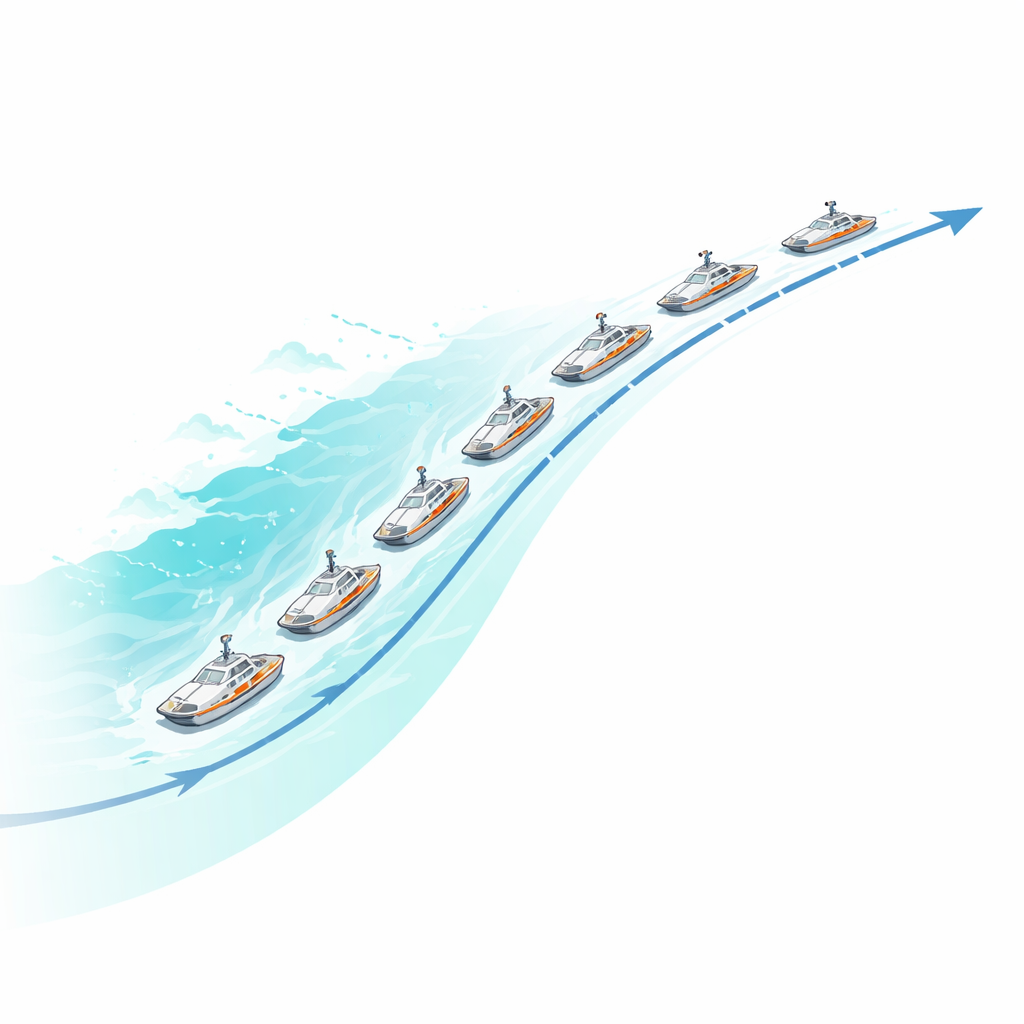
Imagine a crew of small robotic boats patrolling a harbor, searching for a lost vessel, or mapping an oil spill. They must move together in a tight pattern, hold safe distances from one another, and stay on course despite waves, wind, and currents constantly pushing them off track. This paper introduces a new way to control such teams of unmanned surface vehicles (USVs) so they can travel in formation accurately and safely, even when the water is rough and their own behavior is imperfectly known.
Why Coordinated Robot Boats Matter
USVs are increasingly used for jobs that are dangerous, tedious, or expensive for crewed ships: maritime rescue, mineral exploration, and coastal security among them. Often, one boat is not enough; a group working together can cover more area, share tasks, and add redundancy if one unit fails. But coordinating several boats is tricky. Each vessel must follow a planned path while keeping a safe distance from its neighbors, and all of this must hold under real ocean conditions where unseen forces and subtle modeling errors can degrade performance or even cause collisions.
The Challenge of Staying Together
Traditional control methods—such as simple proportional–integral–derivative (PID) controllers, model-based predictive schemes, or neural-network-based backstepping—have been applied to USV formation in the past. While they can work, they come with trade-offs. Basic controllers are easy to tune but struggle with large, time-varying disturbances. More advanced approaches can handle nonlinear motion and unknown effects but often require many parameters, heavy computation, or detailed training data. In addition, most methods do not directly guarantee how quickly errors will shrink or how tightly they will stay within safety limits during maneuvers.
A Control Strategy That Fights Back Against Disturbances
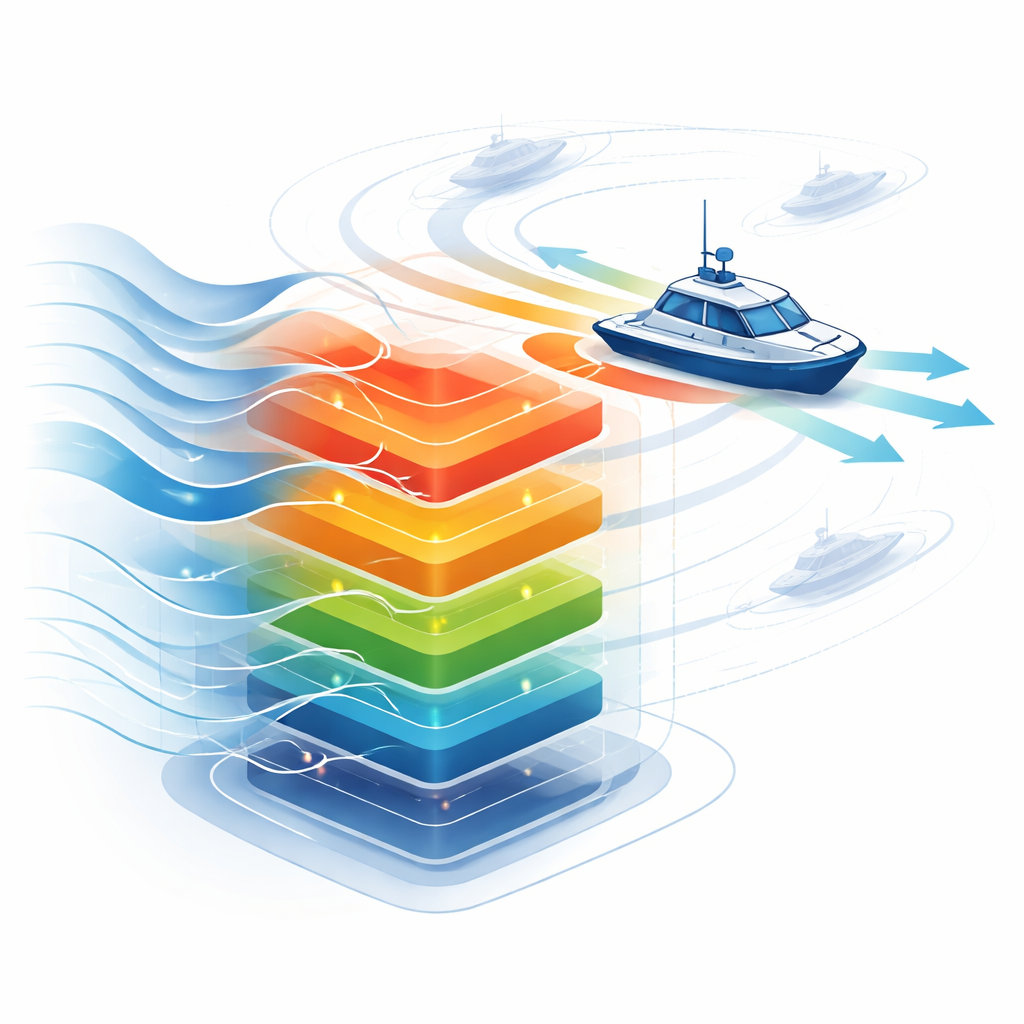
The authors build on a concept known as active disturbance rejection control, which treats everything unknown or unwanted—such as drag changes, wave forces, or modeling mistakes—as a single “total disturbance” to be measured and countered in real time. They design an expanded observer that estimates this disturbance while using knowledge of the USV model to lighten the observer’s workload and improve accuracy. Another component called a tracking differentiator replaces messy repeated calculus in the controller, avoiding the explosion of complexity that can otherwise make real-time use impractical. A barrier-based mechanism then shapes how tracking errors evolve over time, enforcing time-varying limits that keep boats from approaching too closely or drifting too far apart while still allowing rapid convergence to the desired path.
Putting the Boat Platoon to the Test
To see how well the approach works, the researchers simulate four identical USVs following a path composed of straight segments and wide circles, under strong, constantly changing forces that are hidden from the controller. They compare their method with three common alternatives: a neural-network-enhanced backstepping controller, a standard disturbance-rejection controller, and a PID controller. Across metrics that measure total error, worst-case error, and how smooth the steering and thrust commands are, the new method stands out. It reduces cumulative error and root mean square error by more than half compared with PID, and still significantly outperforms the more sophisticated backstepping scheme, all while producing smoother, less jittery control signals that are friendlier to real hardware.
What This Means for Future Marine Robots
In plain terms, this work shows how a team of robotic boats can keep their formation tight and safe in a messy, unpredictable sea using a controller that is both robust and relatively simple to tune. By actively estimating and canceling the combined effect of waves, currents, and modeling mistakes, and by wrapping error evolution inside carefully designed bounds, the method keeps each vessel close to its intended trajectory without risking collisions or losing communication links. The authors note that extending the framework to more limited, underactuated boats and automating parameter tuning are important next steps, but the results already point toward more reliable, efficient fleets of marine robots handling complex missions with minimal human oversight.
Citation: Huo, M., Mao, W. & Wang, X. Formation tracking control of multiple USVs using ADRC with prescribed performance. Sci Rep 16, 11417 (2026). https://doi.org/10.1038/s41598-026-37252-0
Keywords: unmanned surface vehicles, formation control, disturbance rejection, marine robotics, trajectory tracking