Clear Sky Science · en
Low-voltage U-shaped RF MEMS shunt switch integration for K-band phased array beam steering
Smarter wireless beams for everyday connections
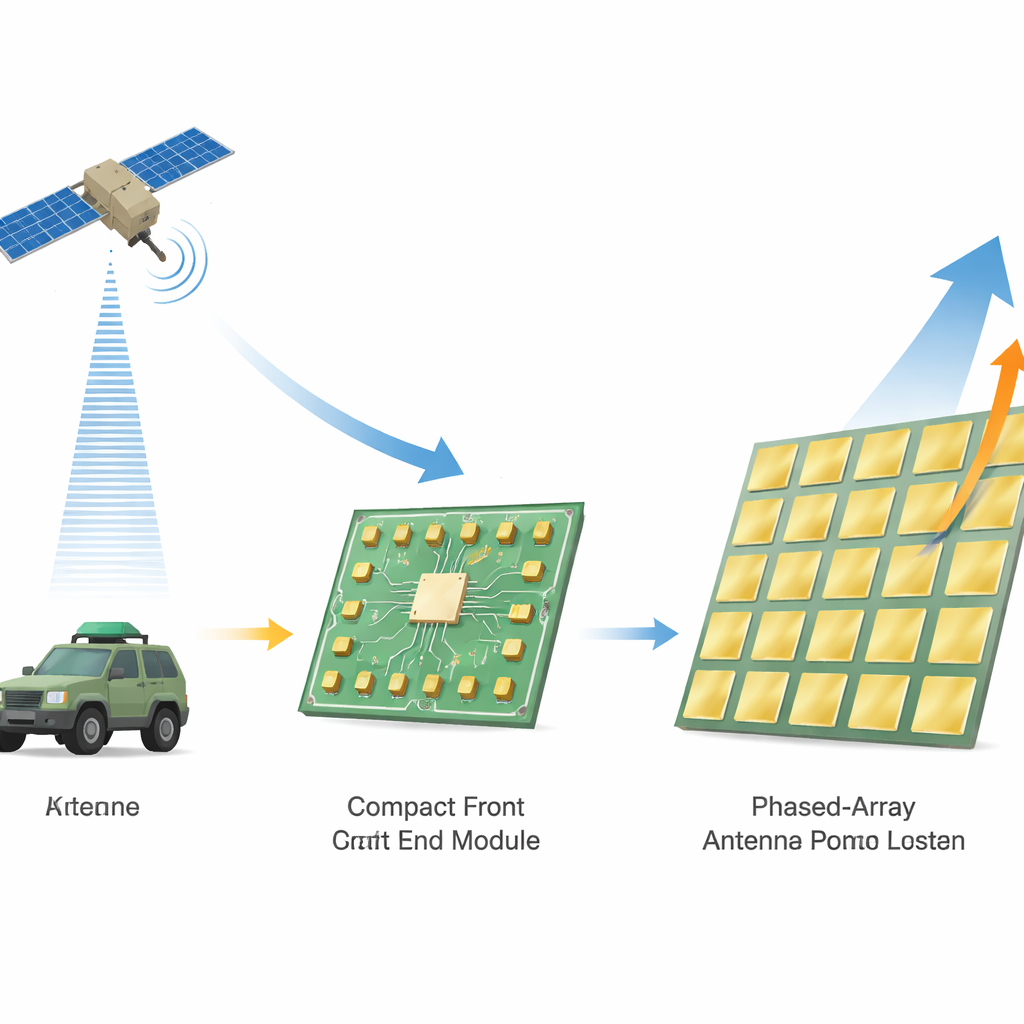
From satellite internet on airplanes to car radars that watch the road ahead, many modern systems rely on antennas that can rapidly point their beams without any moving parts. This paper describes a tiny mechanical switch, built on a chip, that helps such antennas steer their beams more efficiently while using very little power. The advance could make future 5G/6G networks, satellite links, and radar sensors smaller, cheaper, and easier to run on limited power supplies.
Why steering radio beams matters
Traditional antennas radiate energy in fixed directions, like a light bulb. Phased array antennas, by contrast, act more like a searchlight: they use many small antenna elements and carefully timed signals to push the beam where it is needed. This electronic steering is crucial for fast-moving satellites, high-speed vehicles, and dense urban wireless networks. However, the circuits that adjust the signal timing often waste power and distort signals, especially at very high frequencies used in K-band (around 18–27 GHz), which are important for next-generation communications.
Tiny moving parts that guide radio waves
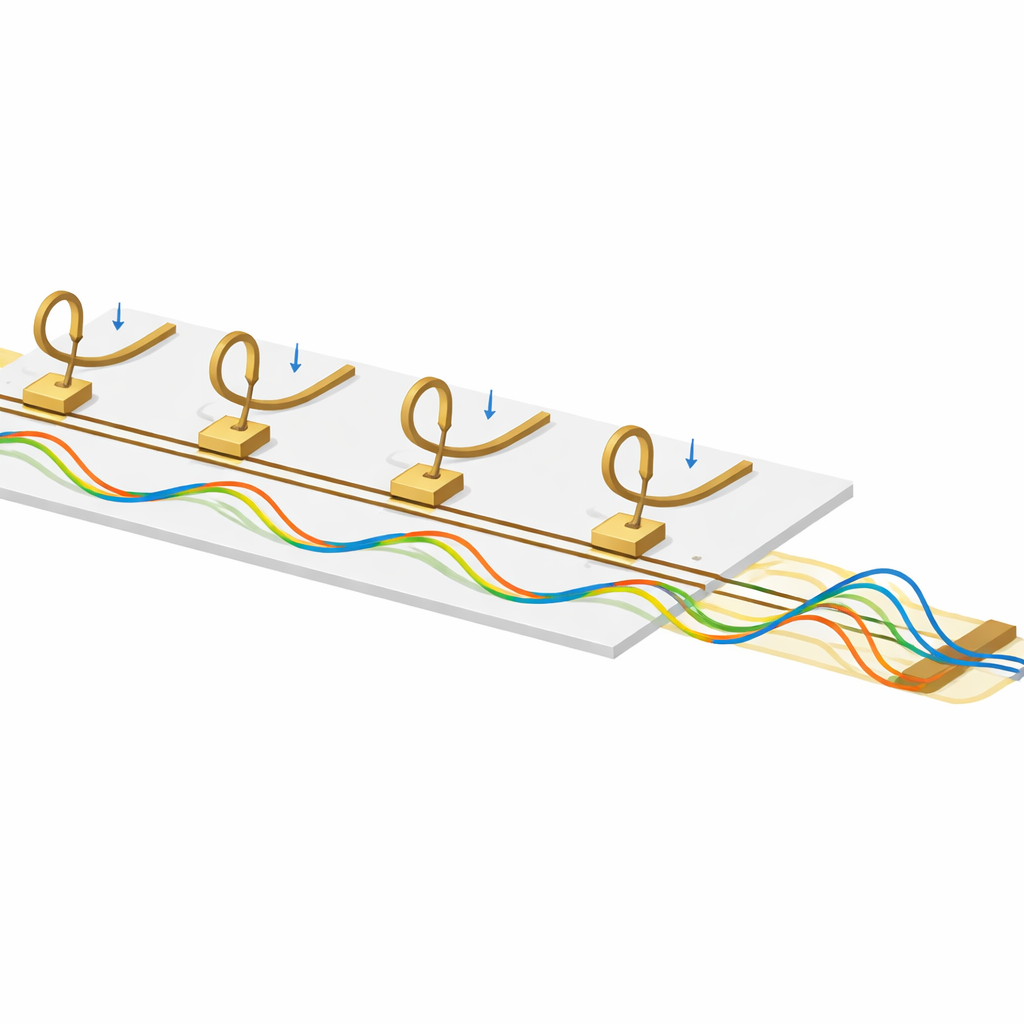
The authors focus on a special kind of component called an RF MEMS switch—essentially a microscopic metal beam that can be pulled down by a small voltage to change how a radio signal flows. In this work, they design a new “U-shaped meander” beam that is anchored at both ends and curves back and forth like a folded spring. This shape makes the beam more flexible, so it moves with a much lower control voltage than earlier designs, but still forms a strong electrical connection when it touches down. When the beam is up, radio waves pass almost undisturbed; when it is pulled down, it behaves like a powerful gate that redirects the signal.
Building a controllable delay line
To turn these switches into a useful steering tool, the team arranges many of them along a special high‑impedance transmission line, creating what is known as a distributed MEMS transmission line phase shifter. Each switch, when activated, adds a small extra capacitance to the line, slowing the wave slightly. By selecting how many switches are on in a given section, the overall delay of the signal can be adjusted in discrete steps. Linking these phase shifters to individual antenna elements in a four‑element K‑band patch array allows the researchers to impose a controlled progression of delay from one element to the next—exactly what is needed to tilt the combined beam.
Engineering for strength, stability, and low loss
Because these beams physically move, the authors carry out detailed mechanical and thermal simulations to ensure the device can survive real-world use. They show that the stresses in the metal remain far below its failure limit, with a healthy safety margin even when manufacturing variations are included. The structure’s natural vibration frequencies are high enough that everyday vibrations are unlikely to cause trouble. Heating to elevated temperatures produces only tiny changes in performance, and the electrostatic actuation method draws almost no steady power: the energy needed for each switching event is only a few picojoules, resulting in negligible average power use at typical steering speeds.
Sharper beams with gentler control
When the phase shifter is combined with the antenna array, simulations show that the beam can be steered smoothly over ±30 degrees while preserving high efficiency and keeping unwanted side lobes low. Across the K‑band, the new switch maintains very small signal loss and strong isolation between on and off states, meaning that nearly all of the radio power is preserved and cleanly directed. Compared with similar devices reported in the literature, this design achieves substantially lower control voltage, lower loss, and better reliability, all within a compact layout compatible with front‑end modules.
What this means for future wireless gear
In plain terms, the study demonstrates a microscopic radio switch that can reshape high‑frequency beams using about the same voltage as a smartphone, while barely wasting any power or degrading the signal. Because it is both efficient and robust in simulations, the approach is well suited for dense arrays with many elements, such as those envisioned for 6G base stations, advanced car radar, or reconfigurable satellite links. The work is currently based on simulations, so the next steps are to fabricate the device and test it in the lab, but it already outlines a promising route to more agile and energy‑saving wireless hardware.
Citation: Anusha, Y., Guha, K., Mummaneni, K. et al. Low-voltage U-shaped RF MEMS shunt switch integration for K-band phased array beam steering. Sci Rep 16, 11585 (2026). https://doi.org/10.1038/s41598-026-36980-7
Keywords: phased array antennas, RF MEMS switches, beam steering, millimeter-wave communication, 6G and satellite systems